


In the rich tapestry of African contemporary art, Souleymane Keita (1947-2014) stands out as a master who seamlessly blends abstract expressionism with profound cultural symbolism. His work, deeply influenced by his heritage and personal experiences, offers a unique perspective on the intersection of tradition and modernity. Ten years after his passing, the retrospective exhibition “Et je renais à la terre qui fut ma mère,” held by Galerie Cécile Fakhoury in collaboration with The Jom Collection (May 16th-June 8th), unveils the intricate layers and evolution of Keita’s artistry.
Among the many pieces presented by the collector Bassam Chaïtou during this private guided exhibition, I was particularly impressed by a sublime work from a 1997’s work form Keita’s “Chemise du Chasseur” series.
At the core lies a textured, fabric-like element, its dark and earthy tones providing a robust visual foundation. Surrounding this central motif are densely packed areas adorned with tiny, granular materials, casting a variety of light hues that starkly contrast against the darker centerpiece. These granules may symbolize natural elements or ceremonial substances, infusing the artwork with a tactile allure. Seamlessly integrated into the composition are two keys, endowing the “Chemise du Chasseur” (Hunter’s Shirt) with profound symbolism, particularly within the context of Keita’s lineage.
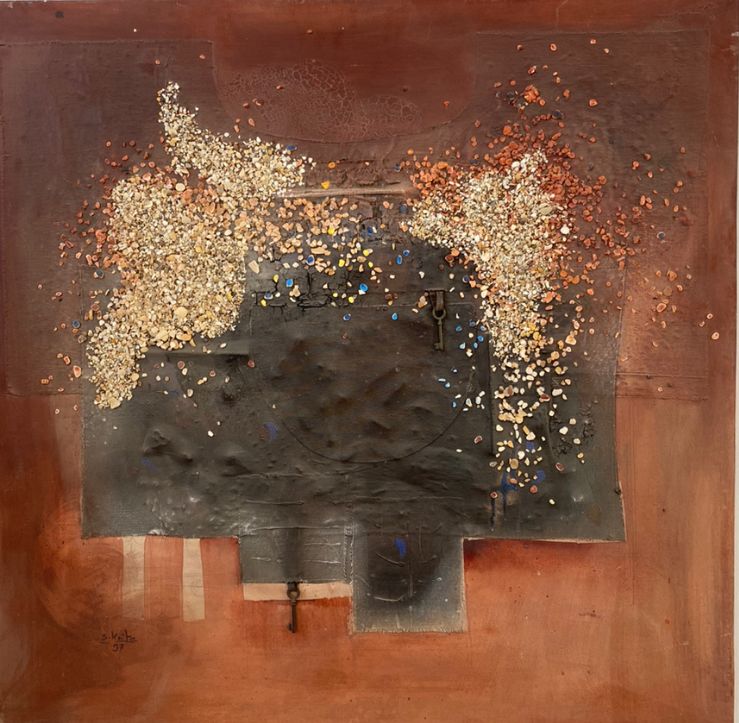
Souleymane Keita, a distant descendant of Sundiata Keita, the founder of the Mali Empire, shares a heritage with the Dozo hunters of the Mandinka tribe to which he belongs. The key symbolizes the spiritual and mystical wisdom held by these hunters, who possess not only exceptional tracking and hunting skills but also deep spiritual and medicinal knowledge passed down through generations. It represents the unlocking of hidden wisdom and profound spiritual insights unique to the Dozo tradition.
While Mali’s landlocked geography does not include the sea within the immediate surroundings of the Bambara hunters, Keita’s artistic expression is shaped by his personal experiences. Born and having resided on Gorée Island, where the sea and shells are prevalent, Keita incorporates these elements into his work. This fusion of environments underscores the intersection of his heritage and lived experiences, bridging ancestral roots with contemporary realities and creating a dialogue between land and sea, tradition and modernity.
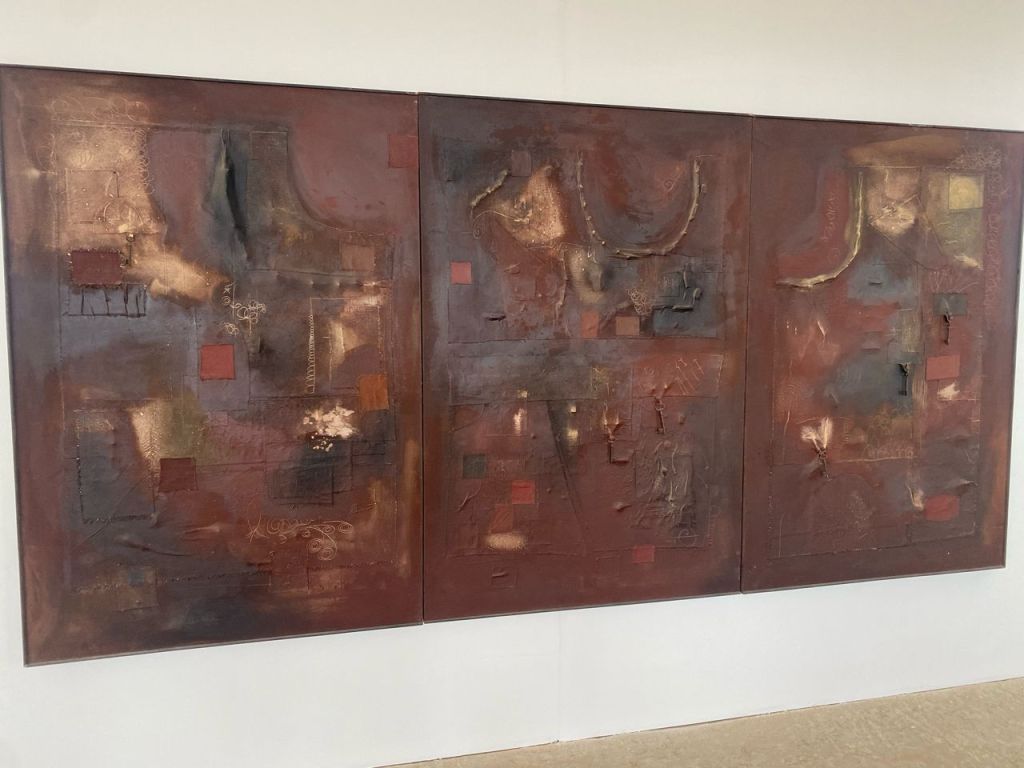
In the “Hunter’s Shirt” series, a triptych from 1998 also revisits the incorporated key symbols, with an ochre background symbolizing the earth. The ochre color is significant as most Dozos adorn themselves with bogolan fabric in this shade of orange-ochre. The presence of symbolic objects such as amulets speaks to their mystical knowledge and understanding.
These series emerged a decade after Keita’s return to Senegal, following a five-year stay in the United States.
Artistic evolution
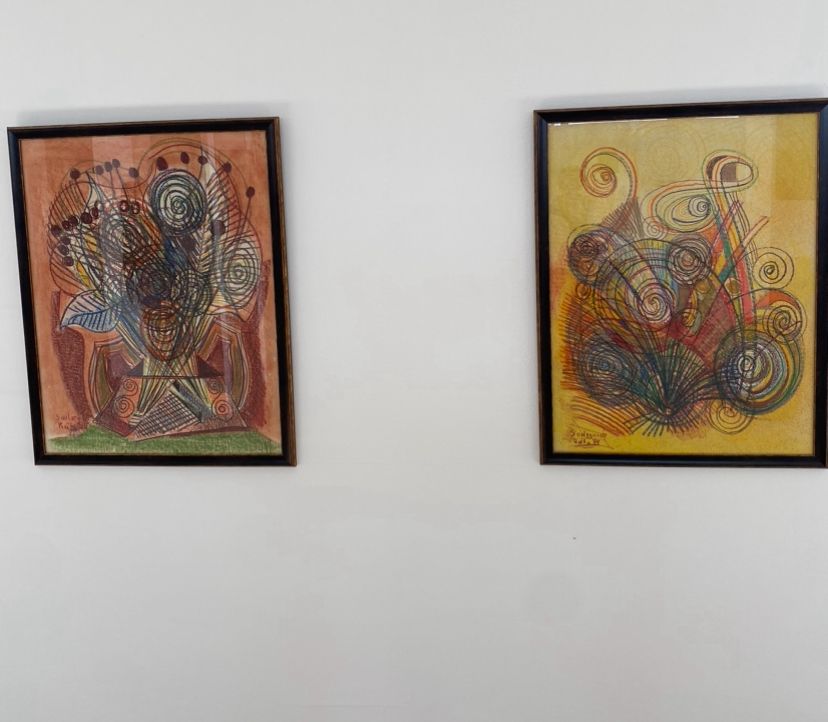
Keita’s artistic journey began at a remarkably young age when he entered the École des Beaux-Arts in Dakar at only thirteen and a half years old. His artistic evolution traces back to his initial engagement with the figurative styles of the “École de Dakar” during the 1960s, characterized by stylized forms and vibrant colors. Early works, as showcased by two pieces exhibited by the Jom collection, displayed these figurative elements.
However, his artistic trajectory was significantly influenced by his travels, notably a pivotal trip to Bamako in 1974 and an extended stay in the United States (1980-1985).

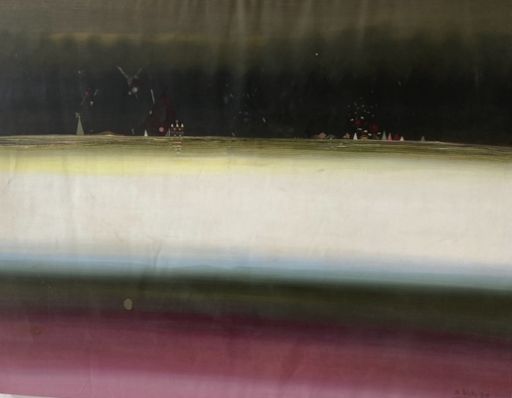
This transformative journey is exemplified by his “Voyage au Mali” series. Another notable piece, “Pleine Lune à Gorée,” crafted in 1986 captures the Gorée landscape by the sea in vibrant hues. Inspired by American painters he encountered during his time in the US, such as Bill Hutson, Melvin Edwards, and Ed Clark, all ardent advocates of abstraction, Keita adopted in his painting of “Pleine Lune à Gorée,” a style reminiscent of abstract expressionism.

“Chemise du Chasseur” and the “Synthèses” series, among the final series in Keita’s career, showcase the fusion of abstraction with African symbolism, highlighting Keita’s personal and professional evolution. His shift towards abstraction, incorporating african traditional objects, could be interpreted as a quest for spiritual fulfillment, echoing the concept of “inner necessity” espoused by Wassily Kandinsky, whose elegant style echoes through Keita’s oeuvre, connecting his work to broader artistic and philosophical traditions.
Find below a photo gallery showcasing other artworks featured in the exhibition




 Bridging Africa and The World Through Contemporary Art
Leave a comment