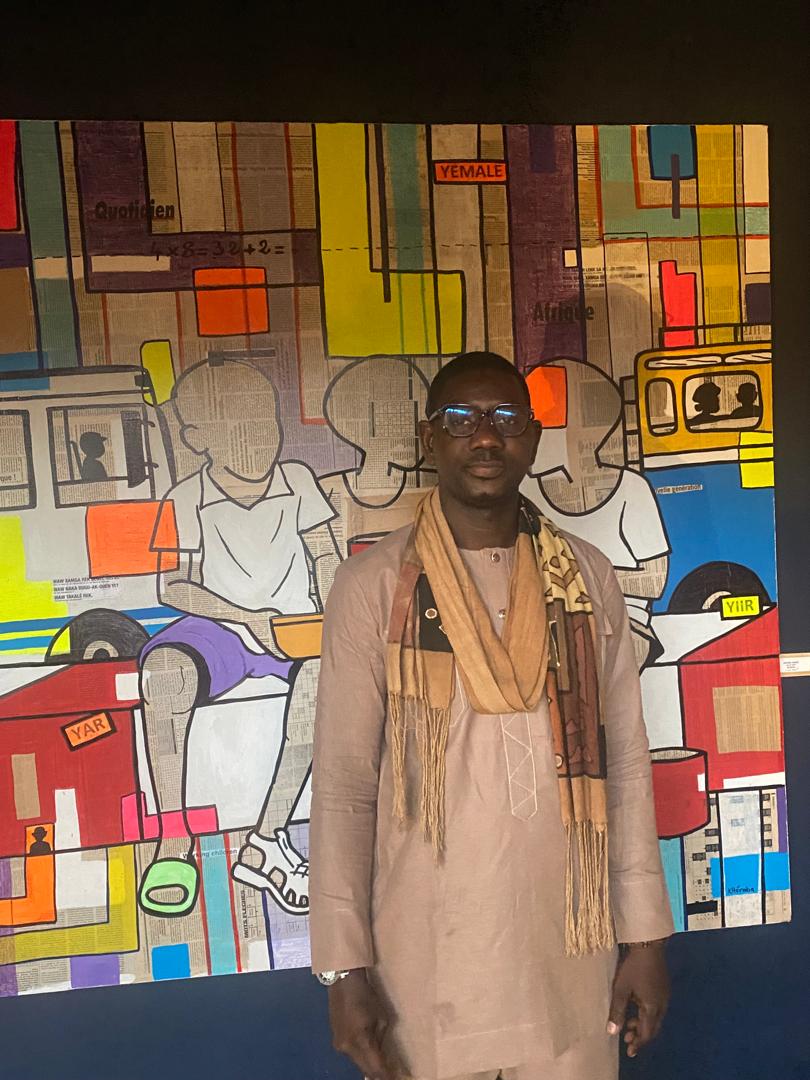

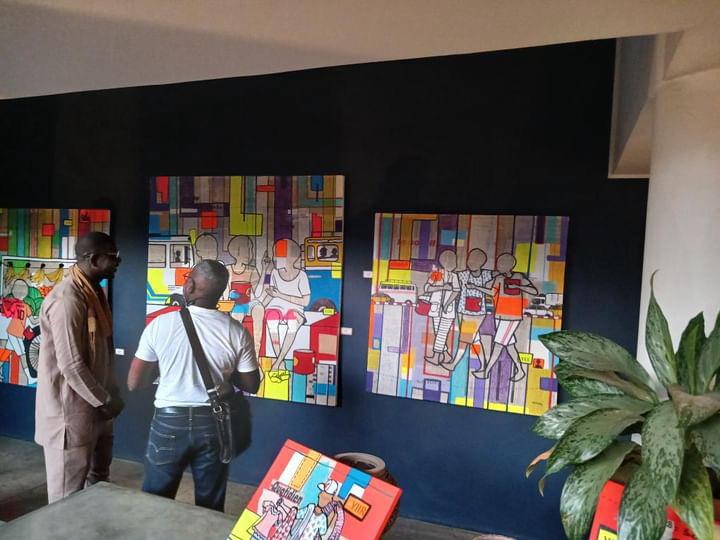
After visiting Kheraba Traoré’s recent exhibition at the Boma Hotel in Dakar, I felt deeply moved and inspired by the profound engagement with the theme of childhood that his work displays. His art, both luminous and committed, draws inspiration from his personal experience as a talibé child. Talibés, the Quranic students sent to the streets by their teachers to beg, are part of the scenery of the Senegalese capital. They are seen almost everywhere. Talibés are subject to multiple abuses, vulnerable, and often at the mercy of adults. This phenomenon is perpetuated by the beliefs of the Senegalese population, who hope to receive blessings by giving donations. The talibés must hand over the collected money to their Quranic teachers. Sometimes, they are beaten by these teachers if they return empty-handed. Senegal, being a predominantly Muslim country, makes this a complex and delicate issue.
This poignant social reality is at the heart of Traoré’s work, which seeks to draw attention to their plight and advocate for change.
Although he never had to beg himself, he shared the daily life of his friends who did, accompanying them in their daily activities. This contrast between his own journey and that of his peers has fueled an artistic reflection that has flourished in his creations.
A Spontaneous and Colorful Process
Traoré adopts a spontaneous approach in creating his works. He chooses to bathe his paintings in bright and luminous colors. Fluorescent hues dominate, symbolizing the cheerfulness and joy inherent in childhood. This chromatic choice is not accidental: he seeks to overturn expectations and introduce an optimistic and vibrant vision of youth, despite the often harsh realities of their daily lives. He emphasizes, “I noticed that most artists work on dark pieces. So I wanted to bring a lot of light into my creation.”
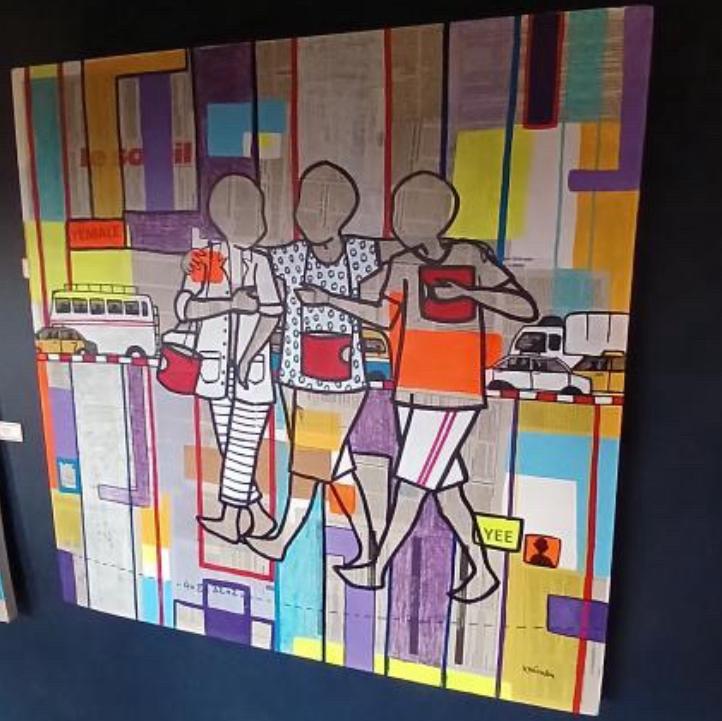
The works of Traoré are built around stylized, extremely simplified figures of children. The silhouettes are outlined by thick black lines, creating a stained-glass effect that is recurrent in Traoré’s work. The bodies of the characters are made up of blocks and various geometric shapes, primarily rectangles and squares.

The background of his artworks are a complex assemblage of rectangles and squares of different sizes and colors, creating a mosaic effect. These geometric forms are arranged to create an impression of depth and movement, as if the characters are evolving in a fragmented urban environment.
The choice of rigid geometric shapes could symbolize the constraints and structures imposed by the senegalese society. The children, depicted in a lively and colorful manner, seem to be caught in this structured environment but still manage to interact and connect with each other, suggesting resilience and the ability to find joy even in difficult situations.
Over-Information and the Symbolism of Newspapers
One of the most striking aspects of his work is the use of newspapers, which he calls “over-information.” The newspapers, with their writings reversed to make them unreadable, serve as a graphic backdrop for his works. Although these elements have aesthetic value, their symbolism is deeper. They illustrate the incessant flow of information and awareness on social issues, which paradoxically, fail to bring about change.
“I use newspaper papers because I denounce a phenomenon that is struggling to be eradicated.”, he told DakartNews. By focusing on the graphic aspect rather than the textual content of the newspapers, Traoré highlights the inefficacy of the information overload in provoking concrete actions.
Commitment to Child Protection
Traoré does not just paint; his commitment is also academic. During his studies at the School of Fine Arts, he defended a thesis on the protection of children and their rights. This commitment is directly reflected in his works, where he advocates for better living and educational conditions for children. He is convinced that well-supported children today will become better adults tomorrow. This vision translates into rigorous geometric compositions, symbolizing the order and structure necessary for harmonious development.
In my view, art should educate and communicate messages, not just prioritize aesthetics.
For Traoré, art must be educational before being aesthetic. His works convey powerful messages about society and children’s rights. He inscribes seven Wolof terms based on the convention on children’s rights, incorporating elements of local culture to enhance the resonance of his message with the Senegalese public. These inscriptions add a linguistic and cultural dimension, enriching the depth of his creations.
Kheraba Traoré’s work is a vibrant testimony to the importance of art in defending children’s rights. Through his luminous canvases and engaged messages, he manages to draw attention to often overlooked issues. His work is a beacon of hope, a call to action to offer children a better future. Traoré shows that art can be a powerful weapon to raise awareness, educate, and inspire change.
Remi Demi
 Bridging Africa and The World Through Contemporary Art
Leave a comment