

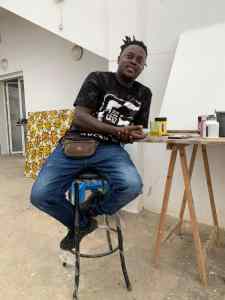
Abdias Ngateu, a contemporary artist based in Douala, Cameroon, immerses us in a pictorial universe where humans and animals intertwine in a metaphorical dance rich in symbolism and social critique. His artistic journey, beginning in graphic arts and transitioning into plastic arts, reflects a constant evolution and a quest for meaning deeply rooted in the changing realities of modern Africa.
Abdias Ngateu’s paintings remind me of the time I stayed in Cameroon, where public roads are dominated by benskinneurs as if these were their own. In addition they take me back to an environment alive with arguments and counterarguments between them and passengers. Ngateu has managed to capture this human warmth, urban dynamism, and perpetual motion in his works.
His canvases mirror an ebullient mosaic of city life so that the disorderly streets feel like they’re palpable through brushstrokes. These are therefore not simple snapshots of everyday reality but glimpses into the society which expose individuals’ struggles and relationships with one another. Using bright colors and intricate details Ngateu documents as well as comments on the complexities of Cameroonian urban culture.
In other words, Ngateu’s art is more than just mere representation because it is a window which reflects on the ever-changing web of people’s lives and communities that shape them. Furthermore, his ability to stop instances of town commotion or human communication shows how well he sees our social fabric.

Since he was a kid, Ngateu has been on the path to art through formal decorative arts and screen printing training. His mother then enrolled him in a particular learning institution at the age of 14 where he acquired these competences which have enhanced his career today.
His meeting with Cameroonian artist Achillekà Komguem in 2009 became decisive moment in his artistic development as it opened him up to plastic arts and expanding his creative horizons. Ngateu incorporated popular art into his work, influenced by artists such as Chéri Samba but approached it with a critical and committed vision.
The Intersection of Sociology and Art

Ngateu’s majoring in sociology at the University of Douala is what significantly shaped his artistic ideas. His works raise essential issues about humanity’s role within a chaotic and dehumanized society while examining how humans lose their values turning into “other”– animals or objects- under social breakdowns. In this regard, animal figures on human bodies provide an example of this reflective choice that represents insanity.
In other words: “We know that animals behave instinctively while humans are thought to act rationally; however, we can see from experience that human beings no longer function rationally meaning they lose their essence as humans.”
Ngateu uses a lion and a deer, a panther and a monkey, or an antelope in his works to interrogate coexistence. He brings together beings of different natures—predator and prey—to question why we should fear our fellow humans. “In a country with multiple ethnicities living , this issue of living together is central,” he adds.
The Creative Process: From Capture to Composition
Concerning Ndoumbé’s work, he calls his creative process a complicated intimate journey. “I start with my camera, I take pictures,” he explained . “Then, in my studio, I make compositions. It is like a patchwork where I put one image from a photo and relate it to another using the computer.” Then on canvas, I draw this and continue to paint. My intention is to create exaggerations with the kind of things I do. After that, depending on their behavior and what they represent or express about me (my emotions), I alter the animal heads.” This very careful and well thought-out approach allows Ngateu to blend personal vision and reality captured by his works into an extraordinary depth.
Urban Journey as Allegory and Reality
Through metaphorizing larger social malaises, the chaos associated with urban transportation in Douala serves as an emblematic backdrop for Ngateu’s work. The artiste’s compositions are captivating by their subtle mixture of humor with criticism thus exposing a world where absurdity coexist side by side with despair calling for deeper reflections about present state of Cameroonian society.
“It is through transportation that we observe a country’s development. Here, there are no roads. My work questions politics. Means of transportation depict a country’s image. I approach this subtly and with a lot of humor, but it is political,” he emphasizes.
Humor: A Subtle Instrument of Social Critique
Ngateu skillfully employs humor to address serious subjects like corruption and infrastructure deficiencies. Inspired by Albert Camus, he firmly believes that art should evoke emotion and provoke collective awareness. His vibrant compositions, vibrant with colors and playful aesthetics, conceal a sharp critique of society, making his messages accessible yet impactful.
Humor serves not only as a tool for engaging the audience but also as a shield against the ire of authorities when criticism becomes overt. In a cameroonian context where freedom of expression is severely challenged, such as where journalists face threats of arrest, abduction, censorship, and imprisonment, art becomes an innovative means to circumvent such censorship. By infusing his work with humor, Ngateu navigates these challenges, using wit and satire to convey dissenting views in a more palatable and less confrontational manner. Thus, humor in art becomes a strategic choice, enabling artists like Ngateu to convey powerful messages while minimizing direct reprisals from those in power.
Naïve and Popular Style, Anchored in the Times
The naive art style of Ngateu is related to the tradition of artists from the Zaire School of Popular Painting, in which one might include Pierre Bodo, Chéri Samba, and Moké, with his “painter reporter” style on urban life. His works also evokes the of naïve paintings by Edward Saidi Tingatinga from Tanzania.
Like these artists, Ngateu reduces the forms to simple shapes, and with vivid colors, he paints scenes of everyday life in Cameroon to capture and comment on them. His approach infuses irony with the celebration of the mundane to stand him within the neo-popular movement on a global scale. He does not openly declare himself an activist, but provokes and challenges. His works, reflecting themes of cohabitation, ethnic diversity, and coexistence, reopen consideration of human relationships in a society devoured by open tribalism.
“I just hope my creations make people reflect,” he says.

Anthropomorphism in Art
Ngateu’s work continues a long tradition of anthropomorphism in art, a practice with deep historical roots. One of the oldest is an ivory carving known as the Löwenmensch, created in the Upper Paleolithic epoch some 32,000 years ago, depicting a human figure with the head of a lion. Ancient Egypt was flirting with anthropomorphism via a statue of Pharaoh Amenhotep III next to Sobek, the god of fertility and protection with a crocodile head. It was already an artistic form that evolved through many ages and cultures, from Greek and Roman representations to Christian iconography, such as the images of Jesus as the Lamb of God.
In more recent art history, the likes of Giuseppe Arcimboldo, who painted human portraits out of arrangements of fruits and vegetables, and Salvador Dalí, with his anthropomorphic cabinets, really pushed the concept beyond any form of traditional thinking. Towards this end, the anthropomorphic figures of Max Ernst, a major artist in the surrealistic and often bizarre, generally express something related to the many things represented under this process.
But Ngateu has taken anthropomorphism of the cavalcade up a notch, intertwining African cultural stories into contemporary societal critiques. He says, “The animal figures represent for me the loss of rationality and the raw survival instinct that dominate our society.” His is not an ornamental effort at all.
“Taxi V.I.P”: A Revelatory Masterpiece
“Taxi V.I.P” is an excellent work representing his style. The scene of a busy city with an overloaded taxi, carrying anthropomorphic figures, is transferred to the 150 x 140 cm artworkᅳall painted down to the last detail, creating an impression that is both real and surreal. The travelling yellow taxi, with a sign “Taxi V.I.P” and full of passengers and baggage, underlines the irony of disparity between aspiration and reality. The scene speaks to Cameroonian society at largeᅳwhere everyday struggles to survive and move around become the face of political and economic failure.

In Abdias Ngateu’s “Taxi V.I.P” and in other works, he reveals an ability to capture contemporary issues with an aesthetic both playful and incisive. His art does not just document a world; rather, it invites critical reflection on the human condition. Ngateu, through his creation, fights for the awakening of perception toward daily reality and the social and political structures that build it.
Represented by the Out of Africa gallery and increasingly recognized at the international level, Ngateu is an artist in perpetual evolution, ever in search of new artistic directions. His interest in love and cohabitation, inspired by travels to Senegal and Mali, certainly continues to give rise to poignant and meaningful works. His experimenting with video art is a sign of extension of medium and effect.
 Bridging Africa and The World Through Contemporary Art
Leave a comment