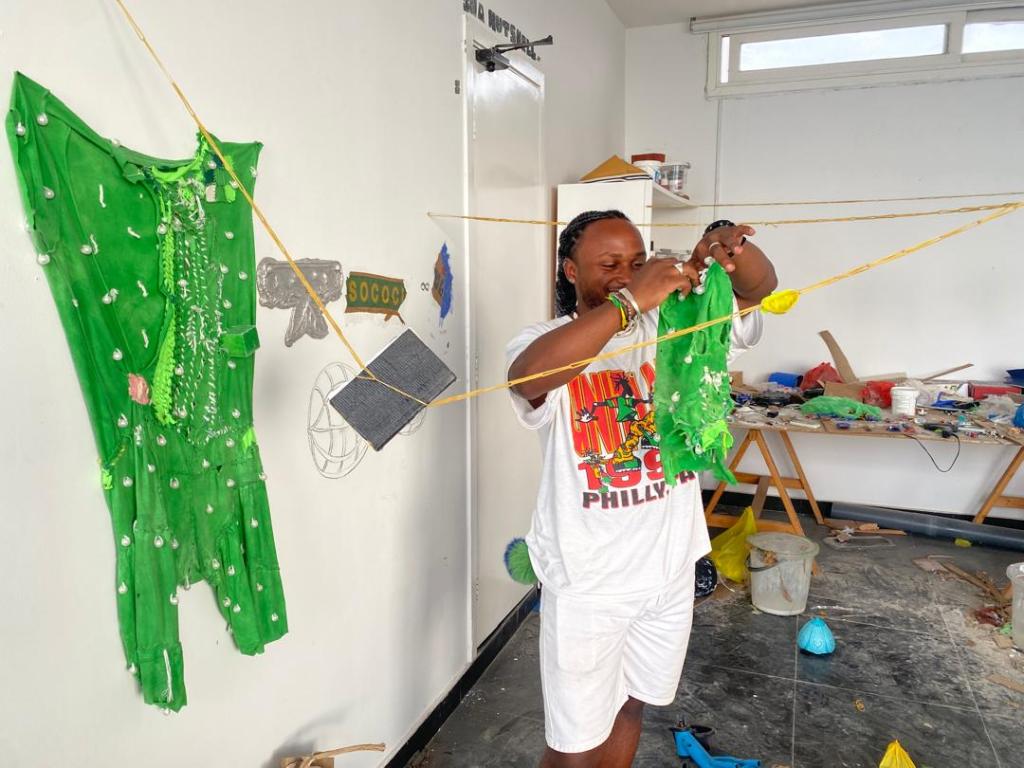

DakartNews recently visited Black Rock Senegal, a “multidisciplinary artist-in-residence program founded by renowned artist Kehinde Wiley in 2019.” We had the privilege of meeting Pap Souleye Fall, an artist in residence nearing the end of his tenure. Stepping into his studio is like entering a world where chaos and creativity converge seamlessly. Papers mingle with cement bags, tree branches intertwine with cartoon figurines and human busts. This eclectic environment isn’t just happenstance; it’s the very essence of Pap Souley’s artistic expression. A Senegalese-American exploring sculpture, installation, performance, cosplay, digital media, and comics, Fall navigates dual identities through themes of diaspora, post-apocalypse, and Afro-futurism.

Which project have you been working on during your residency at Black Rock Senegal?
I’ve been focusing a lot on aluminium casting. I’m really excited because I didn’t realize how much aluminium casting is actually a recycling process. In my work, I use this recycling to connect with contemporary African art. There’s a big conversation right now about recycling and bringing back materials, which influences my work. You can see I use a lot of paper, like cement paper. There’s also a digital aspect with a green screen. I use green paper to reference digital materials. Using cement bags in my work reflects the constant construction happening everywhere in Dakar without always understanding the reasons behind it. This resonates with my thoughts on digital space, limitless capitalism, and linitless production.
I’m thrilled about my time at Black Rock and how aluminium has become a new medium for me. Before coming here, I used aluminium tape. And I was doing research and I remembered the pots which are made from aluminium. So I said I would love to learn from people who are doing this. I’m also exploring creating images differently. Modern African art often portrays people in glamorous, model-like ways, but I’m more interested in older African art forms like wooden sculptures and textiles. I’m experimenting with creating comic pages through aluminium casting. They could then be held up like potential paintings and maybe have a kind of utility. Black Rock has been fun to explore these ideas.
How has growing up between Senegal and the USA influenced the themes in your art?
Initially, my work reflected the experience of straddling two cultures, a common theme for diaspora individuals moving between Senegal and the USA. As I developed my practice, I became even more interested in how there are already good existing connections. My love for comics and mangas became the source of understanding how pop culture has connected a lot of people. For example, everybody knows Dragon Ball Z and everybody has done their own version of Dragon Ball.
Even people from the diaspora, all over the world. So that really inspired me when thinking about the way I make art. So it’s a kind of medium mixing which is popular in lots of mangas where they make little figurines, they do the TV shows, they make the clothes. They make the little pocket things that you can have. They accessorize themselves in the things that they believe in. So my in-between being Senegalese-American is that I am accessorizing myself with both entities and making it something new.
You work with various mediums like installations, sculptures, and performances. How do you approach creating transmedia art?
I enjoy blending different art forms. My studio is often chaotic, filled with materials for performances, installations, sculptures, even dental comics. This chaotic environment allows ideas to flow freely. While each medium has its focus, I sometimes find myself shifting from sculpture to comics to installations based on the ideas I want to explore. I would be like maybe I want to do a comic now. So I would then do a comic and relate whatever happens in that sculpture to that comic. Then from the comic maybe I will do an installation. And from the installation, I will do a performance. I think this jumping around allows for a need to conceptualize a lot of what is ambiguous and opaque parts of my practice, which I think are the strongest parts. A lot of African philosophies that I have researched have this desire of opacity. I think opacity allows for a certain sort of room for possibilities. And I think I like to avoid finiteness.

How do you hope that the audience will engage with your themes and interpret it? What impact do you aim on viewers through your work?
My favorite part about viewers, that I have noticed more and more, is that they get lost with me. And I love that. When I look at art, I look for art that allows me to forget myself. I think that’s important because I believe in a lot of truths in art. Art speaks truth because it speaks about that individual truth. So I think from my work, all I would really want is for people to get lost and to find things, to discover new possibilities, to see connections that I have not maybe seen or to fall into the rabbit hole that I have created for them. And for myself (laughs). A lot of art for me is play and that’s what I hope for the audience.
For example, the last installation I did in New York was the real first time a gallery gave a whole room and told me I could do whatever I want. It was called “It Ain’t that Deep”. A lot of African Americans, when they feel a certain emotional pressure, there is a desire for something like “you are not going to control me, there is no way you can know me fully. There are things that I hold to myself.” This is a clear boundary. It could also be an emotional immaturity as well. So conversating around this whole thing, people were immediately so lost. Because the whole room was blue, you couldn’t really tell what was top, what was bottom. There was shoeprint, there were shoes and gloves on the ceiling. So that was really interesting. It kind of turned people around, they were weaving through the space. I found that really interesting.
 Bridging Africa and The World Through Contemporary Art
Leave a comment