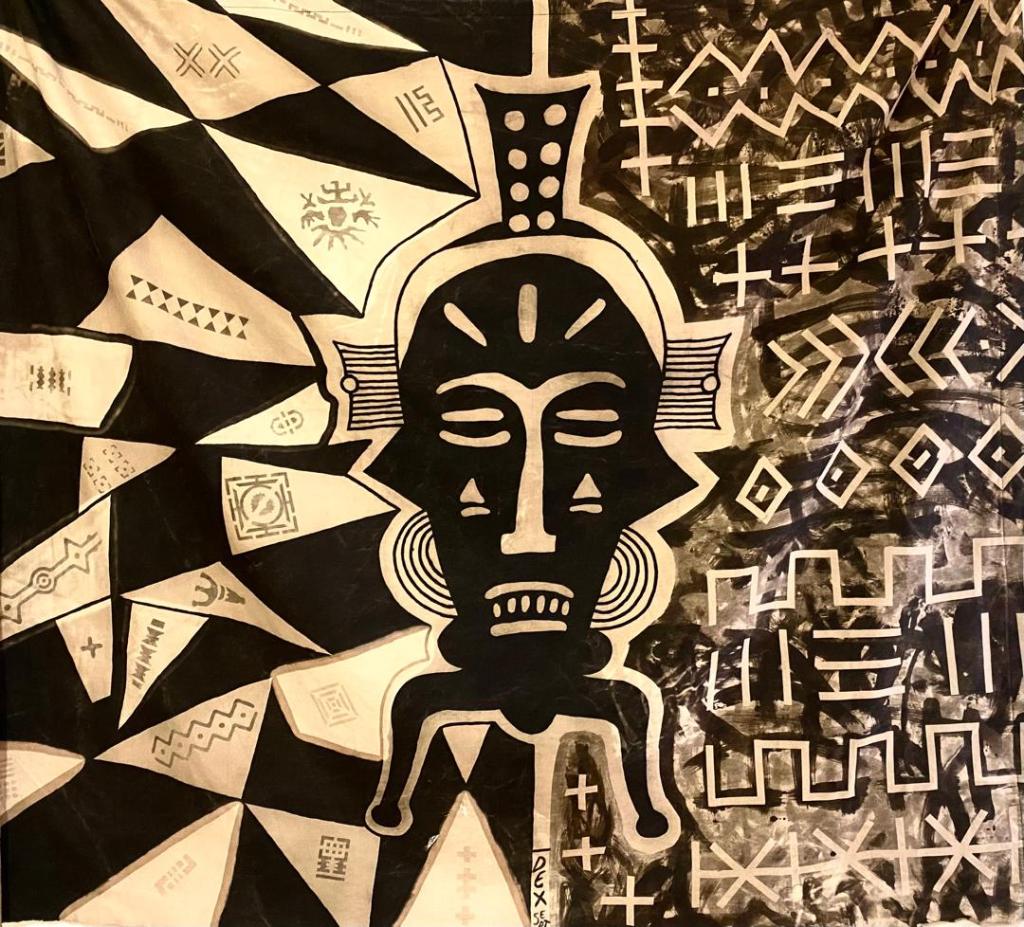

Our “Artwork Spotlight” column highlights the work of Malian artist Tidiane Ndongo, known as DEX. In 1995, he created “The Mask,” a piece part of the DakartNews collection. This artist introduced the DOGODOGONI style, distinguished by a unique approach to bogolan, a traditional textile art from West Africa. Traditionally, bogolan was an activity primarily carried out by women.
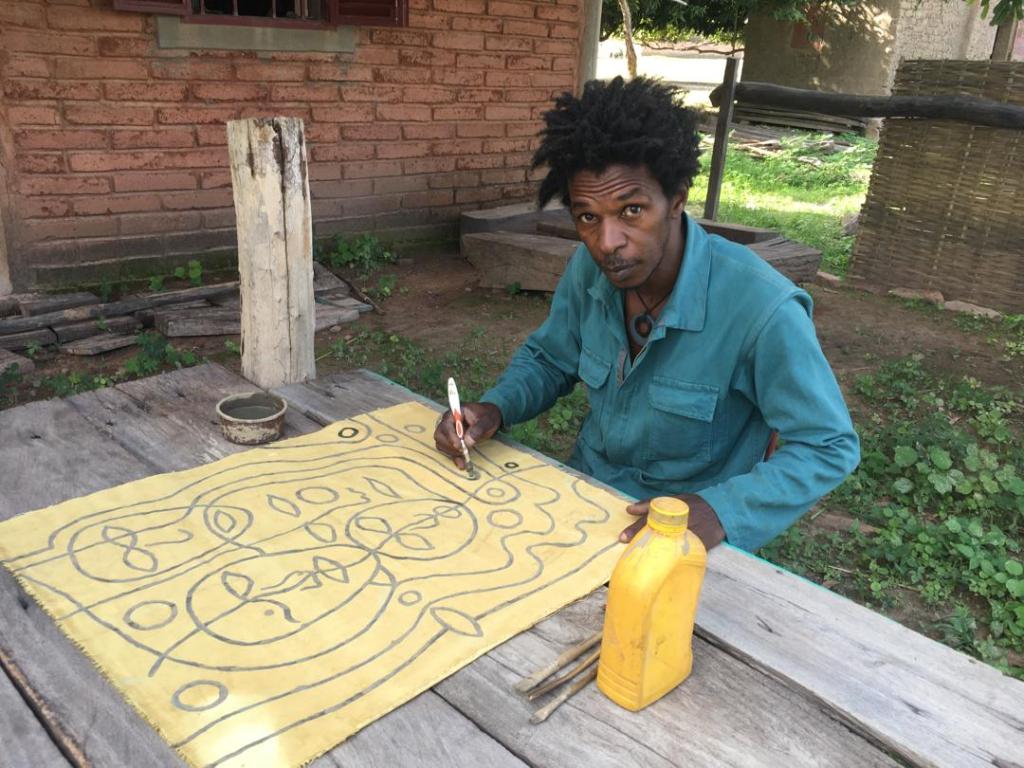
According to Tidiane, the creation process begins with a decoction of the ngalama plant, in which the fabric is repeatedly soaked. The patterns are then drawn using clay. This traditional method, where the light parts result from the effect of ngalama and the dark parts from the application of clay, gives bogolan its name, derived from “bogo” meaning clay. The fact that the fabric is made with earth elements underscores a profound connection to the land and nature, grounding the art in the very soil of the region. As he explains, “The light parts are ngalama, and the dark parts are clay. Bogolan comes from ‘bogo,’ which means clay, so bogolan is what is made with clay.”
“The Mask” A Manifesto for Cultural Authenticity and Conservation
The visual composition of “The Mask” is dominated by a central Sénoufo mask. The Sénoufos, a people spread between Mali, Côte d’Ivoire and Burkina Faso, attribute a sacred value to these masks. By placing this mask at the center, the artist evokes the tensions between the cultural and spiritual value of objects in Africa and their aesthetic reinterpretation in the West. This juxtaposition criticizes the trade of African antiquities, where sacred objects are often extracted from their original context to be sold elsewhere, thus losing their sacred significance. Tidiane elaborates, “In my early days, I lived in a neighborhood with many antique dealers who sold masks. Some people viewed these merchants negatively. That’s why I put the mask at the center of the canvas—because it’s at the center of the issue.”
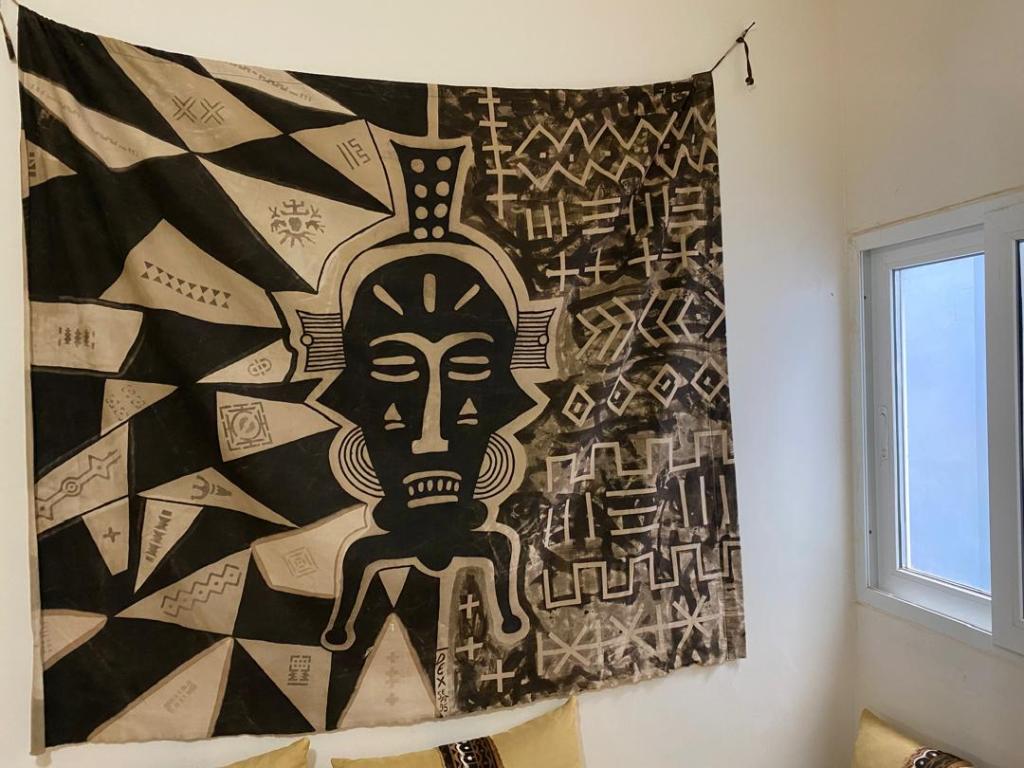
Clay and plant on cotton fabric
The work is divided into two distinct sections, each rich in symbols, which are like codes and messages of the Mandingue culture. The right, darker part, is adorned with squares with dots, representing the four cardinal points and symbolizing femininity. The crosses illustrate encounters and complementarity in a couple, while the zigzag lines represent the paths of the swindler. These motifs suggest a reflection on human interactions and the deceptive paths taken in trade. “The crosses talk about encounters, the meeting of two beings, one horizontal and the other vertical. It represents complementarity in a couple”, he notes.
The left, lighter part, is marked by triangles symbolizing the triangular trade. Here, the artist criticizes the persistence of a modern form of exploitation where cultural objects and natural resources from Africa are extracted to be sold abroad, thus depriving Africa of their benefits. The non-traditional motifs in this section indicate a transformation and a threat to cultural originality and authenticity. This reflects the change imposed by external influences and trade, symbolizing the degradation of cultural originality in the face of commercialization. “Even if people are no longer taken to be sold, objects are taken to be sold. It’s also like the natural resources that Africa has but does not benefit from,” he explains.
Tidiane invites us to a deep reflection on the dichotomy between originality and cultural exploitation. His use of traditional motifs and symbols, while introducing non-traditional elements, creates a visual dialogue on the loss and transformation of cultural values. This work criticizes the trade of sacred objects, highlighting how sacred objects lose their spiritual significance when they leave their original context. The central Sénoufo mask is both a symbol of African cultural wealth and a critique of its commercialization.
“The Mask” by Tidiane is not just a visual art piece; it is a powerful statement on the conservation of cultural heritage and the impacts of international trade on sacred objects. It is essential to recognize the artist’s commitment through his DOGODOGONI style to defend cultural authenticity and denounce the injustices of global trade. With this creation, he captures and conveys deep concerns about cultural exploitation and the preservation of identity.
By integrating traditional techniques and symbols with contemporary commentary, he offers a work rich in meaning and relevance, inviting viewers to reflect on the true cost of cultural appropriation and the commercialization of sacred objects. The use of earth in creating the fabric also symbolizes a grounding in tradition and the natural world, emphasizing a symbiotic relationship with the environment and highlighting the importance of preserving these organic connections in the face of modernity and commercialization.
DOGODOGONI & TIDIANE N’DONGO
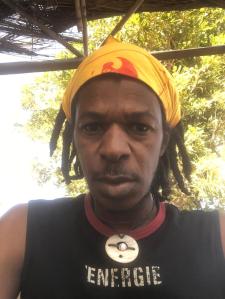
From the artist’s shared biography
Tidiane N’DONGO was born in 1970 in Bamako, Mali. He began his education at a Quranic school with his peers, then transitioned to a Franco-Arab institution at his mother’s insistence, where he studied until he obtained his baccalaureate. Without securing a scholarship to study abroad, Tidiane took on various small jobs.
In 1994, Tidiane decided to learn the bogolan technique from Youssouf Sidibé Nelly in Bamako-Coura, a popular neighborhood in the Malian capital. Quickly, Nelly, who became both his mentor and friend, entrusted him with the management of his workshop. While adhering to the traditional techniques of using clay, plants, and roots, Tidiane developed his own unique style, which he named DOGODOGONI, meaning LABYRINTH and GALLERY.
Following his training in bogolan, Tidiane began teaching the technique to the youth in his Bamako-Coura neighborhood. During this time, he formed a close relationship with his neighbor, the late Yssou Keita, a prominent artist from the same area. It was Yssou Keita who encouraged and guided Tidiane in creating his first paintings.
Bogolan, a traditional painting technique using clay, plants, roots, and more, is like a labyrinth that hides behind geometric signs an entire history, wealth, tradition, and even a civilization.
In Bamanan (Bambara), one of the meanings of the word DOGODOGONI is LABYRINTH. Dogodogoni represents a process, a necessary passage. Everything, from the mundane to the exceptional, is a process. Even a simple, everyday object that can be held, turned over, and examined involves a process, which can be lengthy. What doesn’t stem from a process? A process is a path, a journey with its own meaning and logic.
For Tidiane, DOGODOGONI is akin to a chameleon: a symbol of surprise, discovery, reflection, change, and adaptation. In essence, DOGODOGONI represents both the style and philosophy of Tidiane. This style is evident in the comprehensive view of his works, his reflections, and his perspective on things. Some of Tidiane’s paintings reflect a continuous movement, appearing and hiding, transforming like a game of hide-and-seek, as if the artist is concealing his own curiosity. Tidiane’s lines encourage deep thought and questioning.
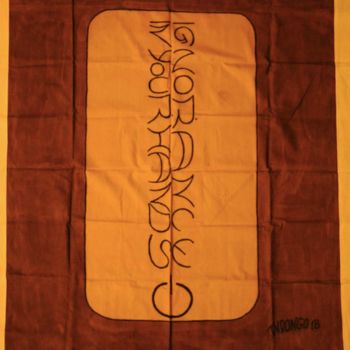
An avid reader and admirer of sacred texts, Tidiane sometimes incorporates writings into his canvases, blending them with his visual expression. Tidiane opposes ignorance, which he considers the sole source of evil, and believes that reading is a remedy against it. For him, to read is to understand. According to Tidiane, reading is multifaceted. For him, meeting, observing, listening, walking, touching, speaking—all are forms of reading. To read is to try to understand, and understanding is the purpose of reading.
Tidiane’s motto is: “To know myself, to be myself, for myself.” This is not selfishness; he believes that self-knowledge is the best way to progress and open up to others. This is the path he tries to follow to free himself from the physical and moral barriers surrounding him.
Tidiane is convinced that “humans are a mix of flaws and qualities, which they display according to circumstances.” His work continuously develops this conviction, aiming to make it universal and timeless.
DakArtNews


 Bridging Africa and The World Through Contemporary Art
Leave a comment