


Dr. Ibou Diop, a distinguished Senegalese curator, art critic, and literary scholar based in Berlin, has significantly contributed to the discourse on colonial memory and contemporary African art, having worked on a remembrance concept for colonialism for the Berlin Senate. During his recent visit to Dakar in June 2024, DakartNews had the privilege to discuss his background, views on the evolution of African literature and art, and perspective on the state of contemporary African artistic creation. In this interview, Dr. Diop offers a critical perspective on the contemporary creation of African artists, particularly those from Senegal. He observes that many of them reproduce global aesthetics and is concerned that today’s artists focus on market demands instead of exploring their cultural heritage
Can you tell us about your background and what brought you to cultural matters?
I think that very young, my friends made fun of me. They said I could watch all the films because I could watch the ones they didn’t find good. What interested me was the image. I believed that in every film, there was a story, and I wanted to understand that story. When I was in my final year at Lycée Blaise Diagne in Dakar, we created a club called Literature and Philosophy. I had invited the rapper Didier Awadi and Professor Sankharé to talk about rap and poetry. That was in 2001/2002. After high school, I first went to France, then to Germany to study literature. Throughout my journey, I have always been interested in literature as text, as narrative, and as art. I enjoyed looking back at my first writings on literature. I realize that I have always viewed literature in relation to art, cinema, text, and image. These are fields that have always interested me.
Can you elaborate on the relationship between African literature and African art?
I wouldn’t make a separation. I would speak of African arts, of which literature is a part. When we look closely at this literature, we realize that most of its major players were also artists. African literature has always been a literature that was between sections. This means there is no separation between artists, literary figures, journalists, and actors. They were all together. For example, at the First International Congress of Black Writers and Artists in 1956, we see that people spoke about both literature and the arts. They were between these spheres. There was no separation because literature as an artistic expression was the most natural way to express and position oneself. It is not by chance that “Notebook of a Return to the Native Land” from Aimé Césaire is prefaced by André Breton and that in this literature, which greatly inspired the surrealists of Paris, the texts were not just texts but artistic expressions in the way they were sung, written, and shared. African literature is not thought of as something that is exclusively text but as text and art. This is why we could say that intersectionality is in African art and African literature. We don’t need to cultivate it.
The intellectuals from the Negritude were searching for the essence of this culture that had been scorned and denied.
You mentioned the first Congress of Black Artists and Writers in 1956. What has changed since then in regards to the new generation of artists?

I think there is a very big difference because the intellectuals from the Negritude movement were in search of something, felt the necessity to express something, to bring something to universal civilization. They were in search of the essence of African culture by expressing it through words, texts, and songs. They also sought to show what Africa and the diaspora could contribute to the civilization of humanity, whereas I feel that today’s artists are no longer searching for something but copying something. Their reference is no longer the essence of culture and artistic expression from the African diaspora.
But times have indeed changed, haven’t they? In 1956, most African countries were not independent.
We cannot compare the struggles. We were in a time when the black man was supposed to be someone acculturated, a person who needed to be taught everything and had absolutely nothing to give. Senghor, Césaire, and others, and long before them, all the intellectuals who thought about artistic expression were sure of their culture. They were searching for the essence of this culture that had been scorned and denied. They knew it was important for the black man to contribute something, even though they did not deny the legacy they had from colonization, which was a violent legacy. They were able to integrate that into their discourse while being clear about what a black civilization could and should be. But today, what are we proposing? We can no longer shout “I am black and I am proud.” It makes no sense. Concretely, what are we offering to humanity with what is happening on our continent and our connection to others, to the human, to the earth we share? What is the role of the artist in economic, artistic, and aesthetic development? What aesthetic are we proposing?

Can we define an aesthetic identity specific to Africa?
I cannot define an African artistic identity today. At most, we can say that this identity does not exist. It is hybrid, always a mix of something. It could be something deeply rooted in the African continent, but rooted in what we have become. For me, hybridity is something positive. We are nations that have always thought about their future in relation to the rest of the world, hence the hybridity. For example, in Senegal, we see that the Peuls mix with the Sérères, the Diolas mix with the Sarakholés. Our art is also like that.
As long as racism persists and people are killed because they are black, our work must be political.
What is your perspective on contemporary artistic creation in Senegal?
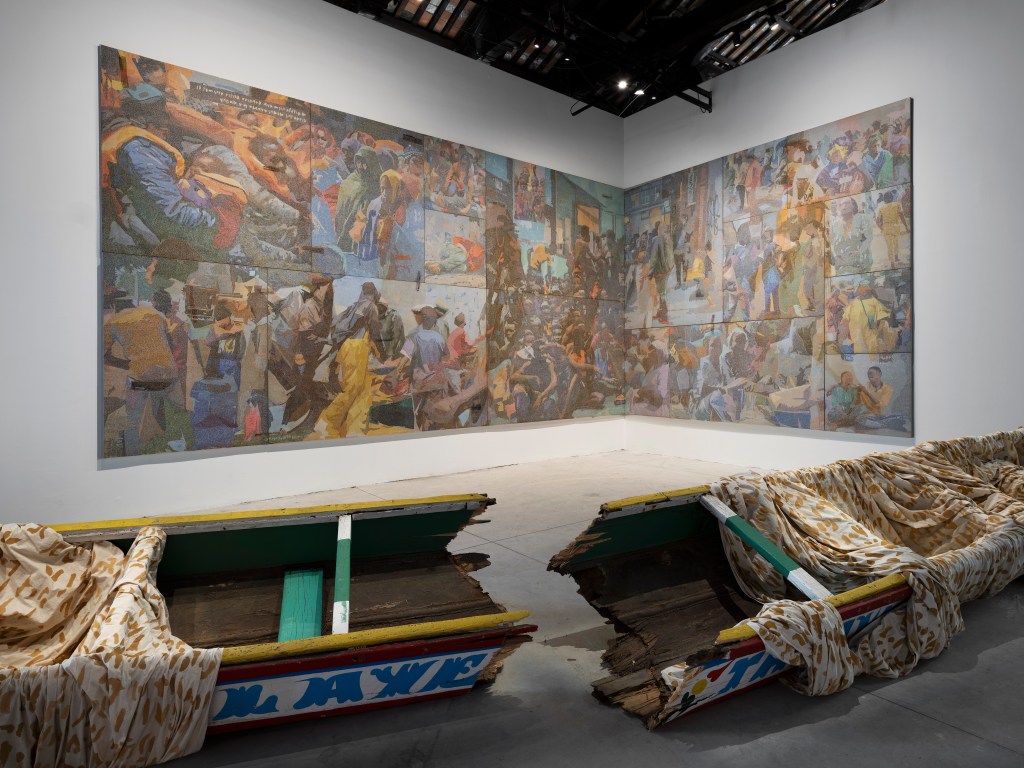
I feel that artists are reproducing what is happening elsewhere as the aesthetics found on their paintings are always the same. Today, an exhibition held in Dakar, I can see the same aesthetics in New York, Berlin, and London, even though these are more or less different worlds. And the aesthetics are uniform. I wonder why? For whom are these installations made? What are they meant to address? I wonder why suddenly, everyone is making installations. The aesthetics have evolved a lot compared to the Dakar School. Today, I feel that artists make paintings and propose things based on demand, which is not bad. I am not judging. But I question what we want to offer, beyond this demand, to the societies we come from. For whom is this art made? That is the question. For whom are we making all these paintings? What should they bring? We can also make art for art’s sake.
Isn’t the current production to be considered in relation to the context of globalization?
This globalization that has homogenized us, who benefits from it? That is the question to ask. Who benefits? If we answer this question, we will answer the question of whom these paintings and installations are for. We can also truly make art for art’s sake. What is certain is that art has liberated us because the intellectuals who fought for independence were artists.
How does the legacy of Negritude influence today’s Senegalese artists?
I think that young artists have not read Senghor or people from the Negritude generation. There was a legacy, but there was no transmission. Maybe in the current context, reading Senghor could be “dangerous” because one might be considered close to France or Francophonie. Personally, I am not interested in Senghor the man, but I am very interested in the intellectual. I think he was very courageous. And I think he brought something to the black man. Our role is to go beyond what Senghor proposed. We can criticize him and others too. Maybe we were born after colonization, but the foundation of colonization still dominates the current world. Racism, for example, stems from colonization and slavery. And it was fueled by a Western science that hierarchized men and women according to skin color and created racial, social, and economic classes. So, as long as racism persists and people are killed because they are black, our work must be political.
But in the Senegalese context, artists living here are not concerned with racism
Senegalese are not just here. They are all over the world, and Senegal is part of the world. The artist can question the situation of women here, the homophobia that plagues our societies, the caste system that destroys lives, the madness in the streets.
That could be dangerous to address topics like homosexuality…
Mbougar Sarr did it in his book “Of Pure Men” concerning literature. Art is subtle. Art is always either behind or ahead, said Barthes. I think that artists should be ahead of their society, and I do not feel they are, in the Senegalese context.
Curatorial work is not only about writing the catalog text but also allowing the artist to express themselves fully.
You have been living in Germany for about twenty years. What role should African diasporas play in the dissemination and evolution of contemporary African art?
I think that diaspora people are bridges who may understand the inside and the outside. Being outside of Senegal gives a kind of detachment. However, when I observe the Senegalese diaspora, some of them have an attitude inherited from colonization. Some think that because they live in the West, they are better than those living here. Some consider themselves above those who stayed. I see it in their attitudes from time to time. But I think it comes from colonization. And these Senegalese, when they return to Senegal, they should be quiet and listen. I think their role is that of a bridge. For questions as political as art, I think they have a say, but they must listen more than talk. They can only be facilitators from a structural, thought, transmission, and translation perspective. In this sense, they are not actors. They should be passive, not active.
As a curator, how do you approach presenting African art in a global context?
My curatorial work always starts with the artist and discussions with the artist. I try to help the artist present their work in the best conditions. I do not try to impose a discourse on the artist’s discourse, but I try to facilitate by talking and communicating a lot with the artist. I ask the artist what interests them. My curatorial work is very participatory. In my opinion, it is important to let artists express themselves and give them the framework to do so. This can be very demanding and difficult, and it is important. We need to see each other, understand each other. What I seek is to give the artist as much space as possible to express themselves. It is not about imposing a vision on the artist. It is really very dialogical. To create is to be free. I think the curator must respect the artist’s freedom. It is the most difficult thing to do. Curatorial work is not only about writing the catalog text but also allowing the artist to express themselves fully.
You moderated a participatory process to develop a concept for a memorial site in the city of Berlin, involving artists, essayists, and members of the German civil society. Could you tell us more about that?
The city of Berlin approaches issues like racism, discrimination against non-binary, lesbian, or homosexual individuals, and those from the diaspora, or who don’t feel recognized by their country of birth, by engaging the affected communities. Working with these individuals is crucial because, in my work, I rely on intellectual, emotional, and experiential knowledge. A single person often doesn’t possess all these types of knowledge. To discuss memory or art, we need all three kinds of knowledge from people who embody them to varying degrees. This principle guides my curatorial work. When dealing with memory, for example, my background in museum work and literature provides intellectual knowledge, but I lack experiential or emotional knowledge, which the artist might bring.

In this work, there is no hierarchy. We can’t work on decolonization while recreating the same structures of colonization. For 30 years, all the civil societies involved in this process have fought for a memorial site. Today, the city of Berlin’s contract includes a concept for such a site. Thus, the work of these civil societies has resonated in the political sphere. The concept is complete and is set to be presented to the Berlin City Assembly.
What were the key proposals of this concept?
One key proposal is the establishment of a memorial site, ensuring that colonial memory is reflected in the city’s architecture. Many people who suffered from colonization lived in Berlin, yet their contributions to the city are not acknowledged. The proposals include building a memorial for colonization, which might be a museum, library, or documentation center. Additionally, streets named after individuals involved in colonization and the slave trade should be renamed after those who fought against colonization. The concept was written and moderated by individuals who are victims of colonialism. In our work, we drew inspiration from Édouard Glissant, who extensively explored the memory of slavery and the idea of a “whole-world” society.
DakartNews
 Bridging Africa and The World Through Contemporary Art
Leave a comment