

As part of our What is Art? series, we are delighted to show the vision of Magatte Touré, a visual artist whose work is deeply intertwined with life and creativity. Graduating from the Fine Arts School of Dakar in 2005, Magatte Touré also serves as a specialized educator at the Aminata Mbaye Center in Dakar, working with children with autism, Down syndrome, and motor disabilities–a theme that his works also carry.
What does art mean to you?
For me, art is a passion that has brought stability and meaning to my life. Art is deeply connected to life itself. It allows us to interact with our creativity, develop ideas, and shape works that contribute to a better life. In summary, art is an essential engine for the development of society.
Do you seek beauty in your creation ?
Beauty is not a primary goal for me, as it is subjective and depends on individual perception. A work of art might seem frightening to some while being enriching for me. So, the concept of beauty is relative and personal.

So, at no point in your creative process do you think about aesthetics?
It depends on the style of the work. When I paint faces or create observational drawings, aesthetics and precision are important to preserve the integrity of the image. But, for more spontaneous work, aesthetics is secondary. Some of my works may range from figuration to semi-abstraction or even abstraction, and I don’t necessarily seek beauty in them. Instead, I focus on the message and the transformation of the image through various patterns and elements.
Is the message more important than aesthetics?
Both are important. Message and aesthetics often complement each other. A work can convey a powerful message while also being aesthetically pleasing. In some cases, aesthetics contributes to enhancing a space or evoking joy, but the message remains crucial for fully understanding and appreciating the work.



Visual Rehabilitation of Children with Disabilities
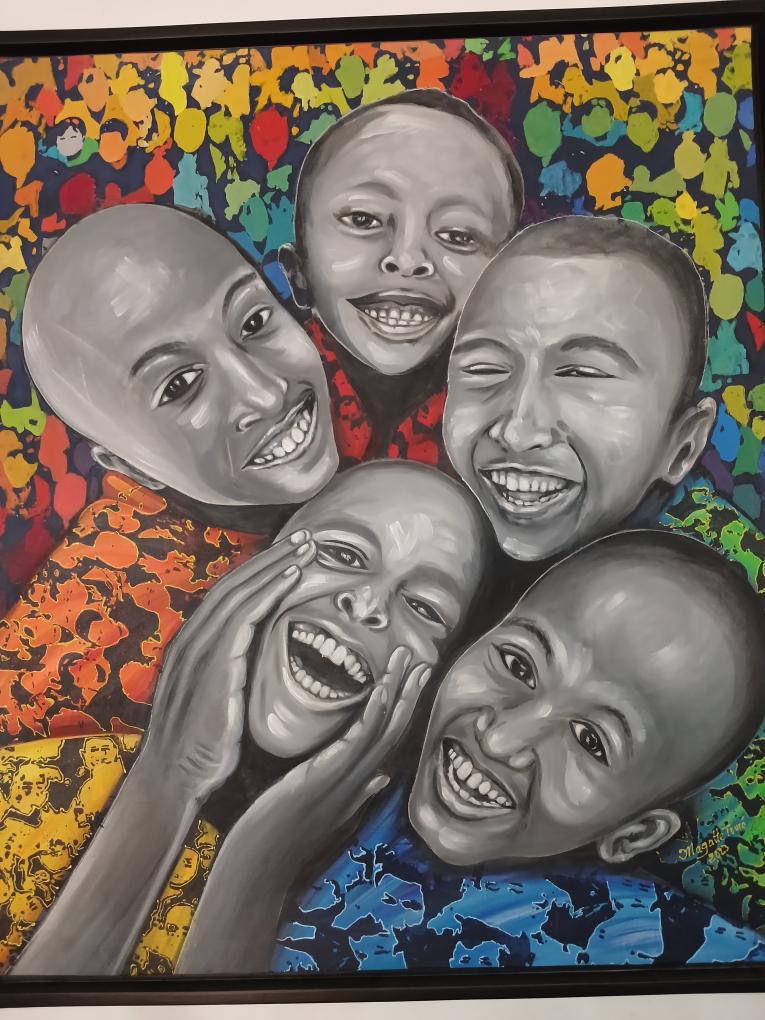
Through his works, Magatte Toure profoundly expresses his dual roles as a special educator and artist working with children with intellectual disabilities. His intentional use of vivid hues —oranges, yellows, and bright yellows—challenges the frequently depressing tones connected to depictions of handicap.
These color selections serve as a visual metaphor for the humanity and strengths of the kids he works with in addition to being beautiful choices. Touré challenges the idea that a disability equates to a reduced quality of life by using such vibrant colors in his canvases.
Also, Touré’s art is a vehicle for social commentary and advocacy. Combining his artistic practice with his professional experiences, he challenges viewers to rethink their perceptions of disability, presenting it not as a limitation but as a unique, equally valid perspective on the world.
His paintings draw attention to each child’s uniqueness, passion, and power while also demonstrating their depth of feeling and potential for pleasure. Children with impairments are sometimes thought to be under the influence of a bad spirit in his country. Touré’s work addresses and challenges this misconception by offering a different perspective.
His work is dynamically strong because the children he teaches have vibrant lives that fully express their power via movement and communication. Their journey of self-discovery and self-transformation is symbolized by recurring motifs.
 Bridging Africa and The World Through Contemporary Art
Leave a comment