


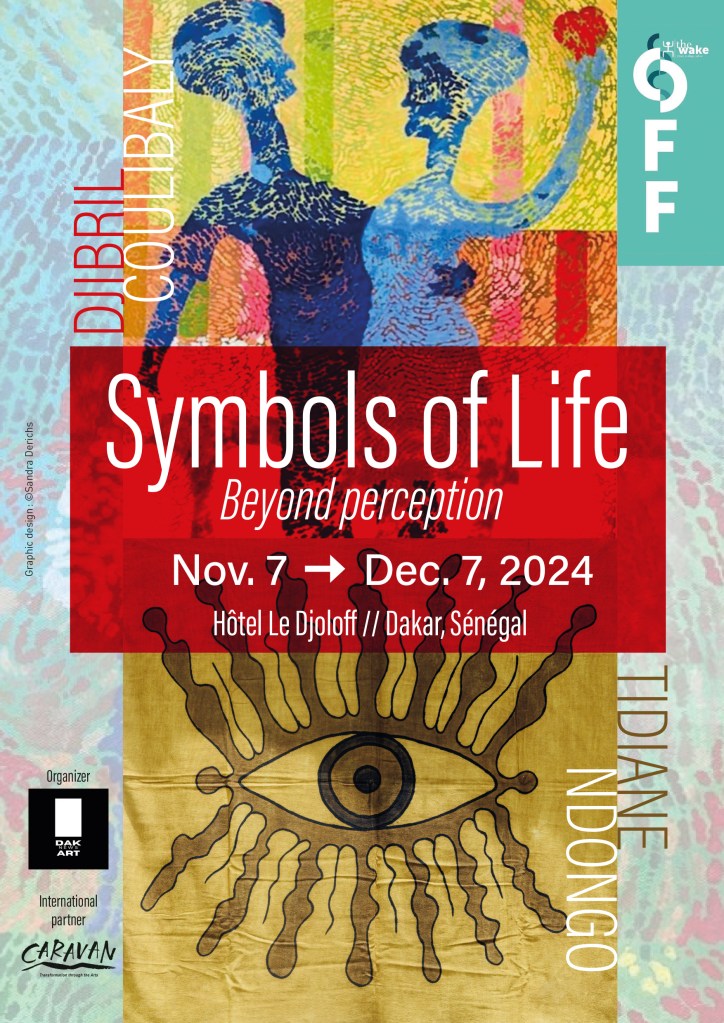
Tidiane Ndongo, born in 1970, is a Malian artist. He learned the traditional bogolan (Mudcloth) technique at the age of 24, guided by Youssouf Sidibé Nelly in Bamako. His work is influenced by the research of late Youssouf Tata Cissé, a Malian scholar, specialist in the myths and legends of Mali. Ndongo shared a close relationship with him. Ndongo’s artistic journey blends tradition with modernity, drawing on the symbolic richness of bogolan while engaging with contemporary issues. This year, Tidiane Ndongo will showcase his artworks during the OFF program of the Dakar Biennale. He is participating as part of the exhibition Symbols of Life: Beyond Perception – An Artistic Exploration of The Human Soul. Organized by Dakartnews in collaboration with its international Art partner, Caravan Arts, the exhibition will run from November 7 to December 7, 2024, at the Djoloff Hotel, in Dakar, Senegal.
————————
Known as Mudcloth, Bogolan, an ancestral technique originating in Mali, was long an exclusively feminine practice before spreading to neighboring regions over the decades. This Bambara term, literally meaning “created with earth,” evokes a dyeing method of impressive richness and complexity, using plant extracts such as ngalama (Anogeissus Leiocarpus) and clay, applied to woven cotton. This use of natural materials underlines a deep connection between art and the earth, where the material becomes both support and essential message.

The women have preserved ancestral techniques while passing on graphic vocabularies charged with symbolism, reflecting Bambara cosmogony and beliefs. These motifs, inspired by animal tracks and human footprints, do more than simply decorate; they form a complex visual language that conveys cultural knowledge and values. Through these ideograms, they convey myths, historical narratives and moral advice, each drawing carrying a message to be deciphered to grasp its full depth. In this way, the bogolan, beyond its aesthetic and sartorial function, reveals itself as a veritable didactic tool.
In this context, the work of Tidiane Ndongo, born in 1970 in Mali, stands out not only for its determination to perpetuate this age-old tradition, but also for its bold reinvention through the style he has named Dogodogoni, or “labyrinth” in the language of Bambara. This innovative style, conceived as a chameleon symbolizing surprise, reflection, change and adaptation, transcends the simple repetition of traditional motifs. It also incorporates signs from Bambara initiation societies. Notably, those from the Komo, the most important initiation society.
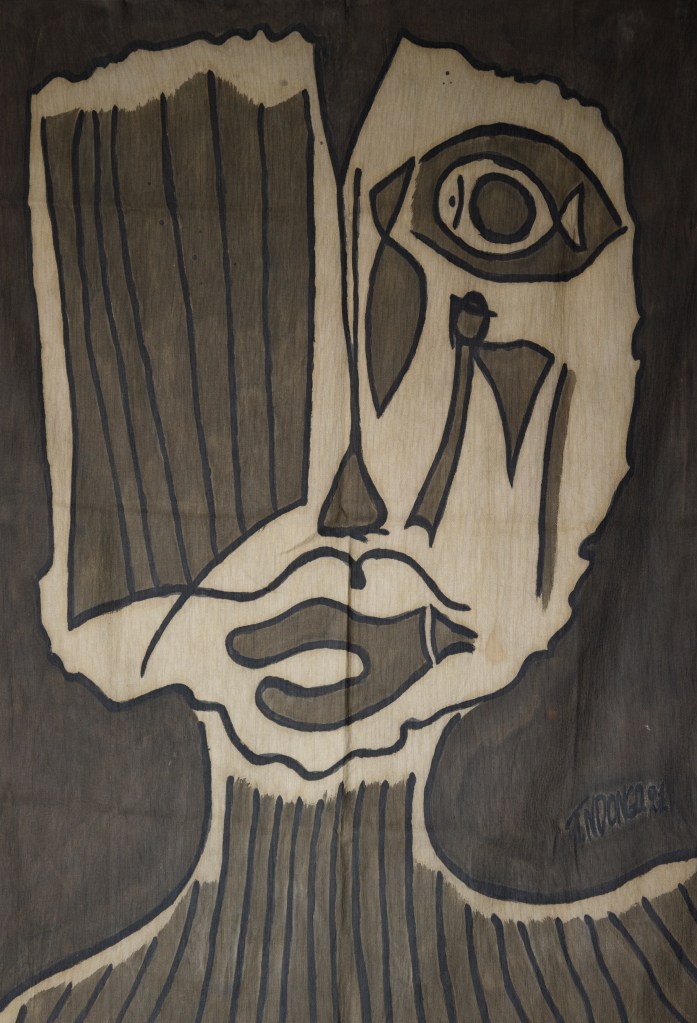
Ndongo addresses contemporary issues through this reinterpretation. These include the role of women, the challenges of migration, and societal and political issues. He also tackles many other pressing matters. He does all this while maintaining a dialogue with these ancestral symbols.
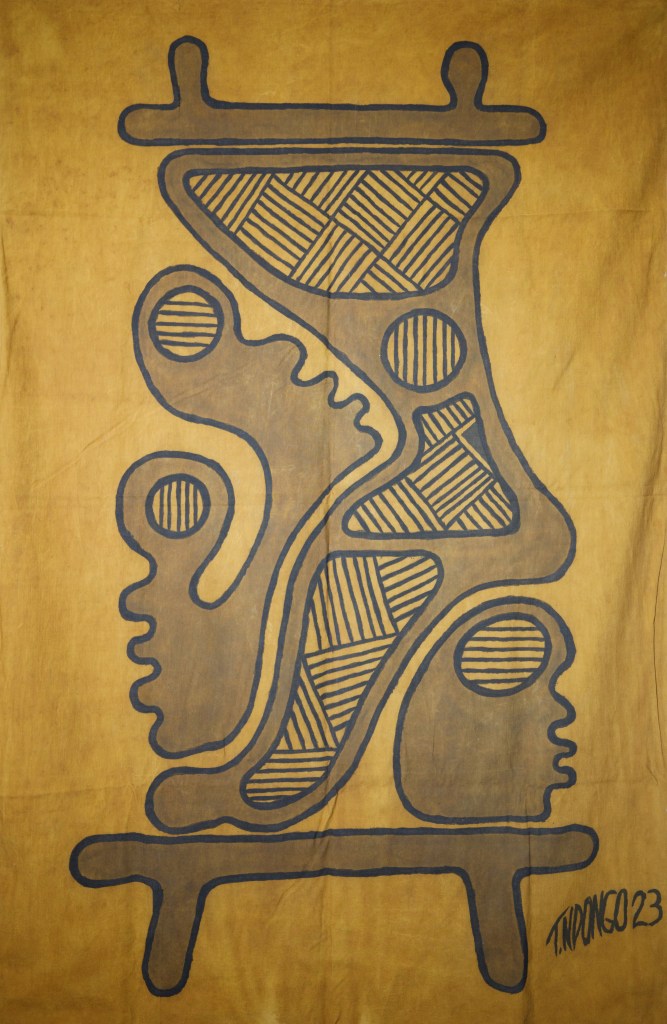
By offering a contemporary reinterpretation of bogolan, Ndongo invites us to explore modern challenges and life’s winding paths. His visual labyrinths, woven from intertwining strokes, create a sense of intrigue and contemplation. By immersing themselves in these interweavings, viewers are led to meditate on the complexity and unpredictable nature of life, while being
captivated by the harmony and intrinsic beauty of the works.
A Socio-Political Context in Transition
His work comes at a time when imported fabrics, notably Dutch wax, are increasingly market share over traditional African textiles like Kpokpo in Sierra Leone, Pano de Obra in Guinea-Bissau, Adanudo in Togo and Ghana, and Lamba akotifahana in Madagascar. This situation has revived debates around questions of cultural identity, appropriation, and acculturation. Through his aesthetics, Ndongo reaffirms the importance of traditional textiles, offering renewed visibility to symbols of African spirit and craftsmanship.
Ndongo’s practice also unfolds within a socio-political context in flux. It is marked by the reconfiguration of geopolitical influences in the Sahel. This is particularly true in Mali, his homeland, which is experiencing major upheavals. These include a gradual break with the Economic Community of West African States (ECOWAS).
In this transformative context, Ndongo’s artworks serve as reflections of the region’s realities. They provide insight into the complexities experienced by its people, and also highlight the tensions shaking the area.
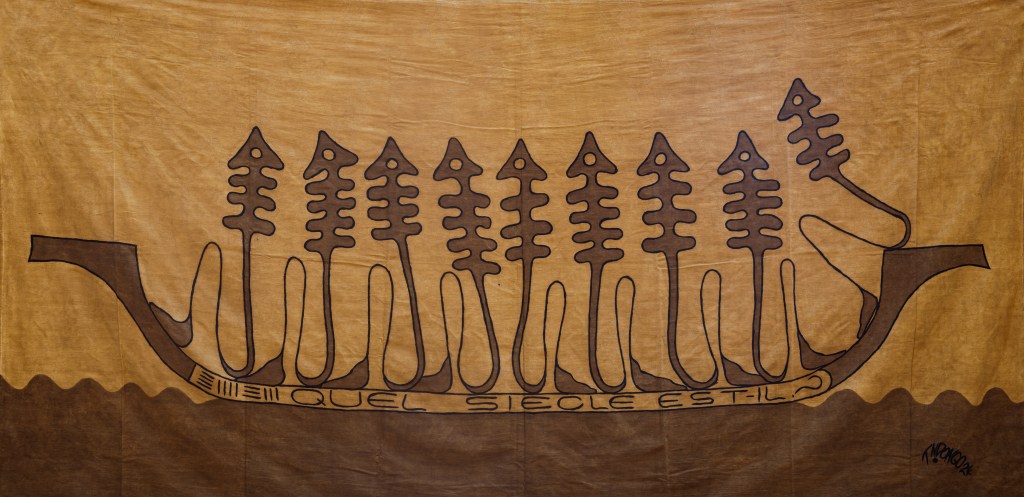
Lampedusa stands out particularly, symbolizing the tragedy of irregular migrations across the Mediterranean Sea, where many Africans lose their lives. This painting embodies the despair and risks faced by those hoping for a hypothetical Eldorado in Europe.
Ndongo’s mastery of the bogolan technique is total, reflecting his 30 years of
experience in this practice. The precision with which he traces each line of clay, an irreversible gesture, is the sign of a rare virtuosity. His complex labyrinths, in which each symbol is perfectly positioned, reveal his artistic maturity. His ability to infuse rhythmic movement and palpable musicality into his characters demonstrates a deep understanding of technique and its potential to be both impressive and expressive.
At the same time, it’s essential to mention that bogolan has also found its place in modern design thanks to pioneers like Chris Seydou. In the early 1980s, Seydou became the first African designer to collaborate with major haute couture houses such as Yves Saint Laurent and Paco Rabanne, integrating bogolan symbols into high fashion. This introduction of bogolan into the design world opened new pathways for this traditional technique. It allowed it to reach an international audience and enabled it to reinvent itself in a contemporary context.
By revisiting bogolan’s signs and motifs, Ndongo thus opens a labyrinth of meanings where each path leads to a deeper understanding of contemporary issues while preserving the richness of this ancient cultural heritage.





 Bridging Africa and The World Through Contemporary Art
Leave a comment