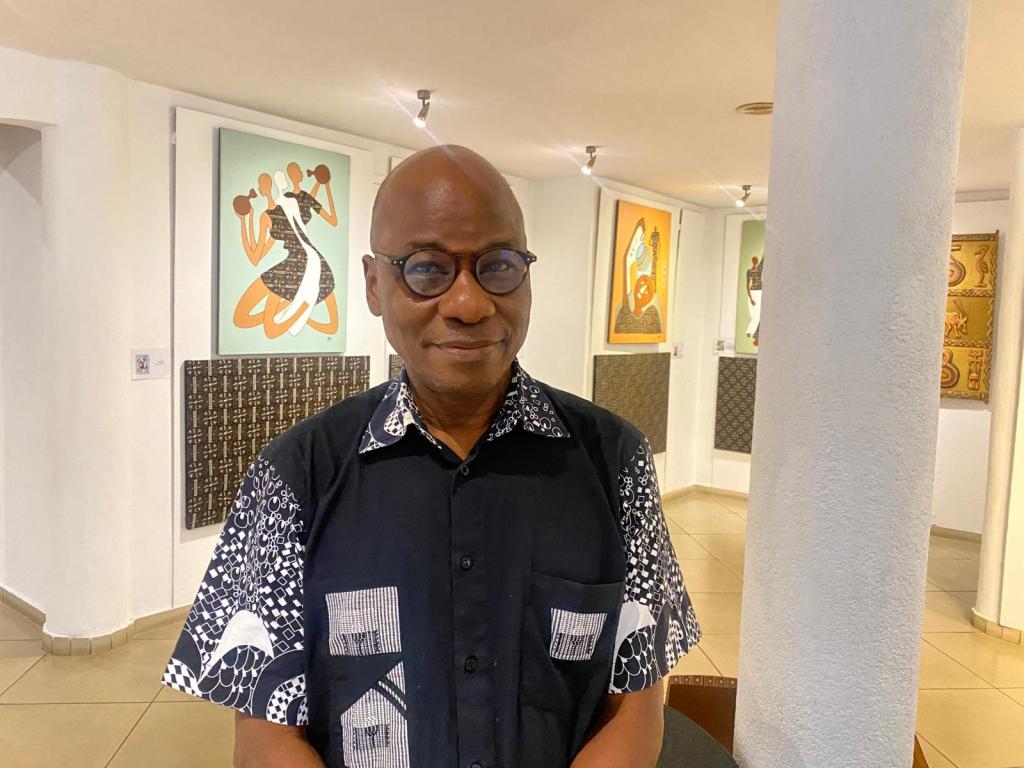

DakartNews had the privilege of meeting with Yacouba Konaté, an esteemed professor of philosophy at the University of Abidjan, renowned art critic, and honorary president of the International Association of Art Critics. Notably, he served as the General Commissioner of the Dakar Biennale in 2006. We sat down with him at the Rotonde des Arts, an art center he has been directing since 2008. During the interview, Pr. Konaté shared profound insights into the current state of African art, emphasizing the importance of personal expression and the individual artist’s journey in shaping the African identity. He also offered thought-provoking reflections on the challenges of defining contemporary African art beyond traditional or stereotypical labels, calling for a deeper, more nuanced understanding of its diverse and dynamic forms. His perspective encourages a rethinking of African art’s place in the global art scene, as well as the necessity for Africa to carve its own path in contemporary artistic discourse.
You have a rich and diverse background, and you’ve worked with several African artists. How would you define African art today?
The question of identity has been debated so much that returning to it directly isn’t tedious because it’s an unavoidable question. Coming from a philosophy background, I can give a definition by thinking of Paulin Hountondji, who passed away a few months ago in Benin. Regarding African philosophy, he said it’s a collection of texts written by Africans that present these texts as philosophy. What seems important to me when defining African art is to provide a broader perspective. For a while, there was what was called tribal art during the colonial period. There was a shift with Léopold Sédar Senghor and the Negritude movement, where people spoke of Negro art. I believe the notion of African art involves moving beyond the generic term “Negro art.” It’s an art that emancipates itself from Negro art and gives precedence to individuals, people, and subjects who are African artists. The question of the creator as a unique individual seems important in this context. Today, one can say that African art is made up of individual and singular artists who identify as Africans and produce something that either shapes or challenges this African identity. It’s also important to note that some Africans do not wish to be called Africans. Therefore, when defining African art, we must not only consider inclusive criteria but also reflect on the marginal perspectives that challenge the notion of African identity itself.
In your opinion, can’t African art be characterized by the object itself?
I place more emphasis on the creator. I wouldn’t define African art in terms of objects. I focus on the creators. What the artist creates is a confrontation with their individual status. Then there’s the reception, whether or not the context accepts it. This reception can be immediate, but it can also take time. There are works by artists that were rejected at the time they were created, and with hindsight, they are rediscovered. There are numerous examples.
For someone who was born outside Africa and identifies as African, can his/her creation falls within the scope of African art?
I would struggle to answer because it depends on the work. This reminds me of what Johnny Clegg did in music. At a certain point, he integrated with South African musicians. He got involved in the fight against apartheid and worked with musicians from the townships, helping them rise above their situation. I don’t know if you’ve heard this anecdote, but one day, while he was in a township with a team of journalists, some locals said to him, “You’re reckless; you came with these white people and didn’t warn us.” Even though he was white himself, he no longer appeared as such. This shows that what makes the difference is attitude and one’s relationship with the environment. If you’re in a place where you feel uneasy, lack familiarity with the codes, or don’t have the right support, your integration is more difficult. Knowing the codes is crucial. I believe the question can no longer be addressed in racial terms but rather in terms of forms, personal journeys, and how people present themselves to us through their works. Another example: when Manu Dibango plays the trumpet or makes music, he doesn’t say he’s making African music. He’s just making music. Yet, a Japanese passerby who listens might say it’s African music, and if they decide to play African music, they’ll imitate Manu Dibango. But Manu Dibango doesn’t say, “I’m going to make African music,” he just makes music.
Africa must create its own version of contemporary.
It is also possible to have a reception of works from the Western classical repertoire. If you study the history of jazz, you’ll see that jazz is filled with pieces that are sometimes covers of Bach. Bach himself has been covered by reggae singers. That’s why I believe we shouldn’t view the question of identity or Africanity solely as a matter of consistency, seeing only what is inside, but we must also look at what is inside that aspires to emerge. Because the question of identity is not a fixed one; it is not a closed question. Traditions are creations. They have not always been this way. It is this dynamic that allows societies to regularly transcend their own limits, and we cannot stop that.
Read also: The State of Contemporary African Art Today: Dr. Ibou Diop’s Critical Perspective
In your book titled The Dakar Biennale: Towards an Aesthetic of Contemporary African Creation, Tête-à-tête with Adorno, you suggested that Africa should bring its own version of the contemporary. What does contemporary mean in African art?
The contemporary is what exists at the same time as us; it’s our context. At the time, the debate was that video art was very trendy. It was becoming impossible to have an exhibition without video art. Installations were also emerging. I remember a comment by the sculptor Ousmane Sow: “A sugar cube in a glass of water will never be a work of art.” He criticized certain artists who, under the pretext of making an installation or conceptual work, would put a sugar cube in water, film it, and present it as art. This kind of performance or achievement was supposed to showcase the spectacle of dissolution.The question was: should we imitate these performances to be contemporary, or should we invent our own version of the contemporary? I agree with Ousmane Sow: a sugar cube in water isn’t enough to make art. But I’ve seen striking videos and conceptual works that were profound reflections. Contemporary art goes beyond beauty. It’s no longer about aesthetics in terms of smooth and contemplative objects, but about works that have a presence and may disturb. And I believe there exists a precolonial truth within all these forms of conceptualization.
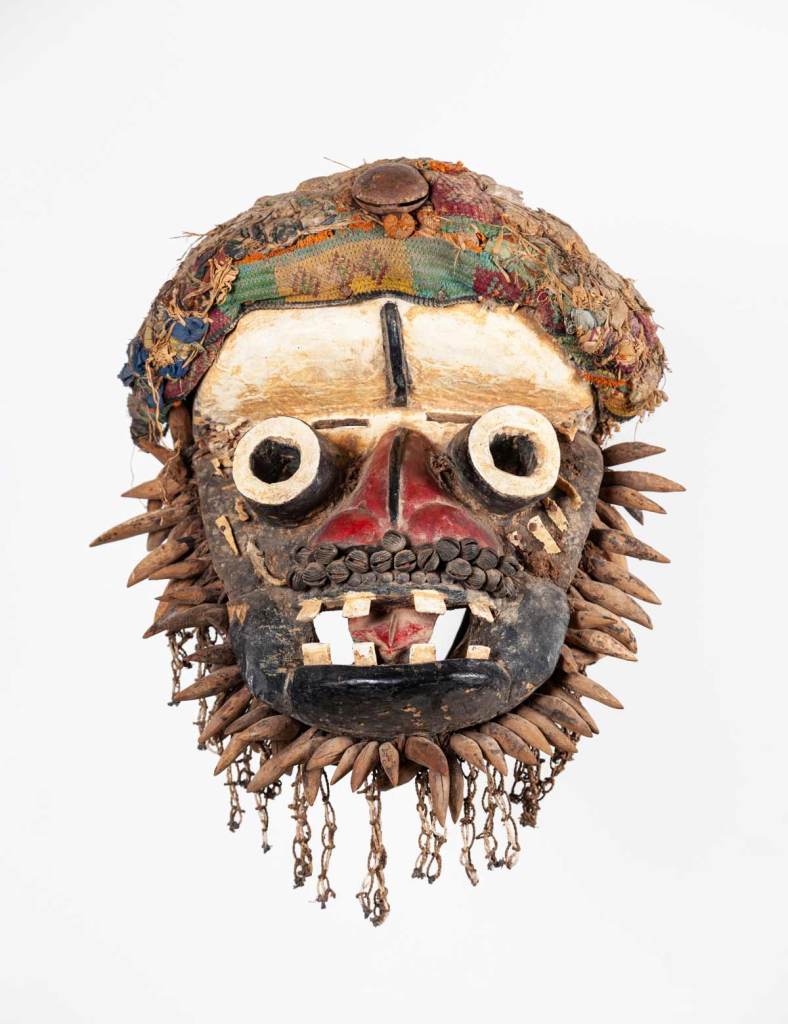
In Côte d’Ivoire, the We are known for their terrifying masks. These masks are spiritual entities, which makes them an aesthetics of presence, not beauty. In their culture, you don’t say you’ve created a mask. It’s a spirit. The masks are entities, so they can’t be created. So in the Wê culture, one of the aesthetics that most impressed modern Western artists, like the Cubists, is that the masks they created weren’t bouquets of flowers. They were sometimes systems of terror. There was a concept they were trying to express. In my view, this non-aesthetic of beauty or smoothness but of presence, of manifestation, is a way to reconceptualize the idea of the contemporary. That’s why Africa must create its own version of the contemporary, and this is already happening. Take artists like Jems Koko Bi, Soly Cissé, or Romuald Hazoumé; they are doing contemporary art without copying anyone. What Romuald Hazoumé does is highly contemporary and connected to the history of his country, Benin. The jerrycans he makes are entire concepts about Benin’s political economy because they’re fuel containers from Nigeria that have shaped Benin’s economy. Benin partially thrives on its close ties with Nigeria. Moreover, these are people with a culture of metalwork, so he plays with all of that. Today, to me, he’s one of Africa’s greatest artists. Abdoulaye Konaté also has a remarkable career.

Mixed media, 400 x 600 x 600 cm. October Gallery.
What trends and evolutions do you foresee for African contemporary art in the coming years?
It’s difficult to anticipate because history is full of emergences and surprises; it’s not a straight line. In Côte d’Ivoire, there’s a strong investment in urban art. Neighbors and friends have become sources of inspiration for artists. This proximity doesn’t only show consensual attitudes; there’s flair in the writings and expressions of young people in the neighborhoods. Will it last? I can’t say. But in the past ten years, this kind of expression has emerged. However, I regret that sculpture is being neglected, partly because of the market, as sculptures are harder to sell than paintings. On the other hand, photography is thriving despite the dominance of digital.
The Dakar Biennale takes place from November 7 to December 7, 2024. As someone who was the general curator in 2006, how important is it in the art world?
It’s more indispensable than ever. I always make an effort to attend because these are structuring events. It’s a meeting place for artists, but also for all industry players. Gallery and museum directors will be there. The great strength of the Dakar Biennale, beyond the official exhibition, is the presence of the parallel events known as the OFFs.
 Bridging Africa and The World Through Contemporary Art
Leave a comment