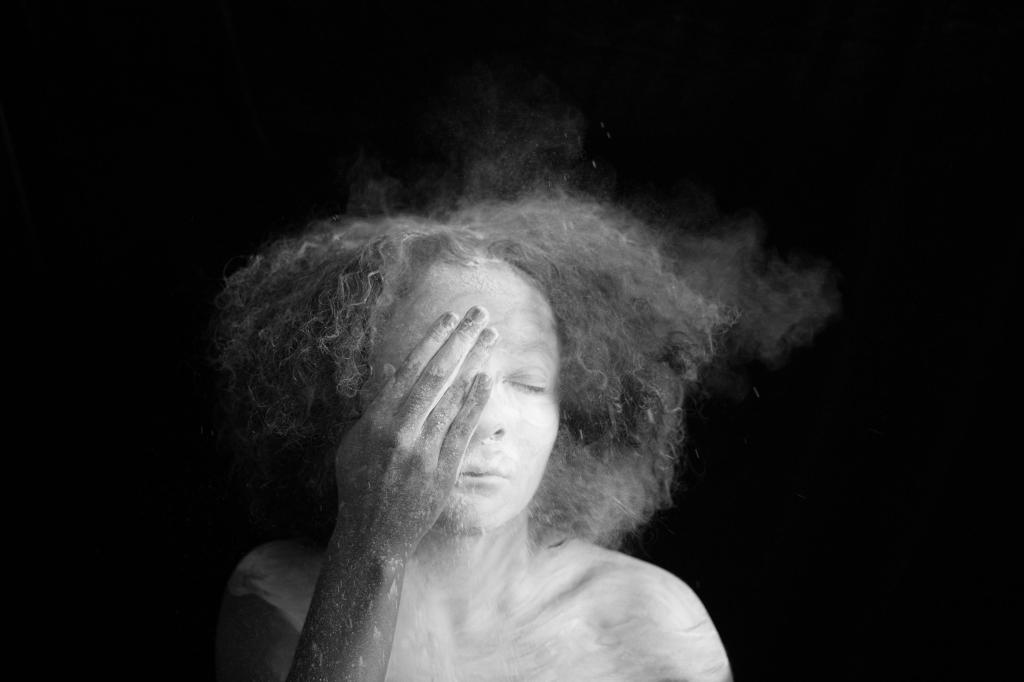

To navigate between worlds — this might be the most fitting way to describe the practice of Agnes Essonti Luque, born to a Spanish mother and a Cameroonian father, whose work, both intimate and political, transcends disciplinary, geographic, and symbolic boundaries. At once a performer, photographer, curator, and cook, she draws on ancestral memory, diasporic knowledge, and personal narratives to create works that serve as spaces of encounter and reflection. Rejecting fixed labels, her art unfolds through careful research where listening, reading, and conversation always precede the final form. She draws on the multiple languages she speaks — from Pidgin to Camfranglais, French to Spanish — to construct an artistic language that is deeply embodied. Inspired by intellectual figures such as Frantz Fanon and Cheikh Anta Diop, and grounded in decolonial thought, she approaches each work as a space of transformation. In this interview with DakArtNews in Barcelona, she reflects on the foundations of her approach: the guiding figures that shape her, the role of healing, the power of food as gesture and story, and the complexities of existing between multiple territories. Her voice is lucid, generous, and visionary — illuminating the stakes of an art rooted in the living.
——————————————————————————–

Your work weaves between performance, photography, installation, cooking, and ritual. How do you choose the medium that best fits what you want to express?
I would say my practice is really research-based. I always start by reading, listening to music, talking to people. The medium actually comes through that research. When I’m starting to think about an idea, I never know if it’s going to be photography or performance. It takes shape with time.
So you start with the idea first, and then the medium follows?
Exactly. The medium is not the first concern — it’s shaped by what I want to say.
Ancestral memory and Afro-diasporic identity are central in your practice. What nourishes your imagination around these themes?
My own experience. Growing up, I was very connected to my heritage and family. I took part in communal gatherings and rituals. That’s always been very present in my life and work.
Which artistic, intellectual, or spiritual figures have inspired your practice?
I’m drawn to decolonial theories and love how Frantz Fanon connects activism, psychiatry, and theory. I also admire Thomas Sankara, Cheikh Anta Diop, Oyèrónké Oyèwùmi, Osun (the Orisa), and Cameroonian independence leaders like Um Nyobé.
Why those figures specifically?
My father raised me to be politically conscious. He’s socialist. And growing up, he immersed me in that thinking. That has definitely shaped my views and my work, especially in creating community-based performances.
And artistically, any references?
Yes, I really admire Zina Saro-Wiwa — she works with food and performance, which resonates with me. I’m always looking at what other artists are doing.
You often play with languages — Camfranglais, Pidgin, Spanish, French… What role does language play in your artistic work?
Language helps us understand the world in multiple ways. I grew up speaking Pidgin with my dad. My grandmother only spoke Pidgin. It’s a symbol of hybridity for me — and that hybridity is in my DNA. There’s a great book I recommend: Pidginization as Curatorial Method by Bonaventure Soh Bejeng Ndikung.
So is your art and curating about hybridity too?
Yes. I’ve been working to deconstruct the idea of “purity.” Everything is made of many things — memories, identities. My work embraces that.
Gastronomy is also recurring in your work. What does “nourishing” mean beyond eating?
I had a weekly cooking project for three years in Barcelona called Nourishing Is More Than Eating. It’s about labor, ingredients, the act of sharing. It’s holistic. As artists, we should care about what we consume and why.
What is art for you?
Art is self-expression, but it doesn’t need to be aesthetic. It must be transformative — that’s its power.
What do you seek to transform through art?
I used to focus on racism and oppression. Then I took a break and realized I wanted to talk about my essence — not always in reaction to racism, but in affirmation of who I am. Now, my work isn’t just responding — it’s building new paradigms.
Is beauty important in your work?
It is, especially as someone trained in photography. I have a curated gaze. I want things to be beautiful, but full of meaning.
What is beauty to you?
That’s hard to define. It’s a feeling. When something moves me deeply, I know it’s beautiful.

You’ve exhibited in Dakar’s Off-Biennale, in museums, and in Cameroon. How do you navigate African and European contexts?
I try to stay true to myself. We all carry contradictions. I don’t create “for” a specific context — I just try to share my stories authentically.
How has your dual heritage shaped your worldview and creative process?
It’s made me value multiplicity and richness. But it also means learning how to navigate different contexts and knowing what’s appropriate where.
Do you see yourself as a bridge?
Yes, especially between Spain and Africa. Spain is closer to Africa than many think — places like Ceuta and Melilla are in Africa. Spain is so linked to Africa in many ways and my work sometimes rescues those connections to highlight the presence of afrodescendent people in the country, be it in the past and also present times.
You say “Africa,” not just “Cameroon.”
Yes, because national borders like “Cameroon” are colonial constructs. I work in Cameroon, but I’m interested in connecting across the continent.

You were the artistic director of Yaoundé PhotoFest this year (12–15 June 2025). Can you tell us about this festival?
We launched it two years ago to revive the energy of the earlier YaPhoto festival. This year’s theme was New Dreams, New Imaginaries. It’s about rethinking photography — from a colonial tool to a liberating one. We had an open call, invited artists, and showed historical Cameroonian photographers. There were workshops, talks, and masterclasses.
Why are events like this important?
We don’t have many photography festivals in Cameroon. Photography is still so powerful — whether to document, imagine, or experiment with AI.
In Freiburg, Germany, for the biennale taking place there, you’re showing a piece called A Journey — can you tell us about it?
It’s an installation of about 10–12 images, originally commissioned by the Anthropology Museum of Barcelona for an exhibition called Re-enchantments. We were invited to respond to objects from their collection. I chose a byeri statue from the Fang-beti culture (from Equatorial Guinea), which represents an ancestor figure used in rituals — offerings, divination, harvests… I collaborated with Ibrahima Seydi, a Senegalese sculptor based in Barcelona. I asked him to sculpt a new ancestor figure based on the stories of my own lineage — my aunt, my great-grandmother, whose name I share.
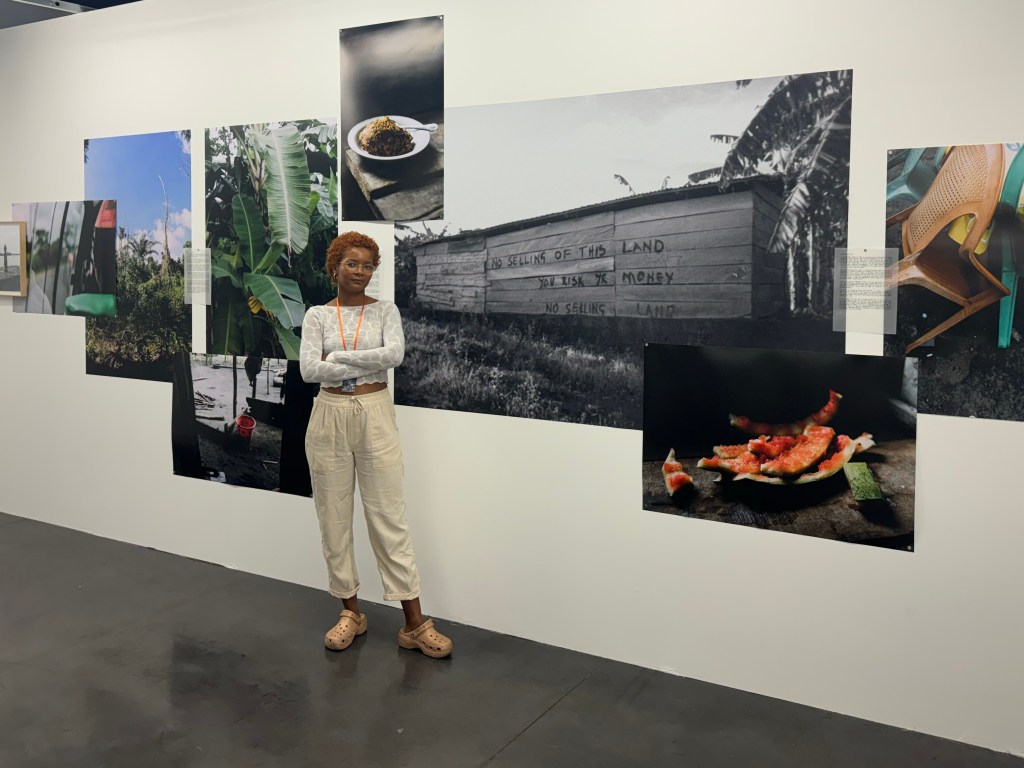
I took that new statue to Cameroon as a metaphorical restitution. I wanted to explore whether this was a return or a first journey, and what energies these objects carry when removed from their spiritual context. It was recently acquired by Museo Reina Sofía in Madrid for their permanent collection. Also, the National Anthropology Museum in Madrid invited me to do a solo exhibition next February, expanding on the restitution research. They’re very open to letting me engage directly with the objects, which is crucial for me.
What dreams or artistic projects are currently driving you? Where do you want to take your work?
I want to work more with video, learn about materials, and create more physical objects. Right now, I’m exploring two new research paths: one around Frantz Fanon and his link with the Catalan psychiatrist Francesc Tosquelles. The other is food-based — I’m creating a kind of oracle card deck using ancestral ingredients to give spiritual readings through food, to help people heal.
You often invoke ritual, healing, and spiritual memory. What are you trying to heal through your art?
That’s a deep one… I’m not sure I have the answer yet. But it’s a question I’ll carry with me.
Read also
Africa’s Artists Deserve a Bigger Stage. Basel Is Just the Start
In Southern Senegal, a Potter Preserves Culture One Sculpture at a Time
 Bridging Africa and The World Through Contemporary Art
Leave a comment