

Romuald Hazoumè’s voice—blunt, defiant, uncompromising—carries the same raw force as his iconic masks made from jerrycans. These sculptures, fashioned from discarded petrol containers, evoke Benin’s shadow economy of fuel smuggling with Nigeria, where many risk their lives transporting volatile loads on modified motorcycles for hidden profiteers. For decades, Hazoumè has transformed waste into works that fuse the ancestral power of Vodun with searing critiques of global excess. “We are all bidons,” he proclaims, a stark metaphor for humanity’s attachment to hollow things, from consumerism to modern slavery’s lingering chains. In an exclusive interview with DakArtNews, Hazoumè reveals the “bomb” of creativity that drives him, his unapologetic embrace of Beninese culture, and why his art remains a clarion call to confront history’s unhealed wounds in a world that discards too easily.

You have a long artistic career behind you. To begin, could you tell us about your early days? How did this journey really start for you?
From primary school, I was drawing everywhere: my notebooks were full of sketches, and my homework was always left unfinished. One day, my teacher punished me so hard… then suddenly thought, “Why am I punishing this kid?” In the end, he bought me paints. I was in fourth grade. But that didn’t mean I was going to become an artist. Then came the Kaleta. You know, our Yoruba end-of-year rites: a mask in the center, someone playing music, two or three singing, and there’s always a kid with the hands to make the mask. That was me.
I began making masks for the play from whatever I could find: sugar cartons, jerrycans, anything. People watched, but I never thought of it as art. Everything disappeared after the Kaleta, nothing was kept. In high school, I continued tinkering with a man named Joseph Kpobly, a cinema decorator who guided me a little. But my father wanted me to be a customs officer, while I dreamed of being a doctor! You can imagine the clash…
Then, in the 1980s, a German friend, Martin Baumgart, invited me to a masked ball. I made a mask from a jerrycan — not my first one, far from it. At that ball, someone told me, “This is interesting, you should keep doing this and think about exhibiting.” So I continued to work on my masks. But no one wanted to exhibit them. I went several times to the French Institute, and each time they told me, “Go do painting and come back.” I thought, “No, I won’t paint, and I won’t come back.” I waited for my chance, for years. Then, when Yves Bourguignon arrived at the French Institute in Cotonou, I thought, “Why not try with this new director?” I showed him a mask… and he loved it! “My boy, we’re going to make a sensation with this,” he said. That was my first official exhibition. And only later, around 1988–1989, during the Magiciens de la Terre period, André Magnin came through the cultural center, discovered my work… and that’s when my professional career truly began. I had never dreamed of being an artist. Never. I wanted to be a surgeon.
You grew up in a culture deeply marked by Vodun and local traditions, like making masks, yet Benin was colonized by France and influenced by Western culture. Do you feel a tension between these two influences?
You can hear about colonization, but nothing can ever erase our culture, our religion. It’s deeply rooted in people. Even if you try to “format” them, that inner strength and the respectful fear inspired by the religion remain. Our cult is powerful. It’s not those who speak on TV or at big ceremonies who really hold power. No. Back home, we say: when you know, you close your big mouth. We, who are guardians of this culture, are proud of it. We don’t hide behind a “tropical Catholic” or a “tropical Muslim” label.
My parents made me Catholic, knowing they themselves were not true believers—they just wanted to conform to the norms of the time. Even the way I dress, the way I behave outside, everything shows who I am. I breathe my culture. I speak French, but I also speak several local languages. At home, culture is deeply anchored. On my mother’s side, there’s Ogu, the god of iron, because she comes from the blacksmith caste. On my father’s side, it’s very mixed, with several Voduns. There is no conflict between my culture and others. For me, I prefer to call on my ancestors when I have a problem, rather than turning to saints I do not know. It’s exactly the same principle for them: they invoke their ancestors to exist. Calling ours costs much less and is far more effective than mixing with a culture that is not ours. So no, for me, there is no conflict.
“I didn’t become an artist; I am an artist.
You said that you didn’t really know that what you were doing was art. Today, as an internationally recognized artist, how would you define art?
For me, art is above all about giving people emotion. It’s about sharing something that intrigues, that questions, that can take someone from happiness to sadness, that can make them experience all stages of life. When you think about the emotion you’ve given people, how you’ve refreshed their memory, the shock they felt—when you present it in a room as just a juxtaposition of two small objects that say everything, less talkative but full of power—that’s when you’ve succeeded.

A creator, an artist, is close to God in the sense that he creates something, but he is not God. He will never be God. He creates with his mind and his hands, and what he creates can provoke very strong emotions: it can take you from positive to negative, or negative to positive. It can shock you, upset you, leave a mark. It’s a bit like a cook. No one would say what they make isn’t art. A mafé or a Thiéboudienne can bring you back to your grandmother. You remember your childhood, the particular taste, the rice slightly burnt at the bottom of the pot—the stories, the memories with your mother or grandmother. That, too, is art: a taste, an image, an object that touches, that evokes a memory or feeling. Yes, art is above all about sharing emotion, provoking a memory, or creating a feeling.
Why have you chosen to devote your life entirely to art?
It’s not just a voluntary choice; it’s something that has to come out—it’s like a bomb. If it doesn’t, it explodes. I had no choice. I didn’t become an artist; I am an artist. I didn’t learn it at school; it’s in me. Every time I have to create something, if I don’t do it properly… it becomes unbearable. I become unpleasant, melancholic, depressed, anxious. It has to come out, I have no choice.
I don’t work every day. I hardly ever paint. There’s a long gestation period, months where everything bubbles inside me, and then suddenly… in three or four days, sometimes a whole month, I produce everything. You can’t stop me. I’ve produced 30 canvases in three days, and people can’t believe it. It’s the same for my masks, my sculptures, my pieces… once the momentum hits, I can’t stop. I can’t say, “I won’t do it.” It’s something that belongs to me and must be released, otherwise there’s a deep malaise.
You earlier mentioned memory, which brings to mind one of your most emblematic works, La Bouche du Roi, begun in the early 1990s. You transformed an 18th-century slave ship engraving into a contemporary installation made of jerrycan masks. Twenty years later, what does this work mean to you? Is it a monument of memory, a political weapon, or a prophecy that remains relevant?
It’s a prophecy that remains relevant. When people say slavery was abolished… in reality, it was never completely ended. A certain type of slavery was abolished: Africans are no longer forcibly taken to work on American plantations. But Africans themselves are enslaved today. For fifty years, we have seen a new form of slavery, and the world turns a blind eye. If you go to Kuwait, it’s African girls—they have their passports taken away, they disappear, they can’t go out… and no one sees anything. Soon, many jobs will be replaced by artificial intelligence. Humans are gradually being sidelined. They are made dependent, forced to accept anything just to survive.

Sound and mixed media (plastic, glass, pearls, tobacco, fabrics, mirrors, cowries and calabashes), variable dimensions (min 12 x 10 m). © Romuald Hazoumè. Collection: The Trustees of the British Museum. Courtesy the Artist and October Gallery, London. Photo: George Hixson.
Regarding the piece itself, can you describe it?
Everything is built with jerrycans. Beneath the jerrycans, there are speakers emitting sounds. Small domes contain vials with scents on cotton: urine, excrement, sweat, dried fish, rotten fish, the iodine smell of the sea… all on the left. On the right, pleasant scents: coffee, cumin, clove, cacao… and sounds broadcasting the original African names of the slaves—Yoruba, Fon, Ouéllé…—which later became Wilson, Ferguson, David, taking the names of their masters. I wanted to remind people of all these lost African names with their meanings.
I gathered forty actors in a studio near Cotonou. I put them under stress, as if they had been captured, speaking only our African languages, not French or English. They had to sing, invoke their gods, express their fears. Some shouted their despair, others responded by singing or praying. I exhibited this piece in major museums like the Rijksmuseum in the Netherlands and in the U.S., and everywhere it had a profound impact.
La Bouche du Roi has also been exhibited at the British Museum and the Quai Branly, two institutions central to debates about the restitution of African artworks. How do you perceive this irony—denouncing slavery and power dynamics within the very walls of these museums?
You can’t consider the people working in these museums as slave traders. They are simply heirs—and fortunately, they preserved these objects. Compare that to Bas-Congo today: many pieces and fetishes in African museums haven’t been protected, and Africans themselves haven’t safeguarded them.
For those of us living in Africa, there is a constant need for awareness, to remind people where we come from and what happened. If museums like the British Museum or the Quai Branly display this piece, it’s because curators understood the importance of giving space to works that are both critical and memorial, so everyone can remember. And it can reach thousands of people, change perspectives, shift mindsets. We say: “We will not forget this history,” because it always comes back and remains relevant, even if it was long erased. We must stay vigilant.
“What I do is political, but without being a politician.
If you were to reinvent La Bouche du Roi today, in the context of migration and shipwrecks in the Mediterranean, what would you change?
I wouldn’t remake La Bouche du Roi, but I created a piece titled No Return, shown at the Quai Branly, made with 6,000 flip-flops arranged in a spiral. This spiral, for the Kassai, Mbutwa, Mangbetu, Loba, Boussi, or Fon, has various meanings: the infinitely small, the infinitely large, or the first movement, the symbol of the beginning.
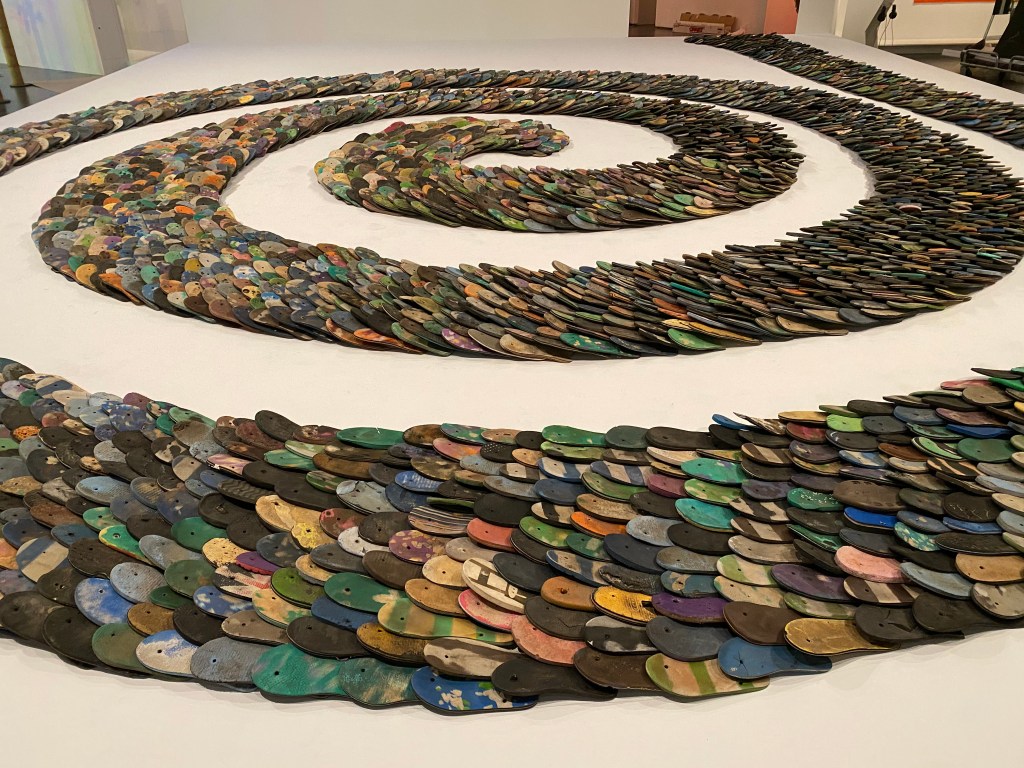
This symbol cannot be forgotten. It recalls both past slavery, which lasted centuries, and today’s voluntary slavery. The Senegalese historian and former rector of Cheikh Anta Diop University in Dakar, Ibrahima Thioub, once told me: “Romuald, if we put a boat in Dakar marked ‘voluntary departure,’ it would be full.” It’s true: many think their happiness lies in the West, because in Africa, nothing has been done for them.
So, instead of jerrycans, I used flip-flops carried by migrants. They don’t sink in the sea—they tie them to their belts to avoid losing them, and they are also used in the desert. I aligned these 6,000 flip-flops like a serpent, a symbol of life and movement, to speak about immigration and remind those who reject migrants that without migration, they wouldn’t be here.
Slavery, the slave trade, and North-South relations are present in your work. Do you think art has a direct political role, or is it just a metaphor?
Art has a direct political role, but you must not get involved with politicians. In 2015, at the Zinsou Foundation in Cotonou, I did an exhibition where I analyzed the political situation through my work. I created a mask called Pantalonade, placed at the entrance, marked “Stop.” This title and piece pointed to who would become president, Patrice Talon.

I never explained it publicly, but many people understood. And it was Talon himself who explained the piece to the public, in his own words, not mine. I didn’t contradict his interpretation because art is about giving emotion, and everyone sees what they want.
You are navigating a double front: on one side, Western audiences; on the other, the political elite in your country or Africa more broadly. How do you manage that?
I have no pity for anyone. My art comes from me, and if it hurts Westerners, Africans, or my own people, so be it. It’s necessary; it’s my role. I’ve done portraits of “transhumants,” people who switch sides before elections, leaving the ruling party for the opposition when they sense the wind turning. What I do is political, but without being a politician. It must come out, no matter who it affects.
“We are all like jerrycans, attached to things of no importance.
You once said that you “send back to the West its own waste” with your masks made from used jerrycans. Is this still the approach behind your practice of recycling objects?
It’s not just about the West; it’s for the whole world. The West accepts provocation with humor, but my own people often don’t. I speak first to my own community. If they refuse to listen, I use the West as a pretext.
In the past, we ate from biodegradable leaves, and tomatoes grew where we threw them. Today, we use plastic, and when we discard it, nothing grows. This should make us reflect. If we Africans do not protect our nature, it’s a problem. This gesture with the masks is artistic, political, and spiritual. Our ancestors created sacred forests to preserve plants and animals for the survival of communities. If we cut everything to plant genetically modified tomatoes sent by the West, which we cannot replant, we destroy our culture.
How do your jerrycan masks comment on the dangers and social realities of fuel trafficking in contemporary Benin?
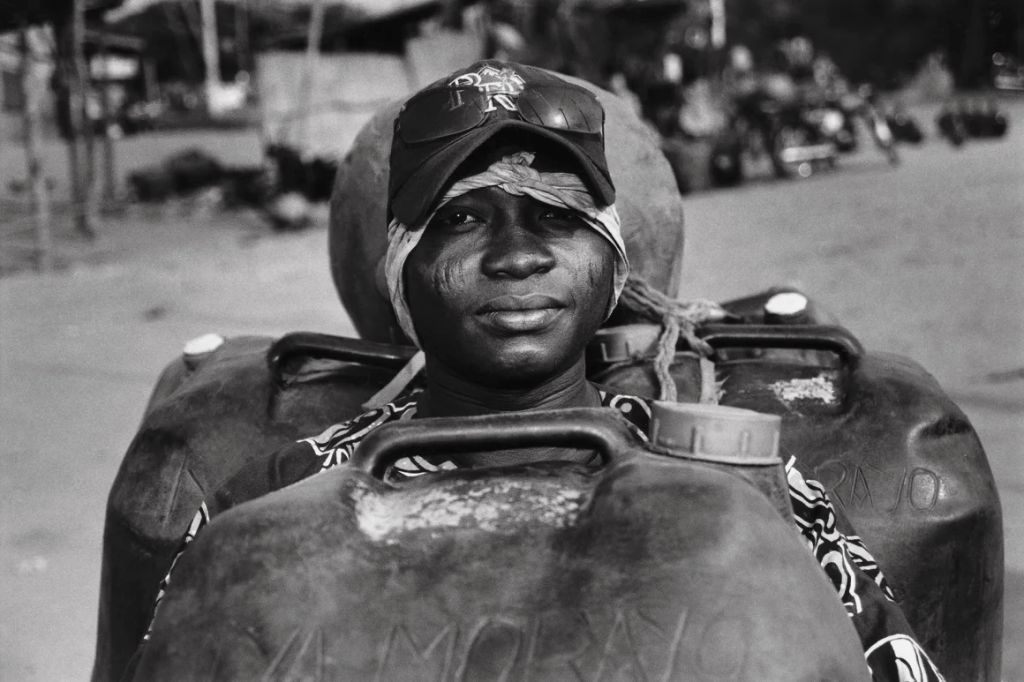
Whoever transports 520 or 1,000 liters of fuel on a modified scooter—do you think the fuel belongs to them? No. They risk exploding, but the real owners are safe. Often, they are handicapped people, former beggars who refuse to beg and ride these rolling bombs. They sit on scooters with a tank in the middle, barely any room for feet. It’s a real bomb. These jerrycans are the face of contemporary Africa, but also of the entire world. We are all like jerrycans, attached to things of no importance, to consumerism, instead of being resolutely African. My work uses humor to make the bitter pill easier to swallow.
You have created hundreds of jerrycan masks. Can this vocabulary still be reinvented, or is it infinite?
Not hundreds—it’s rarer, and it’s becoming harder to create. The one I made recently at Gagosian in Athens carries the same name as the exhibition: Les fleurs du mâle. I’m not talking about Baudelaire, but about Poutine, Zelensky, Trump, Netanyahu—I address the violators, all that hurts me. For this piece, I used a jerrycan collected in Dakar’s dump and multicolored fishing nets to make flowers on a wounded, burned side.

There is a lot of talk about an “African art boom” on the global market. Do you think this new visibility truly changes the position of African artists, or is it just a passing trend?
Only the true artists will endure because there is a lot of mediocrity. Some take advantage of the trend, but few truly evoke emotion. In Benin, for example, there’s talk of supporting artists, but it’s often managed by people who are incompetent and unfamiliar with the field. Before opening a museum or gallery, the state must create an environment for it to thrive. What does that environment look like? In Africa, the wealthy prefer to buy a Rolls-Royce rather than art, unlike wealthy collectors elsewhere who know that art is a safe investment. For collectors to emerge, there must be incentives, like tax deductions for art purchases. Without that, galleries open and close because of a lack of real collectors. In Lagos, it works somewhat. But the collectors we have often buy decorative or mediocre works.
They need to buy the best, like Amoako Boafo or Pascale Marthine Tayou, so prices rise and everyone benefits. If Africans don’t buy African artists, it won’t go anywhere. Western buyers purchase the best, but there are very few truly exceptional artists. In Africa, there is an elite, rich people who could invest, but they don’t. They travel in ultimate-class flights. The wealthy buy Rolls-Royces, Maybachs, Mercedes, some even have showrooms at home. But they don’t buy art, because in their minds, it’s “Voodoo fetish,” seen as evil due to evangelical or Catholic mentalities. Their cars, their houses—all that will disappear one day. But if they create a museum, their name will live forever through a foundation sustained by their fortune. They just don’t realize it.
“Eternal Rebel”
When was the last time a work of art—not your own—deeply moved you?
One Stone Head by the African American artist David Hammons left a profound impression on me. I saw it in New York. It’s a small stone ball with a tuft of real hair—a head, simple but powerful. In just two elements, it says everything, it takes you on a journey, it lets you imagine any face. It’s very powerful, very strong, the kind of work only great artists know how to make.
What advice would you give to young artists?
You have to give yourself 100 percent to what you do. If you give everything, you have every chance of succeeding. But if you think 75 percent about money and only 25 percent about the work, you’ve already failed. Many artists are hungry, and that hunger makes them lose their dignity, their strength. Yet it’s possible to be hungry and still remain dignified, to be fully invested in your art. Thinking about money leads to ruin. Thinking about the work is the path to success.
Where do you truly feel at home—in the studio, in Vodun, in the street, or in the museum?
With my family, where I am rooted in reality. Vodun propels me into nature. The studio is where I dream, where I see new things. The street is competition, with artists who often ignore each other. But when I am with my family, I come back down to earth.
When you see your works in major Western museums, do you feel more pride or suspicion?
Pride—because no one is a prophet in their own land. I wish it were the other way around, but that’s how it is.
You often work with recycled materials. But is there one thing in your life you would never accept recycling?
Money.
In ten years, Romuald Hazoumè—living legend, eternal rebel, or weary sage?
An eternal rebel. There must always be someone to bring people back to the right path, without compromise. It’s necessary.
 Bridging Africa and The World Through Contemporary Art
Leave a comment