

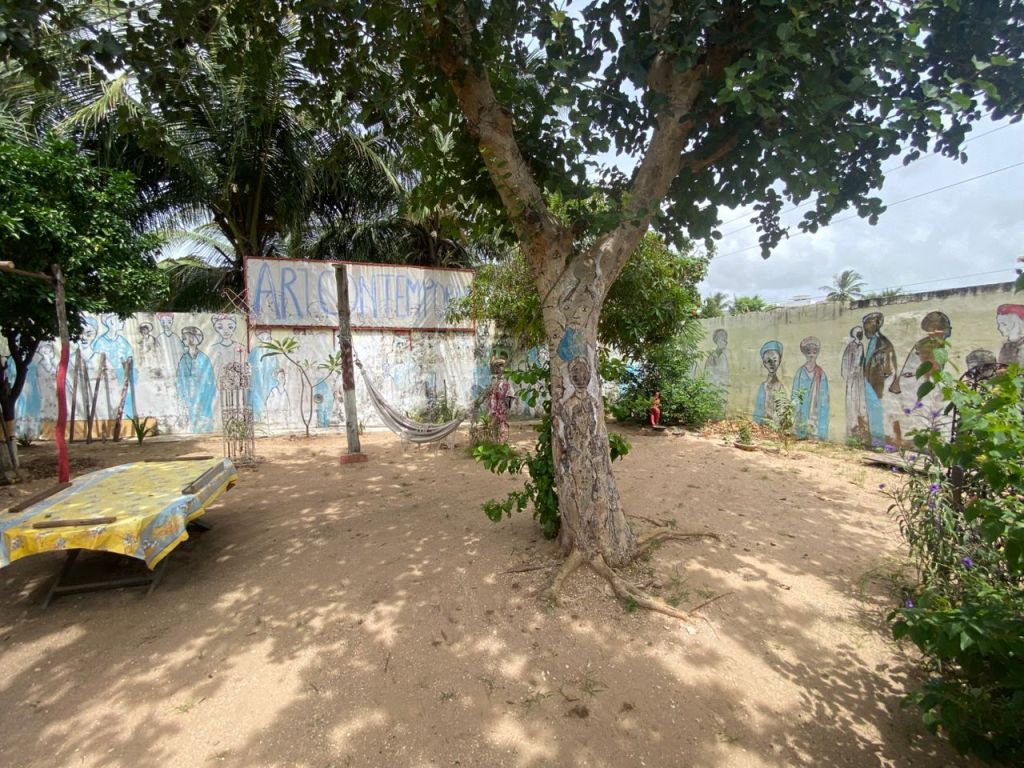
Born in Linguère, in northeastern Senegal, where the rhythms of rural life left no room for canvas or paint, Babacar Ndiaye grew up without an artistic tradition to guide him. His early career unfolded in Senegal’s tourism sector, , a role that first carried him abroad and honed his sense of cultural ambassadorship. Known as Keemetaane—a Wolof term meaning “rare or mysterious phenomenon,” a name others gave him for his singular talent—he is a self-taught artist who journeyed from Paris, where he arrived in 1992, to a sunlit art space in Saly, a coastal resort on the Petite Côte south of Dakar.
“What I do is rare; that’s what people told me,” Keemetaane, 62, said in an interview with DakArtNews. It was in Paris, far from his Senegalese roots, that he first picked up a paintbrush—an act of serendipity that unlocked a lifetime of inner visions. “I saw things I didn’t understand,” he recalled. “Painting let me show them.” A devout Muslim, Keemetaane crafts a spiritual practice that transforms those visions into vivid depictions of crowds—“peoples” embodying Senegal, Africa, and beyond. His works, painted on prayer rugs, wooden panels, and even wine barrels, forge a dialogue between African heritage and Western influences. In Saly, where his visions flow effortlessly compared to the strained effort required in Europe, these teeming figures reflect a collective humanity. Once a model in Parisian art schools, draped in traditional garments he crafted himself, Keemetaane now exhibits paintings that transcend mere representation, alive with the immediacy of his homeland’s light. His art, a spiritual and cultural bridge, testifies to a mission of illuminating shared human experiences.

How did you artistic journey start ?
In Senegal, I worked in tourism, in sound and light. That gave me opportunities to travel. In Europe, I also worked in hotels and was in constant contact with foreign cultures. I realized that every time I traveled, I wasn’t only representing myself but also Senegal and Africa. Working for tour operators, I realized I was selling my country through someone else. I wanted to find my own images. I searched through music and writing until I finally discovered painting—the medium that allowed me to bring back my visions. When I left Senegal, I had no idea of what painting was, but there I discovered brushes and paint. I didn’t take lessons—I just started showing what I had always seen in my mind. Since I was young, I told my parents and siblings, “I see things.” They thought I wasn’t normal. I’m someone who had visions but couldn’t express them—until I discovered painting in Europe. I stumbled into painting. One day, I felt compelled to pick up a brush and translate the visions I’d carried since childhood. But as I developed my practice, schools of applied arts and fine arts in Paris began inviting me to share how I worked. That was my first contact with academia. Later, I also started cutting fabric and creating outfits. It became a way to present myself as a traditional model, to connect with that artistic environment. It gave me a signature, a link between my painting and my tradition. At first, I didn’t fully understand why I did it—but it helped me earn a living. Students would draw me in schools of applied and classical arts. They recruited me as a model for form, drapery, and color studies.
When you started, did you have an idea of what you wanted to represent through your paintings?
Because it came from internal visions, I never said, “I want to represent this or that.” I simply showed what I was within me, without changing it. If the proportions weren’t “right,” that didn’t matter. My only concern was to make visible what was inside me and let others to see it with their own gaze.
You talking about having “visions”, would you say your approach is spiritual?
Yes, many people tell me that, and it’s true. I’m a believer. What I feel when I paint is the same as when I pray or meditate—it’s the same sensation. My work brings together intellectual, artistic, and spiritual dimensions. I often speak with religious persons—we’re using different paths, but often speaking the same language. I’m Muslim, like most Senegalese. But painting brought me closer to my faith. It helped me understand the relationship between man and God. In painting, silence and distance are important—and I realized those same qualities are essential in religion. You know, art came to me. In my family, there are no artists. In my village, there are no artists. Even here in Senegal, an artist isn’t well-regarded by the majority. They’re seen as someone who’s either not normal or living in debauchery, generally speaking. But I had to develop my art it far from my homeland. That, too, has a spiritual significance.
I make art to exist.


What is actually art for you?
For me, art is our interior. It’s what we all share but can’t see, like breath, like the soul—it nourishes us, even if we can’t touch it. Only God can create life, but He gives us a breath, and within that breath, tools to create. Art is that door He opens in us.
Why do you make art?
That’s a good question. Why do I make art? To exist. I make art to exist. It’s my existence. All that nourishes me right now is art.
Is beauty something you take into account when you create?
Beauty doesn’t exist. We’re in the realm of emotion. Beauty is in the academy. When you seek beauty, emotion isn’t there. What I do isn’t beauty—it’s what we feel. So, it’s emotion. I’m not in beauty. Otherwise, it’s not beautiful. We go through emotion to cultivate beauty. It’s not beauty that brings emotion. We enter emotion, and then it’s beautiful. Beauty holds back. Emotion is open. Once it’s open, we can find portions of beauty, nuances, in any case. This color is beautiful. This combination is beautiful. But there has to be the foundation, which is emotion.
So, I don’t make art for beauty. It’s a mission. It’s an existence. And once you have that, once God has given you those tools that allow you to express, He takes back all the other tools. So, your life is tied to it. Your fulfillment is tied to it. Your intelligence, your activities—everything is tied to it. So, there’s no more suffering. There’s only beauty. There’s only contentment. Even if people don’t see it. Even if people see you struggling. But you, you’re immersed in beauty.
You’re self-taught, but which artists inspired you?
I think of Van Gogh. Picasso. When I look at their paintings, it’s as if we were there together. And I also understand how they made the painting, from start to finish, and what they felt while making it.


Do you have any African references?
African references, not many, because we’re already here. I think I find myself in all Africans.
At what point did you decide to return to Senegal?
I was doing well in Europe. I had a studio in Europe. I have a family in Europe, children in Europe. I exhibited all over Europe. In France, I participated in salons. But at a certain point, I felt this need. I don’t know. I think it was around 2012 when I started finishing this house. I began coming here from time to time. Before the house, I would come and bring some paint to work. Because I also wanted to know what light I would feel if I painted in Senegal. Before, I had never done it. I started in Europe. From time to time, I brought paint. But something was missing. I went back. But when I bought the house and started to understand this house and myself, that’s when the decision began. Then I started coming here often. And then, it started to feel a bit restrictive in Europe, for me. To express myself, I needed to be here. It’s like… the light changed. My work is much harder to make in Europe than here.
In what sense “harder”?
Because of the concentration, because of the vision. In Europe, I had to focus to find myself, to bring my country, my origins, into my studio. And that’s work. To be in the flow, to paint, I had to put together an ensemble. Gather all the elements to create. You need the studio, the sounds, the approach, the time—you have to create it. But here, it’s already there.
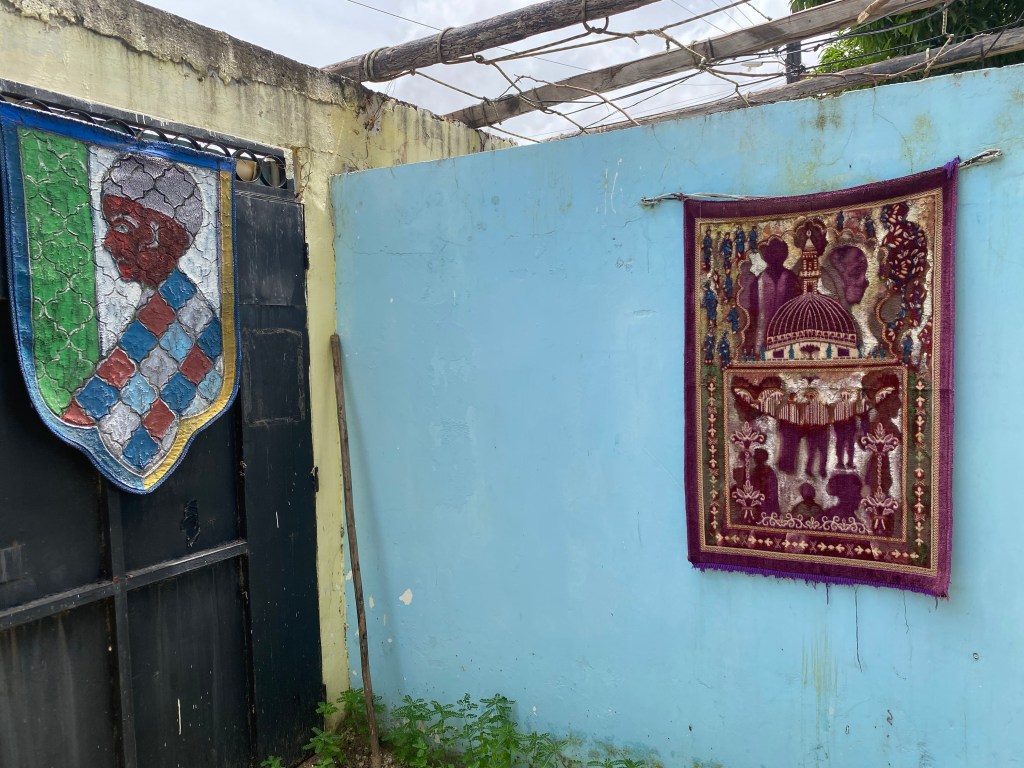
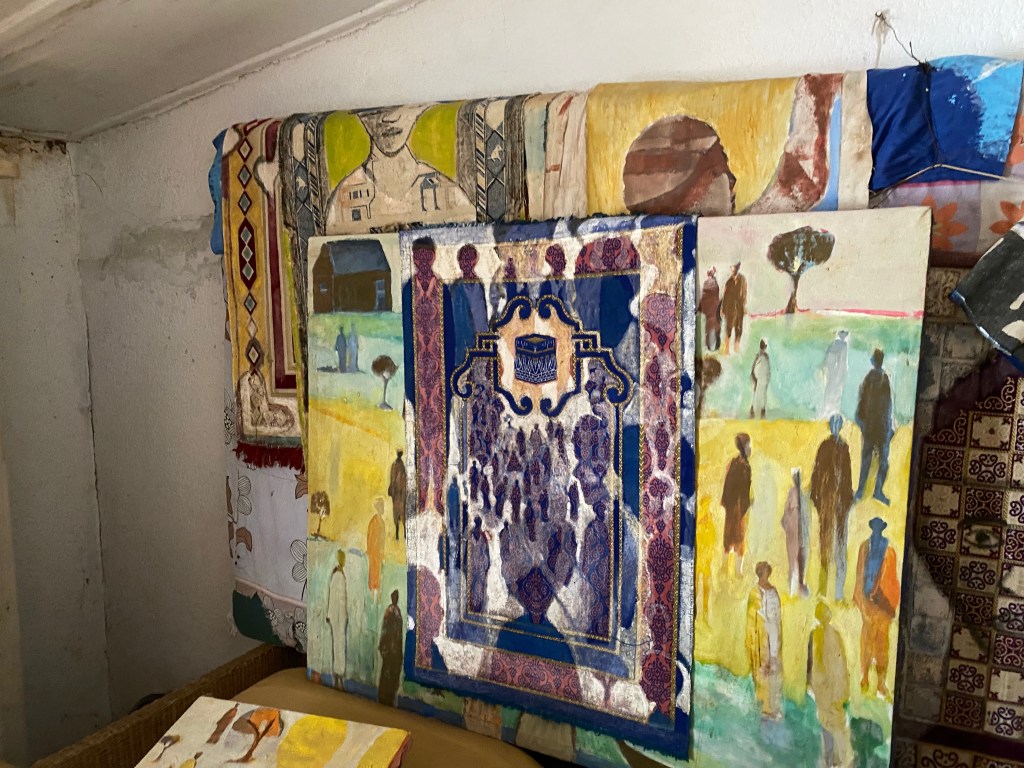
Let’s talk about your artistic practice and process. I see rugs on which you paint. I also see wood. There’s a diversity of supports in which you paint an infinity of characters.
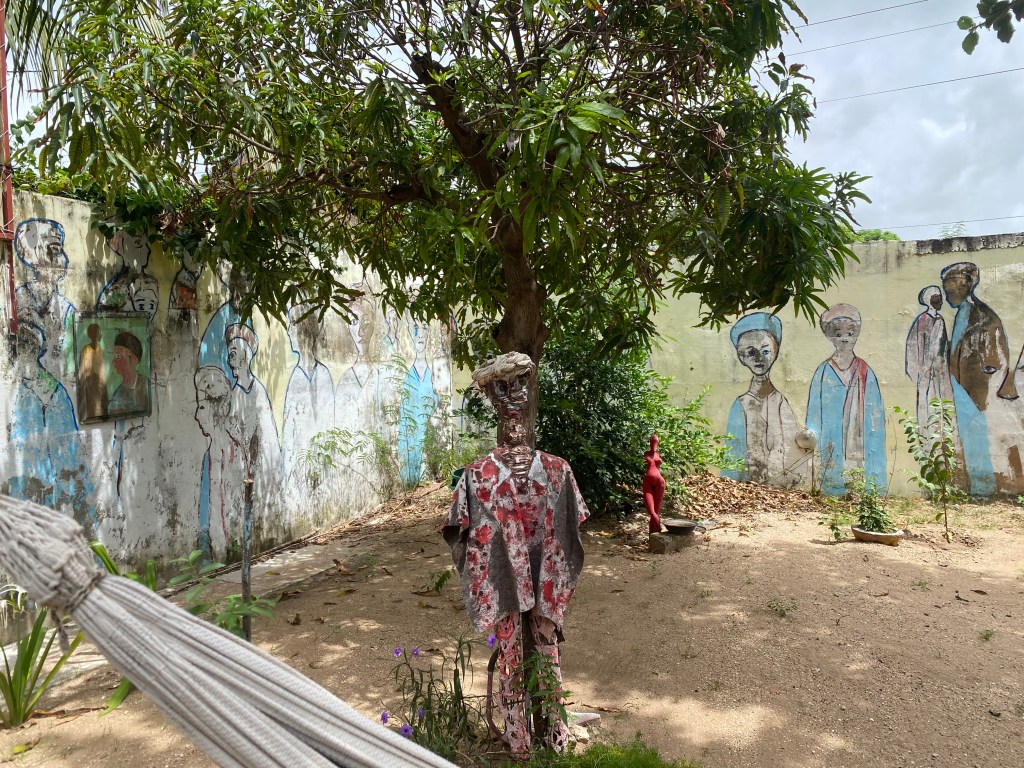
It’s crowds, yes. It’s crowds, it’s the vision. That’s what I saw since I was young. Since I was young, I’ve been confronted with these crowds. A people. It’s as if I saw a people. As if I was taken from a people to show that people. That’s it. That’s spiritual too. That’s what I think. That people is Senegal. It’s Africa. Beyond Africa, even, other continents can recognize themselves. And it’s as if I was extracted from that to shine a light on it. To show it. I focus the beam on it. And since it’s a vision, it’s something natural. If it’s natural, we don’t need a specific support. We’re not confronted with a problem of support. Whatever the support, we place the vision on it. That explains the multitude of supports.

How do you decide which support to create on?
The supports talk. Because they’re tools that are part of a tradition, part of a culture. For example, I’ve worked on wine barrels, which have a Western culture, to stage a dialogue between two cultures—between the West and Africa. Through the support, which is the barrel, and the artist and his signature on it. So, there’s a dialogue of cultures, between Africa and Europe. We’re not just talking about Senegal. All Africans are represented by those characters. And that support isn’t just for France—it’s a common denominator. Then there are prayer rugs, which also speak to us. That brings us back to the spiritual, because we pray on rugs. We look at rugs. Everywhere we go, there are rugs. And we manage to dialogue with those rugs.
To what extent has your return to Senegal changed your practice?
It doesn’t change completely. But it’s more fluid. What Senegal brings to my practice is fulfillment, maturity, ease. What used to take two days, now maybe takes 20 or 30 minutes. The vision is clearer. There, it was like a curtain. I had to doubt myself, draw on my reserves to create. But here, no. Here, it’s like a photograph. It’s there, and I take it. Here, there’s something beyond the image. I manage to capture sounds. So, there’s life. Abroad I use to paint the people, and in Senegal the people are just here. The painting we’re talking about, now it comes alive. That’s the difference. The more I think about it, I am no longer in the brush. Here, I can even stop using the brush. The brush is too slow. The vision is direct now. What I saw, now it’s here. I see it. I hear it.
What are your current projects? What are you working on at the moment?
I work on residency projects with other artists to explore themes related to recycling, spirituality, and the sacred. Sometimes we work on space, on territory, on shared space. We share the space: everyone has their own space and everyone develops their creativity.
To conclude, do you have a message for young artists, both on a human and artistic level?
Yes. The message is that you have to be patient in art. You have to work hard, that’s for sure. You have to work, because it’s only through work that something can be created. Art doesn’t happen overnight. It always comes about through pain, in difficult circumstances. And it’s through these difficulties that it grows. But you mustn’t give up. You must never give up. Because it ends up in the light, when you persevere.

 Bridging Africa and The World Through Contemporary Art
Leave a comment