

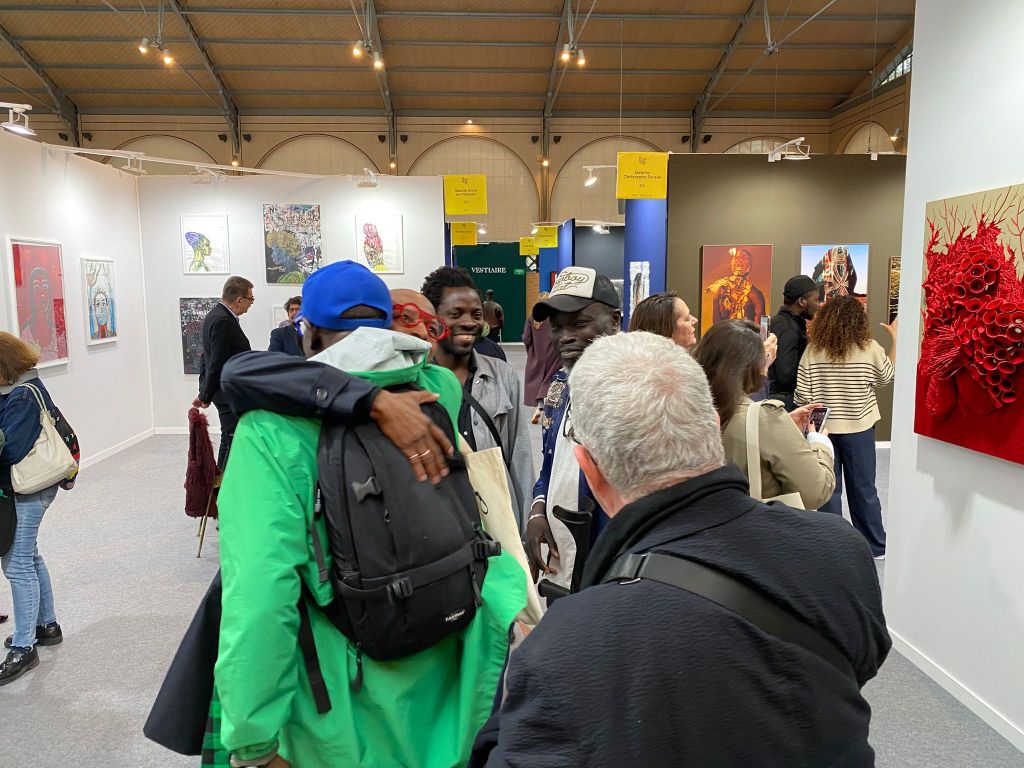
In the crowded aisles of the Carreau du Temple, where the 10th edition of the AKAA art fair unfolded this October, Franck Hermann Ekra moved with the quiet assurance of someone who has spent years reading the world through its images. The Ivorian art critic and independent curator, known for his incisive reflections on aesthetics and identity, resists the usual labels. For him, there is no such thing as “African art” — only the trans-African, a way of seeing that transcends geography, reclaiming relation, spirit, and care as central to creation. Speaking to DakArtNews on the sidelines of AKAA, Ekra reflected on a decade of art fairs, the evolving role of the curator, and why the future of art — from Abidjan to Berlin — must be understood not through the prism of identity, but through the ecology of transmission.
You are Franck Hermann Ekra, art critic and independent curator. How do you define your role?
I see myself first and foremost as an art critic — someone who learns to read the world. I’m also president of the Friends of the Bernard B. Dadié Foundation, which preserves and promotes the work of the father of Ivorian literature and a century of emancipation history, since Dadié began writing in the 1930s.
We’re here at AKAA in Paris. What does AKAA represent in today’s contemporary art fair landscape?
To be honest, there isn’t really an “African contemporary art fair landscape.” There are essentially two major ones: 1-54, which operates in London, Marrakech, New York, and Paris; and AKAA — Also Known As Africa. These fairs emerged from a necessity: to give visibility to artists who have been made invisible within the larger, global art circuits. They offer a platform for those who might not otherwise be seen.
Do you think fairs like this one help redefine the place of African artists on the international stage?
I wouldn’t say that. Personally, I don’t speak of “African artists” — I prefer the term trans-African artists. Individuals escape territories. Many artists from Africa and its diasporas would never have had the opportunity to be seen by certain collectors otherwise. This remains a niche market, yes, but an important one for communities that recognize themselves in the symbols, mythologies, and imaginaries expressed by artists from similar cultural spheres.
AKAA celebrates its 10th anniversary this year, as does Art X Lagos. How do you see their impact on the perception of “trans-African” artists?
Undeniably, yes — though I would say 1-54 has had a broader impact, as it targets a different audience. But this year is particularly interesting: ten years mark not just a milestone but a new beginning. With Sitor Senghor as the new artistic director — someone who has deep curatorial experience and has worked closely with artists such as Ouattara Watts, Ernest Dükü, and Nu Barreto (the latter two featured in this edition) — AKAA gains both vision and continuity. Sitor also brings his experience as a gallerist, which means he understands the market. This 10th edition is perhaps the most international we’ve seen, building on the groundwork laid by former director Armelle Dakouo. It’s not about erasing the past but extending a chain of care and renewal. At the same time, the Paris art scene itself has evolved — from the FIAC era to Paris+ by Art Basel. The city’s ecosystem has changed, with major foundations and international galleries opening spaces here. It’s a time of transformation — and promise.
Some observers argue that fairs like AKAA risk ghettoizing African art. Others insist that artists should simply be called “artists,” not “African artists.” Yet, African representation remains limited at Art Basel. How do you navigate this paradox?
It’s not entirely true that there are no trans-African artists in major fairs — there are. Some galleries have consistently defended these scenes: for example, Galerie Cécile Fakhoury, which presented Binta Diaw at Art Basel this year and previously showed artists like Roméo Mivekannin and El Hadj Lincy Deloumeaux. Ouattara Watts also exhibited with the same gallery during the FIAC era. Others, such as André Magnin, have done the same. This shows that, over roughly a decade, sustained work has borne fruit. As for “ghettoization,” opinions differ. Some artists claim to be “artists before being African,” while others say the reverse. This illustrates the trap of identity-based confinement — the tyranny of classification, skin, and melanin. One is an artist or one isn’t; art transcends identity and origin.
Yet these fairs present themselves explicitly as “African contemporary art events.”
Yes, and I think that’s a bit unfortunate. I believe it’s important to open up opportunities and give a number of artists the chance to be visible, whereas they wouldn’t be otherwise. If they aren’t visible, it’s not because they are African, but because they don’t meet the criteria of the mainstream galleries. Take Nu Barreto, who is part of this year’s AKAA and represented by a major gallery, Nathalie Obadia — one of Art Basel’s leading names. His presence reflects Sitor Senghor’s intention to dismantle boundaries. We need openness, not hierarchy. It’s unfair to label these fairs as “second-tier.” They play an essential, complementary role.
Is the discourse on “African art” still relevant? Can we still speak of authenticity?
Picasso once said, “Negro art? Don’t know it.” To me, Braque and Picasso were modern African artists — they drew from African statuary and artifacts.
I don’t believe in “authenticity” as an essence. Substance always transcends form. What matters to me is what I call the hidden text — the moment when an artist positions themselves behind power: familial, religious, institutional, linguistic. The power to name and classify is immense. Artists who work behind or against these powers interest me deeply. There’s a spiritual dimension in art — not essence, but spirit. Labels and categories are convenient but not part of my toolbox. There isn’t one voice, but many. Meaning is inexhaustible: you may see a six where I see a nine — it depends on where we stand.
How do you articulate a perspective that moves beyond origin?
I don’t work from territory, but from relation — relation to artists, to lived experience. Today, we speak mostly of markets, overlooking experience itself.
Art has been folded into a capitalist, utilitarian logic. That’s unfortunate, because artistic experience is, above all, spiritual.
You’re simultaneously a consultant, curator, and art critic. How do you reconcile these roles?
To me, they are one and the same profession expressed differently. Criticism is about observation and accompaniment. Curating — from cura, meaning “to care” — is about taking care, of artists and of works. Exhibitions are extensions of critical thinking, ways to make artworks converse. My work as a consultant in image strategy stems from my training as a historian. My research on representations of Félix Houphouët-Boigny led me to meet artists at the École des Beaux-Arts in Abidjan, where I began interviewing them and studying visual culture, from political sculpture to press illustration. For me, there are no disciplinary borders — literature, architecture, music — they’re all part of my lived experience of the world.
What place does art criticism hold today, in an era dominated by social media?
I was the first laureate of the International Association of Art Critics (AICA) Award for Young Critics. AICA International, created under UNESCO in 1948–49, remains a crucial platform. I’m part of its Committee on Censorship and Freedom of Expression, where we defend the freedom of speech and the relevance of criticism. Digital media reach vast audiences — but the medium doesn’t matter; it’s all about transmission. Whether as critic or curator, my task is to transmit. Together with my friend Bonaventure Soh Bejeng Ndikung, we speak of an “ecology of transmission.”
Which thinkers, writers, or artists most shape your view of contemporary creation?
I just mentioned Bonaventure Soh Bejeng Ndikung, with whom I speak daily. I’d also name Christine Eyene — curator of research at Tate Liverpool and co-director of the John Moores University gallery — and Hajra Haider Karrar, artistic director of the next Colomboscope in Sri Lanka. These are part of what I call my “Savvy Contemporary family,” a space founded by Bonaventure in Berlin 15 years ago — a laboratory of ideas and forms. They are my intellectual companions.
To conclude, what cultural or aesthetic urgencies do you see in Africa today?
Again, substance transcends form. What matters is what artists carry — their imaginaries, their translation of inner worlds into tangible material. Bernard Dadié said, “Self-awareness is an act of possession.” The urgency, for Africans and beyond, is precisely that: to be conscious of who we are.
Read also
As AKAA Turns 10, Beauty Becomes the Compass for Sitor Senghor’s New Direction
“A Home for Us, by Us”: How Tokini Peterside-Schwebig Made ART X Lagos a Landmark for African Art
The Contemporary African Art Landscape with Prof. Yacouba Konaté
 Bridging Africa and The World Through Contemporary Art
Leave a comment