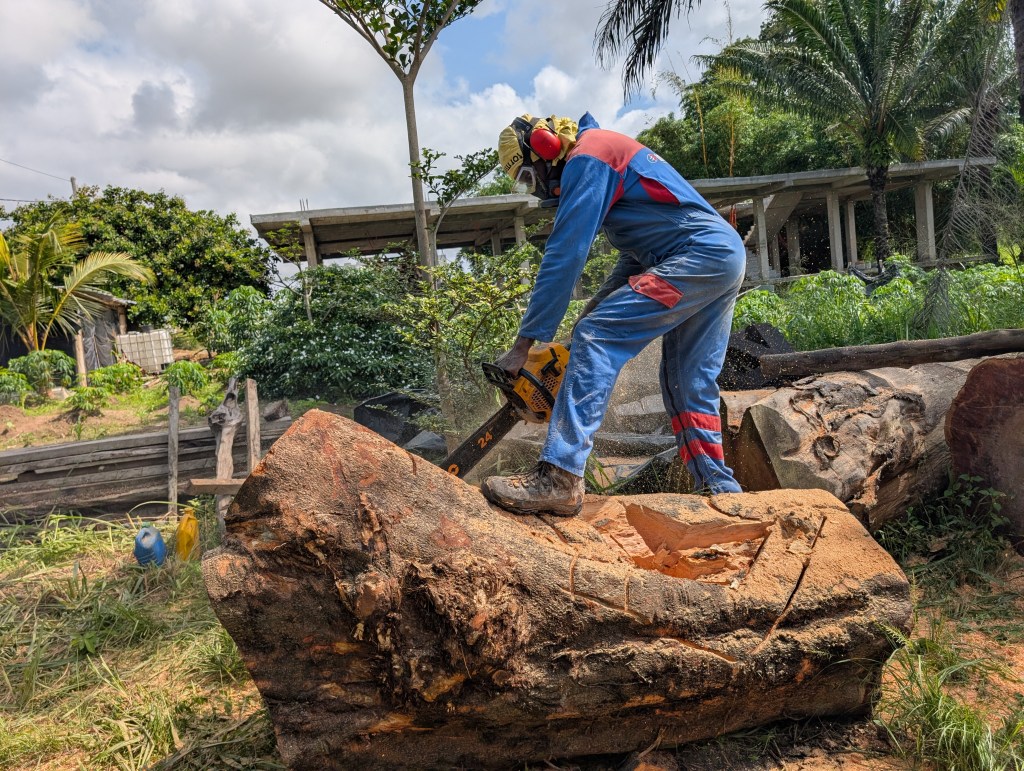

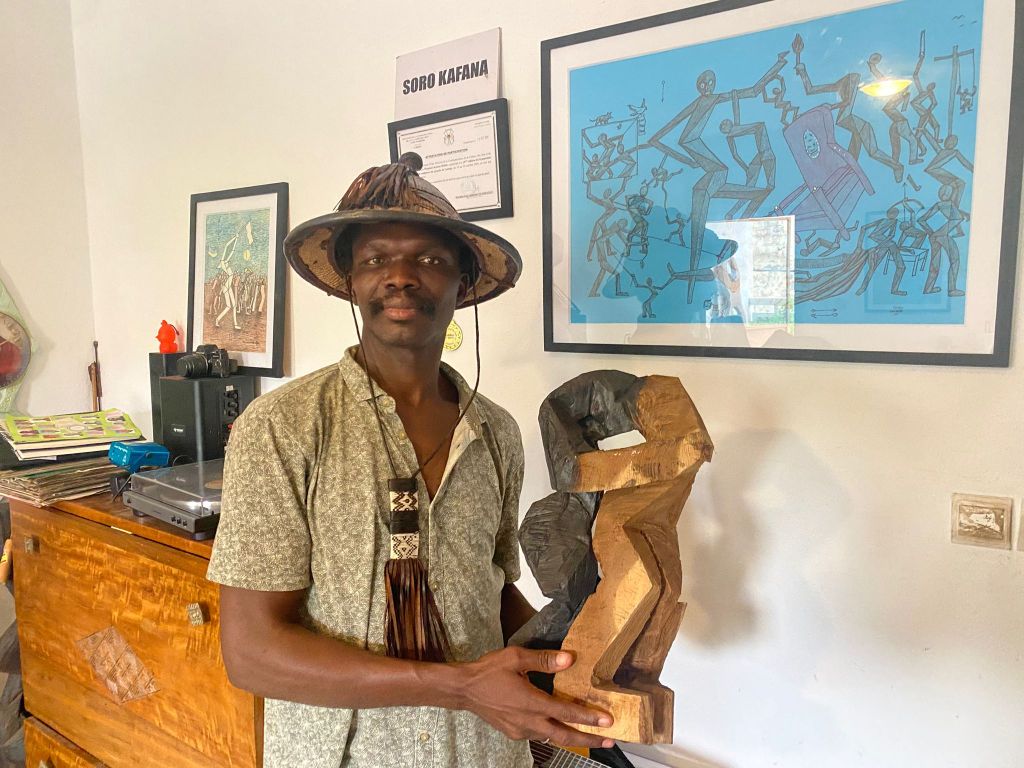
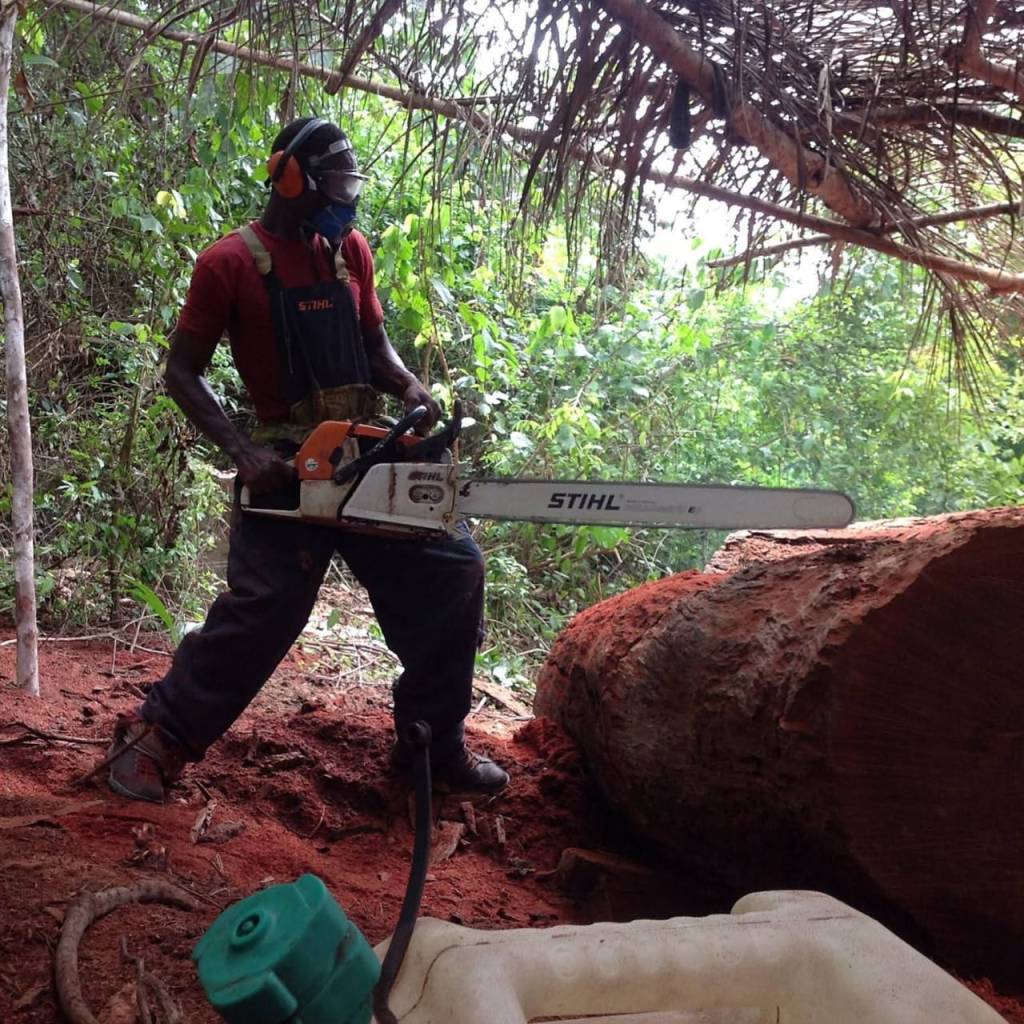
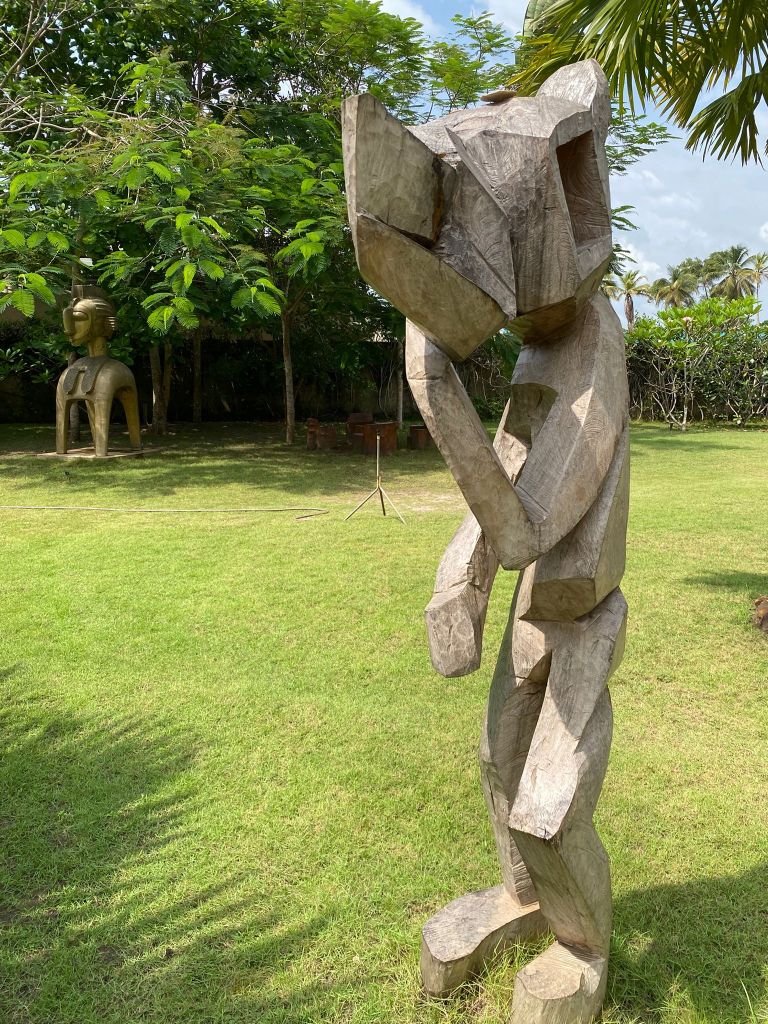
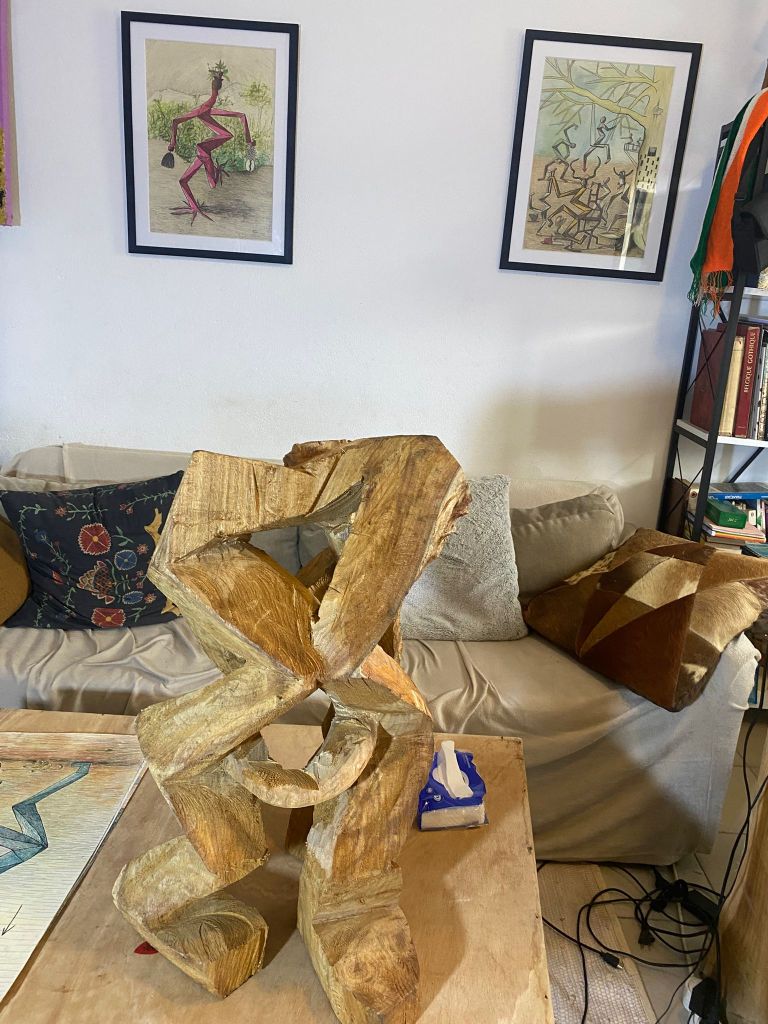
In this interview conducted in Abidjan, Soro Kafana welcomes us into the intimate space where he lives and thinks about his art. Born in Côte d’Ivoire to a family of blacksmiths and farmers, Soro Kafana today “forges” wood with a chainsaw—a powerful, noisy tool that he wields with remarkable sensitivity. For him, sculpting means liberating the “beings of nature” trapped in dead wood. Each trunk speaks to him, guides him, imposes a form. He never sketches in advance; he imposes nothing. He listens, feels, then acts. Trained at the Abidjan Academy of Fine Arts and profoundly influenced by his encounter with artist Jems Koko Bi—whose assistant he became for five years—Soro gradually developed a language of his own. His works, alive with movement, blend human, vegetal, and spiritual figures. He carves them with the chainsaw, leaving surfaces unpolished and preserving the raw marks as traces of the process—a record of the gesture and its vibrations. For Soro, art is above all a form of care—a personal therapy. He creates to heal himself first, hoping his works will in turn accompany those who view them or welcome them into their homes. “I am the first patient,” he says. “I must heal myself before I can heal others.” His deeply intuitive practice, connected to nature, draws from tradition without being confined by it. He transposes its knowledge into a contemporary aesthetic. For him, the tree is a living being, sometimes even inhabited by spirits, and must be respected. “We are not alone,” he repeats. Today, as the Ivorian art scene continues to grow, Soro notes a lack of recognition for sculptors, who often remain in the shadow of painters. Yet he stays confident and active. In September 2025, he organized the first international granite sculpture symposium in northern Côte d’Ivoire—a landmark event. His body of work carries a clear message: art is a path to the self, a space for union and dialogue with the invisible, and an energy to pass on to future generations.
© DakartNews
Your work is deeply connected to wood. Can you tell us about your first encounter with this material, and what it represents for you today?
I grew up in rural Côte d’Ivoire, the son of a blacksmith and a farmer, so my life was very different from that of people in the city. In secondary school, I had an art teacher who sculpted at home. I assisted him. He advised me to go to INSAAC (a public institute in Abidjan dedicated to arts and cultural training.) After my high school diploma, I took the entrance exam but didn’t pass. So I trained with Koffi Donkor, who creates monuments. That’s where I really discovered working with clay and wood. Then I returned to the Academy of Fine Arts. At first, I wanted to paint, but the sculpture students said, “No, you’re a sculptor!” They came to get me from the mural art workshop and brought me to sculpture. That same year, in 2013, I met Jems Koko Bi. I became his assistant for five years. It opened up a whole new world for me. It allowed me to use my personal history and work with wood. I focus mainly on “bonoufoué,” a Baulé term meaning “being of nature.” During that time, I had exhibitions, but I struggled to find my own technique. It was in 2019 that the idea of “trenches” came to me, and I began developing my current style. For me, when a tree is cut down, a life remains trapped in the dead wood. My work is about freeing that life. I never impose a design: I let the wood give me an image, I sketch it with the chainsaw, and I gradually add elements until the sculpture is complete.
What do you think makes your sculptural work unique?
I would say it’s really about movement and composition. I’m drawn to dynamic figures—I don’t like characters that feel static. Working with wood allows me to exaggerate movement and create strong compositions, sometimes with several figures carved into a single trunk, whether two or even six. For me, it’s above all about capturing motion and how the figures interact within the same form.
What is art for you?
Art is an activity that allows someone to bring out what’s inside them, to materialize their thoughts and emotions, and present them to an audience that doesn’t know their story. At the same time, it’s a therapy: it heals the artist first, and then those who view their works.
You have to respect nature because we’re not alone.
You use the chainsaw, a raw and noisy tool. How does this technical choice influence your gestures and relationship with sculpture?
I’d say I use it a lot—not occasionally, but really a great deal. For me, the chainsaw is also a kind of instrument, something that allows me to make music. When you work with it and rev the engine, it’s as if you’re playing a rhythm. You have to listen to the motor, know when to accelerate, and not do it just for the sake of it. This approach helps me work efficiently, but it has also taught me patience.
At the beginning, I wanted immediate results and to move fast. Even with a chainsaw, over time I started working on myself. Now, when I sculpt with it, I take my time so that each piece can be truly different from the others. I also choose to leave the marks of the chainsaw visible. To me, they tell the story of the wood’s transformation into a sculpture. That’s why I don’t polish my works—I keep the traces of the chain on every piece I create.
You mentioned earlier that your work is about “freeing the life” inside the tree. What role do beliefs play in your creative process?
For me, it’s essential to respect nature, because I believe we are not alone. If there are ants, if there are bees, it means that other forms of life exist somewhere. Take air, for example: we can’t see it, yet it exists. So why not also acknowledge these invisible presences? This way of thinking didn’t start with us. It goes back to antiquity. Our ancestors believed in these things—think of ancient Egypt, for instance, or Europe, where trees like the yew held a special presence. People knew where to plant them, how to plant them, and what role they played. This kind of spirituality has existed in many parts of the world. When I work with wood, as a Senufo, I’m aware that in my culture, wood is never used casually. Before cutting a tree, some people would bring a chicken and enter into a dialogue with it. Only when the tree “gave permission”—sometimes a week later—would they cut it, let it dry, and then use it, whether for making balafon parts or other objects.
With this cultural background, I feel that this approach makes sense. When you cut down a tree, a life is taken. Within that life are elements we cannot see—spirits, even angels, that inhabit certain trees. As I said earlier, my work is about these invisible beings. I want each person to be able to connect with the sculptures in their own way. When I work, I let the tree speak to me. I allow it to guide me, to tell me what it wants to become. I stand for respect—for nature, and for all beings that exist on Earth. I don’t follow a single, defined religion like others do.
Do you perform any rituals before or during work?
No, I don’t perform any ritual. What happens is that when I arrive somewhere, a log might look beautiful, but that doesn’t mean I will immediately buy it just because I want to make a piece out of it. I need to feel something first—the energy, the fiber that allows me to work with it. When I decide to work, I touch the wood and let the connection settle before I start drawing. As long as that connection doesn’t happen, no image comes to me, and I can’t begin. That’s why there are times when I buy certain logs and end up not working on them at all, because no image emerges. There’s no ritual involved—it’s simply about touch, connection, and how the wood responds to me, or how I respond when I touch it.
Would you say your creation has a spiritual dimension?
I would say that all creation is spiritual, yes. As I mentioned before, people bring out what they carry within themselves. What others may not see or experience, what the artist lives internally, is what comes out through the work—what exists inside them, what they can perceive and feel. So I would say that all creation is spiritual, and of course my own work is spiritual as well.
And what do you want to bring out, as an artist?
The message I want to share is about understanding what is happening inside ourselves. Very often, it’s difficult for people to grasp what they are feeling internally. Many feel anxious because they are overwhelmed with too much information, and when we carry certain things inside us, we need to release them. When we don’t let them out, it becomes unhealthy. For those who feel blocked or suffocated by thoughts or information, I believe the best thing to do is to use a piece of paper and simply express whatever comes, letting the arms and the mind move freely. Reproducing what comes naturally is healing—it helps release anxiety and clear the body of everything it’s holding onto. Afterwards, you feel lighter, you feel better. So my message is to encourage people to let go, to express what they carry within them.
Do you make art primarily to heal yourself?
Yes, I make art to heal myself first. I am the first one who is ill, so I need to heal myself before I can heal others.
What kind of illnesses do you suffer from?
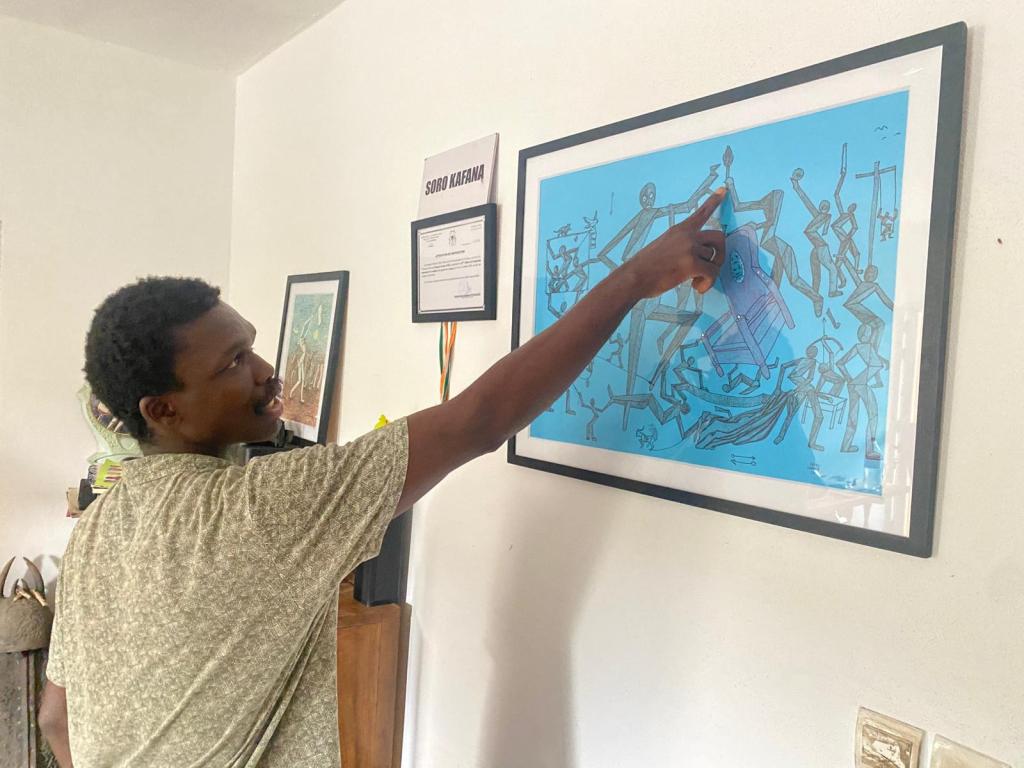
I suffer from an overflow of information that lingers in my mind. As I mentioned with drawing, there are moments when I’m lying down and certain thoughts or information suddenly come to me. When that happens, I can’t ignore the urge to get up and draw—that’s why there are papers placed everywhere. I have to get up, draw, and once the drawing is done, I don’t feel the need to add color. I draw, and that’s it. I go back, and the drawing stays as it is until new information comes and pushes me to continue.
You come from a craft-based background, — your father being a blacksmith. How does this family heritage inform your contemporary practice without simply repeating tradition?
I think it starts with who I am—both as a cultural being and someone rooted in tradition. I was also fortunate to go to school, to encounter other cultures, and to see how people develop ideas in different contexts. For me, the goal is to draw inspiration from my own culture while allowing contemporary influences to take shape within me. When certain ideas come to me, I naturally think back to how things were done by blacksmiths in my culture. But at the same time, I adapt those ideas to the present moment, to my own time and to what I’m doing now. I think in terms of tradition, but I translate it into a contemporary language. My father forged iron; for now, I “forge” wood. Maybe one day I’ll add iron.
Your sculptures sometimes feel as though they exist at the boundary between the human, the tree, and the spirit. Are you intentionally seeking to blur these boundaries?
No, not at all. For example, just behind us there’s a painting where I’ve represented angels—angels that inhabit trees. What I’m really sharing is what goes on in my mind. Even when I walk through a forest, I feel that there are beings living within certain trees. So it’s not about confusing people or deliberately blurring things. At the same time, as I mentioned earlier, the compositions are often imposed by the tree itself. Even small pieces, like the one here, can carry several layers of information at once. There may be figures, plants, different elements combined together. Sometimes these things come together naturally, but it’s the tree that gives me the possibility to do so.
When you work by hand, you charge the piece with a part of yourself, with energy.
So you rarely start with a fully predefined idea?
No. Sometimes I have a general theme, but I let each trunk guide me. The wood speaks to me: when I feel comfortable with it, images come quickly.
In an increasingly digital world, why is it important for you to work with a living material shaped by time and nature?
I believe that no matter what can be achieved through digital technology, it can never carry the same value as something made by hand. When something is handmade, there is what I call “charging” the work. It’s like releasing a part of myself into the piece, much like a mother giving birth to a child. A mother carries a part of herself within her child. No matter what happens, there is always a bond. The mother knows her child exists somewhere, and the child knows their mother exists too, whatever the circumstances. It’s the same for those who work with their hands. When they create manually, they have the time to charge the work—to infuse it with their own energy. Machines can’t do that. Humans can take the time to give their energy to what they make. When the work is finished, there is a deep sense of satisfaction in seeing what has been created. It brings happiness, and as I said before, it heals. When something is made by a machine, that process is much more complicated.
What do you hope viewers feel in front of your works?
I let each person have their own experience. Some feel calmed, others disturbed, others drawn in or drained by the energy. The important thing is that they connect with the piece and, ideally, continue their own therapy by living with it.
How do you see the Ivorian art scene today, especially for sculptors? What are the main challenges in your view?
In my opinion, the Ivorian art scene is gaining momentum. Since around 2014, there has been a real shift. In recent years, several projects have emerged, which is very positive. However, when it comes to sculpture, there are still very few sculptors, and people often struggle to understand our work. Sculptors are usually compared to painters, which doesn’t make sense. For example, when you’re asked to produce a work for an exhibition and you give a budget, some people respond by saying, “But painters do it for this price.” Sculpture is completely different. A 50-centimeter sculpture does not require the same resources or budget as a 50-centimeter painting. In my case, working with a chainsaw involves fuel, maintenance, repairs—there are many additional costs. People simply don’t understand the true value of sculpture, and that’s already a major challenge. Another issue is the lack of projects that specifically support sculptors. Because there are so few of us, organizers often prefer to work with painters when putting together an exhibition. A sculptor is only brought in as an afterthought—if someone remembers or feels they need to add one. By default, the painter is always the first choice.
To wrap up, if your entire body of work carried one essential message for future generations, what would it be?
A message of peace, unity, and support—in the art world and beyond, in family and society. We need to calmly explain the value of what we do, not reject those who don’t understand right away. Many artists face family challenges; we must keep dialoguing.
Did you experience that yourself?
Yes. When I wanted to join INSAAC, my father was against it: “Drawings? Who’ll buy that?” People told him artists are lazy. But today he’s proud. This year, he came to see me work granite at a symposium I organized in Korhogo (North). He saw the effort and suffering involved, and since then, he respects me even more.
If you weren’t an artist, what would you be?
If I weren’t an artist, I think I would be doing a hands-on trade. I like machines, so maybe I would have become a pilot, or something similar—I’m not really someone who enjoys office work. It could also be mechanics, or metal construction. I actually started learning metal construction with an uncle when I was in high school. Even today, I have my own equipment, and when my sculptures require metal installations, I do that work myself.

 Bridging Africa and The World Through Contemporary Art
Leave a comment