
As contemporary African art gains unprecedented visibility, questions of curation—who frames the work, how it is mediated and for whom—have become increasingly urgent. In this interview with DakArtNews, Rosemary Esinam Damalie, a Ghanaian artist and curator, reflects on curation as a creative and educational practice rather than a neutral act of selection and writing. As a 2025 fellow in the education department at Zeitz Museum of Contemporary Art Africa, she challenges hierarchical models, critiques the market-driven pressures shaping exhibition-making today, and argues for collaboration, community and time as essential to building more sustainable curatorial practices on the continent, as African institutions confront the challenge of moving beyond visibility toward responsibility, continuity and care. Drawing from her experience as an artist, she approaches curating as a material and process-based practice—one that begins with alignment with artists, works and communities, rather than institutional authority. Her reflections also interrogate the language of decolonization now circulating widely in museums, asking what it means in practice rather than in principle, and advocating for more rhizomatic, collective modes of knowledge-making in which the curator acts as mediator rather than sole author.
Can you start by telling us how you got into the art field?
I began my journey as an artist, so first and foremost, I consider myself an artist. That identity then extends into curation, education, and cultural work. Being an artist gives me the freedom to experiment across these fields. I studied art at Kwame Nkrumah University of Science and Technology, earning a BFA in painting and sculpture (majoring in painting). Academically, I’m trained as an artist.
Why did you choose to be an artist?
Art calls you—it doesn’t ask for permission. My family is deeply artistic: my grandfather was a carpenter and mason, my mother a lifelong hairdresser and beautician, and my aunt a fashion designer and university lab technician. It runs in the blood. Growing up, I used my hands a lot. In many African homes, that signals your path. My mother suggested business, but I knew art was where I belonged. I pursued visual arts in senior high school and never looked back.
“Knowledge isn’t linear or hierarchical; it emerges everywhere.”
You work both as an artist and as a curator. How do these roles influence each other?
I approach them as one integrated practice. My experience as an artist—who thinks deeply about materials, process, and presence—gives me an advantage in curation. Many curators come from art history backgrounds, approaching exhibitions academically. That’s valid, but there’s real power when curation comes from an artist’s viewpoint: making exhibitions rather than just writing about them.
How do you approach curation as an artist?
I start by aligning with the artist, then with the materials. From there, I research how the work relates to space, time, and global contexts—while keeping Africa at the center. African artists draw from indigenous knowledge systems and communities; I refuse to neglect that. I also emphasize community. No artist succeeds in isolation. Curators must highlight the indigenous communities, the exhibition-making collective, and even the audience community.
This leads to what I call rhizomatic curation—like ginger roots sprouting in multiple directions. Knowledge isn’t linear or hierarchical; it emerges everywhere. The curator becomes a mediator, not the sole author. Everyone gets a voice, even if it means hard conversations and rethinking decisions. It’s complex and challenging—people often prefer the ease of top-down authority—but it reflects how humans actually operate: layered, simultaneous, multiple narratives. African knowledge systems embrace this while Western ones often favor one linear story.
Do you see curation as a creative practice?
Yes, I do see curation as a creative practice. That said, I know some people don’t, depending on their background and how they approach it. For me, curation is creative because I approach it creatively. Just as I would work toward creating an artwork, I work toward creating an exhibition, an archive, or any curatorial project. It involves researching, collecting materials, asking questions, and engaging with the communities to which these beings or stories belong. It’s about having conversations, ensuring that I reflect the narrative accurately, and being careful not to portray people in a negative or reductive way.
Bringing all these materials together is part of the process, as is writing about it—making sure texts are proofread and, importantly, read by people within the community to confirm that the information is accurate and respectfully presented. I also think about accessibility: making sure people can read the text, experience the exhibition, or even listen. Listening is crucial too. I consider how people move through the space, how the artworks are protected, and how visitors themselves feel within that environment. For me, all of this is tied to visual awareness and sensibility. So yes, I see curation as a creative process—one that needs to be approached with the same care, intention, and sensitivity as any artistic practice.
“Before starting a museum, founders and staff should live in and understudy the community.”
What does it mean for you to curate from Ghana with local institutions, rather than responding to external frameworks?
My training emphasizes collaborative curation. Most of my work in Ghana has been co-curated and collaborative—with other curators, artists, or institutions. Many Ghanaian spaces are artist-run or collective, without heavy government rigidity, that’s a strength. I’ve also been part of the collective blaxTARLINES Kumasi since my days at the University, so I can tap into that network for knowledge and support—even when resources are limited. Collaboration isn’t optional; we’re not islands. It builds sustainability.
What do you think are the responsibilities of art institutions in Africa toward artists, communities, and histories?
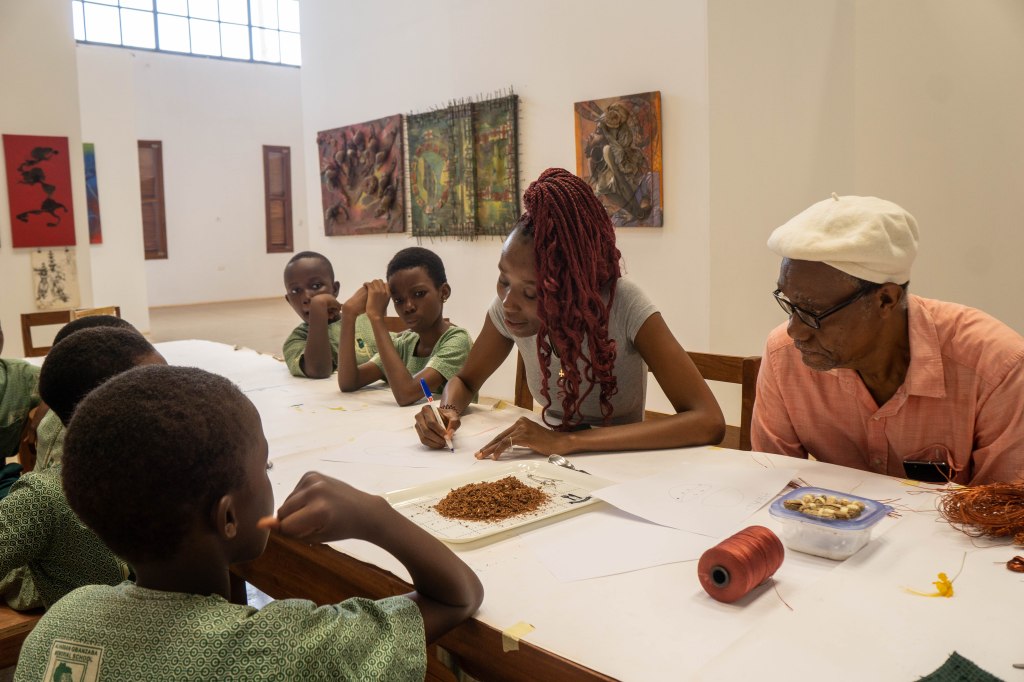
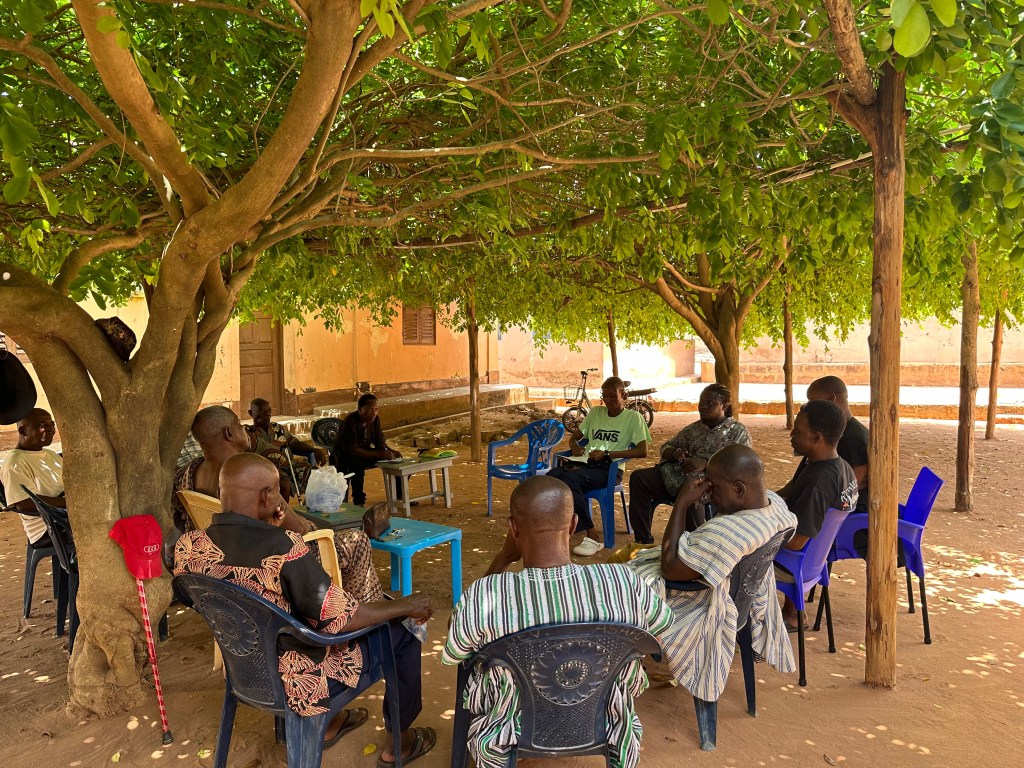
Museums are educational institutions, but education must be bidirectional: not just pushing knowledge outward, but learning from the community and adapting. Most museums do one way only—dumping information—and fail to implement what they learn about community needs. They also need true accessibility: not just buzzwords, but accessible language (no heavy jargon that alienates), archives open to all, and programs that resonate. Before starting a museum, founders and staff should live in and understudy the community. Ask: Do they need this? What kind? Include community representatives on the board from day one. Prioritize local programs first—transport people, collaborate with schools, host gatherings like storytelling or music.
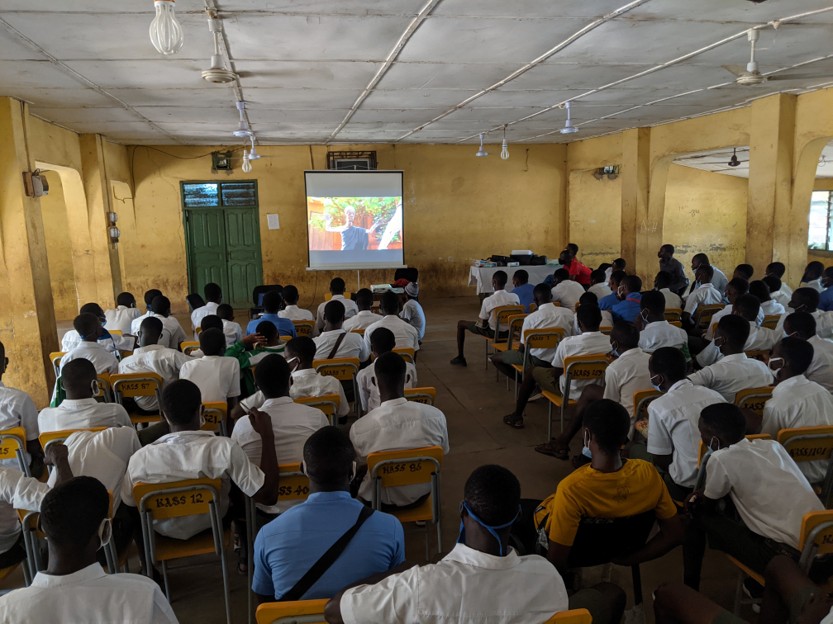
At the Savannah Center for Contemporary Art (SCCA) Tamale, we did this: school visits built confidence, kids brought families, New Year’s Eve bonfires and screenings made the space feel like home. When the community owns the institution, it sustains itself through word-of-mouth.
You mentioned working at Savannah Center for Contemporary Art (SCCA) Tamale with Ibrahim Mahama, a hugely influential figure in contemporary art. What was that experience like?
It was a great privilege and an eye-opener in many ways. SCCA gave me space to experiment with ideas I believed in—collaborative processes, community engagement, and experimental institution-building. I saw firsthand how collective work can elevate something from the margins to the forefront. It wasn’t always easy—multiple voices and shared decision-making can be challenging—but it was worth it. Ibrahim’s practice embodies that: difficult, but possible. I’m grateful to have contributed, and it reinforced the power of collectives like blaxTARLINES Kumasi.
As someone who works closely with institutions, how do you navigate questions of power, visibility, and representation?
I don’t seek the spotlight—I’m more comfortable doing the behind-the-scenes work. But I insist on crediting everyone involved. No one achieves alone; illusions of solo success are dangerous. Power can corrupt, and I’ve seen it misused in the art world. I’m vocal about that—calling out abuse or toxicity when I see it. If someone won’t listen or change, I walk away. The art space is already hard; we don’t need toxic dynamics on top of it. Accountability matters, people in power should accept critique, not dismiss it. Giving others their “flowers” (recognition) is essential.
And speaking of conversation and artistic practices, which ones do you feel deserve more attention today—particularly within contemporary African art?
There are two conversations that, in my view, are either barely addressed or only discussed on the surface. The first is collaborations in the art world, and the second is education within museums and exhibition-making—specifically how we approach educating people. Collaboration is crucial because the heaviest part of an institution, exhibition-making and art-making is fundamentally rooted in collaborative processes. Yet, we often talk about collaboration in a very limited way—almost only when it serves an individual or institutional agenda.
Institutions tend to speak about collaboration with artists, but rarely about collaboration between institutions. On the continent, how many institutions are truly engaging in collaborative exhibition-making? Very few. As a result, much of the work by African artists ends up in Europe or the West; we haven’t organized ourselves collectively or embraced institutional collaboration. So we are often unable to see some of the greatest African artworks on the continent itself and we have to travel outside Africa to experience them. That, in itself, is a problem.
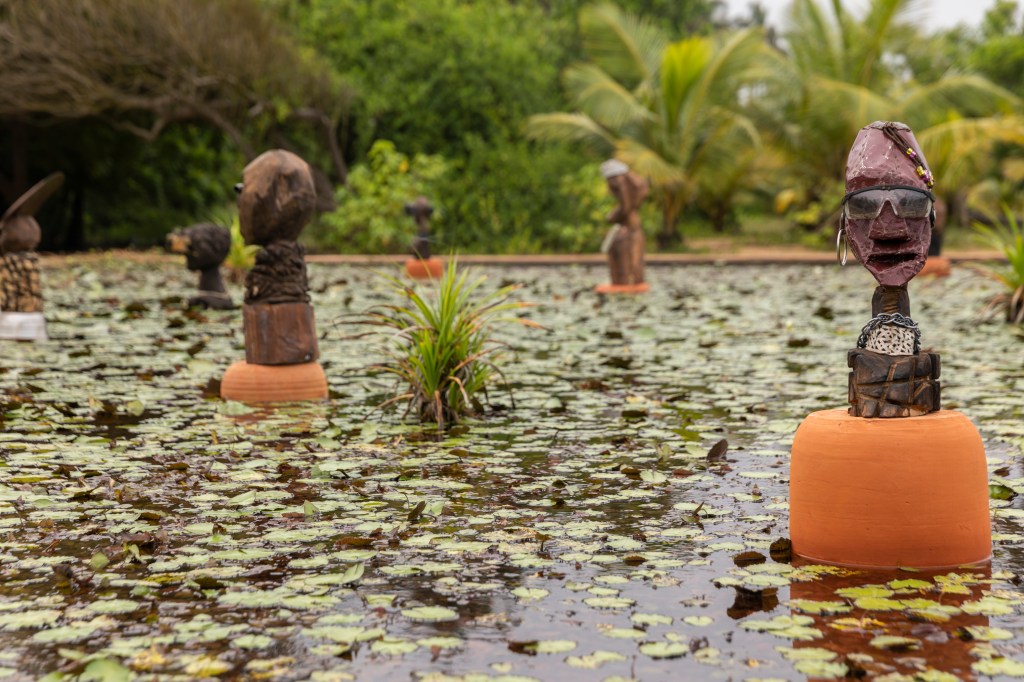
Artists are already collaborating. So the question is: why aren’t institutions doing the same? Institutional collaboration could radically change the entire conversation. Imagine collaborations between Ghana and Togo, between Abidjan and Accra, between Côte d’Ivoire and Ghana. These places have institutions. They may not be many, but they exist. Instead of always looking outward, how about we intentionally and forcefully collaborate among ourselves? This is why I deeply value the project initiated by the African Artists’ Foundation, called Dig Where You Stand, where I had the privilege of curating the second iteration. The model was powerful: a travelling exhibition within the continent, moving from one African country to another. In each new location, local artists and contexts were integrated into the exhibition. It required significant resources, yes—but the capacity exists. The people exist. The expertise exists. What’s needed is for institutions to move more radically and more boldly.
“Many institutions in Africa are not decolonised, even if some claim to be.”
You also mentioned education?
Education is just as critical. Education in museums has been reduced almost entirely to exhibition booklets. And that’s where it often stops. Even when publications are produced, they are frequently expensive, limited-edition prints that are inaccessible to the public. Sometimes, museums don’t even have copies of their own publications available on-site. But education must go far beyond booklets. There is the archival dimension of education. There is interpretation—translating exhibitions into theatre, into sound, into different sensory experiences.
There is accessibility: braille formats for blind audiences, virtual reality for people who cannot physically access the space, and digital platforms that allow exhibitions to be researched remotely. Yes, these approaches are expensive. But many museums do have the resources to implement them. The issue is not always capacity—it is often willingness. And until we expand our understanding of education beyond minimal formats, we are limiting the impact, reach, and relevance of our institutions and the practice.
Many institutions today have included “decolonisation” in their agenda. What is your view on this?
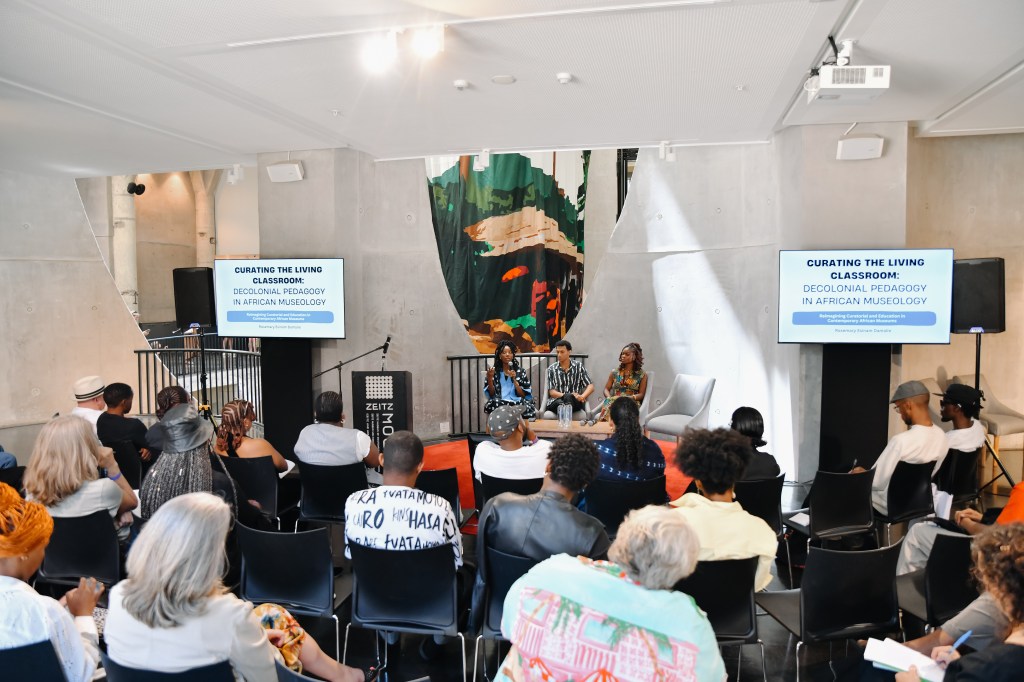
Yes. I write about this extensively in my research—particularly about how many institutions believe they are decolonised when, in reality or practice, they are not. The question has to start with structure. For instance, what does the board of directors look like? Is it simply a copy-and-paste version of what a Western museum considers a board? That’s a critical issue. For me, a genuinely decolonised institution should include people from the community—at least one representative—within its governing structure. So yes, many institutions in Africa are not decolonised, even if some claim to be.
Of course, I can’t speak for all of them, but a significant number are not. And decolonisation is not something you declare; it’s something you do. It is reflected in how information is produced, how exhibitions are developed, and how knowledge is shared. It is visible in the process. The process is where we see whether an institution is truly decolonised or not.
I would also argue that the curatorial process itself needs to be decolonised. It still largely operates within a hierarchy where the curator is positioned at the top. Yet museums often claim to be educational spaces—so why, then, does the education department sit under curatorial, rather than curatorial sitting under education? This is a question I raise in a research paper I wrote during my fellowship.
How do we go beyond this fixed structure?
Perhaps curators need to begin seeing curation as an educational process—not simply as the organisation of what is shown. Curation should involve educating oneself through the process and translating that knowledge for different groups of people. When you approach curation as education, you start thinking about how audiences will process what is being presented, rather than simply transmitting what the artist has said and leaving it at that. Too often, the curatorial approach is: this is what the artist is saying; I’ve written it down; here it is—take it or leave it. There is little mediation. But if we think about education—particularly teaching—you realise it works very differently.
A teacher prepares workbooks, assignments, and classroom exercises. They think about the different learners in the room, their ages, their capacities, and the examples that might resonate with them. In museums, audiences range from six-year-old children to people in their eighties. Is this range truly being considered in curatorial thinking? Or are exhibitions primarily designed for people in their twenties and thirties, excluding everyone else? Yet the formative years of a child, around the age of six, are crucial. If a child experiences an exhibition in a way that is accessible and engaging, it can leave a lasting impression and shape how they relate to art for the rest of their life.
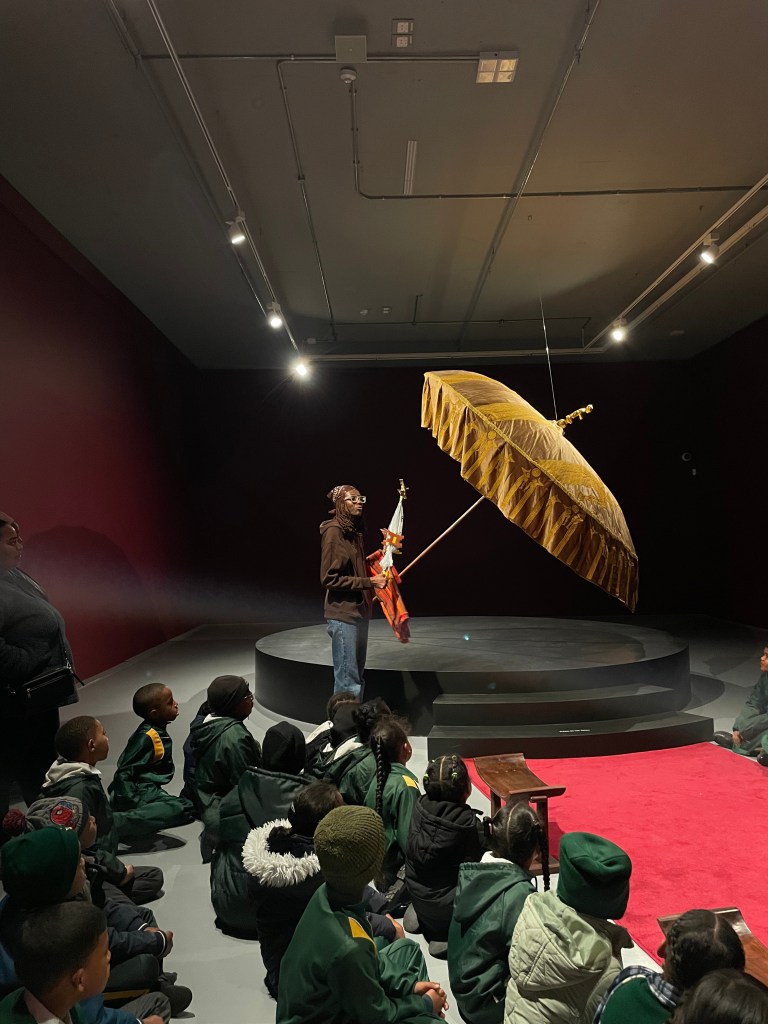
When curation is approached as an educational process, it allows for mediation at multiple levels, for different kinds of audiences. It also enables the curator to learn through the process, not just to transmit information. But when curation follows a Westernised, traditional model—where the role is reduced to organising objects, speaking to the artist, and producing a text—understanding becomes optional. This is why many people visit exhibitions, see the artworks, and feel nothing. They cannot relate. Artists may be addressing urgent issues—geopolitics, social realities, global crises—but without thoughtful mediation, the exhibition becomes a photo booth. People take pictures for Instagram, and that’s where the engagement ends. That, for me, is a failure of the curatorial process.
With increasing international visibility for African contemporary art, what are the main risks and challenges for artists and institutions on the continent?
I think, first of all, that Africa has been working for a very long time. In many ways, this recognition is late—we should have been receiving our flowers a long time ago. But it’s fine if they are coming now. At least we get to witness the season. The risk, however, is that this sudden visibility is largely being orchestrated by Western institutions and Western actors. And because of that, the way African art and artists are being highlighted is often questionable.
You read certain publications and you’re left confused—there’s no depth, no clarity. It feels as though Africa has become the “new great thing,” so it’s simply added as a label, without real engagement or understanding. The danger is that this turns contemporary African art into something resembling fast fashion. There is pressure on artists to produce more, rather than to be thoughtful or rigorous. There is pressure to sell quickly, without carefully considering where the work is going, who is acquiring it, or what the reputation and ethics of the representing institution might be.
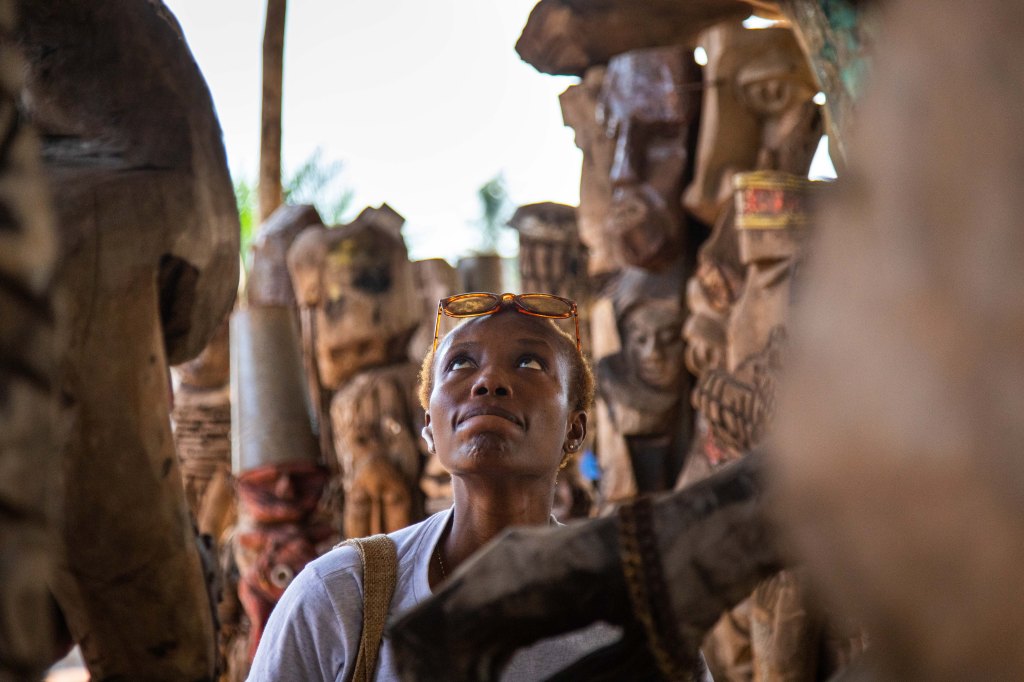
As a result, artists are pushed into deals that feel like selling their soul—quite literally. And this has consequences for the entire ecosystem. It also creates a homogenisation of visual language. When one artist’s work gains massive visibility and commercial success, suddenly many others feel compelled to imitate that same aesthetic. The logic becomes: if this style sells, then I should do the same. And before long, you have dozens—if not hundreds—of artists producing work that looks almost identical. That kind of system doesn’t nurture artistic growth or integrity. It prioritises speed, market trends, and visibility over depth, experimentation, and long-term sustainability. And in the end, it flattens the richness and diversity of contemporary African artistic practices.
In the current economic climate, where many artists struggle to make a living from their work, isn’t it pragmatic to create what sells?
As creative people, if what you produce is not unique and does not come from within you, you cannot sustain it over time. It is not natural. It doesn’t flow organically. You might manage to sell two or three works by imitation, but eventually you won’t even be able to imitate convincingly anymore—because it is not you. At that point, the work stops selling. Collectors begin to question its authenticity. Often, the first works were driven by hunger and by urgency. Later, once some money comes in, that hunger fades, and the imitation becomes weaker. I’ve seen this many times in artists’ trajectories. In the early years, the work can be incredibly powerful—there is fire, intensity, and risk.
But as time goes on, even when artists gain representation or market success, something can feel superficial. The fire is no longer there. That said, this is also why it’s important to understand that artistic work does not emerge in one step. It is a process. It requires sacrifice, patience, and years of dedication. You cannot force it to happen overnight. When we reduce art-making to what sells in the moment, we not only shorten the lifespan of the work—we also shorten the lifespan of the artist’s practice itself.
Looking ahead, what structural changes are most urgent to ensure a sustainable and locally grounded future for contemporary art in Africa?
I always return to community and collective work. This must be the foundation of how we operate on the continent. It is also the most sustainable model. Many institutions in Africa are not sustainable because a single individual carries the entire vision. That person drives everything, does important work, and builds momentum—but the vision is not shared deeply enough. It is not collectively held. So when that person passes away, the vision dies with them. The institution collapses, and its assets—intellectual, cultural, archival—are lost. We need systems where visions can be inherited, understood, and carried forward by others.
A system where multiple people are aligned, trained, and empowered to continue the work. That is how practices survive long-term. This is not unique to the arts—it reflects broader societal structures. Even in business, many initiatives collapse after the founder’s death. But this is precisely where we need to intervene. While we have copied many things from the West—sometimes uncritically—there are also important things we did not copy. One of them is sustainability in institutional structures. Some museums in the West have existed for over a hundred years. There is something in that system we can learn from, even while acknowledging the problematic histories and sources of funding behind some of those institutions. We must critically extract what is useful—particularly around sustainability—and adapt it to our own contexts.
To conclude, if you were to curate an exhibition based on a question rather than a theme, what would that question be today?
What does community mean to you?
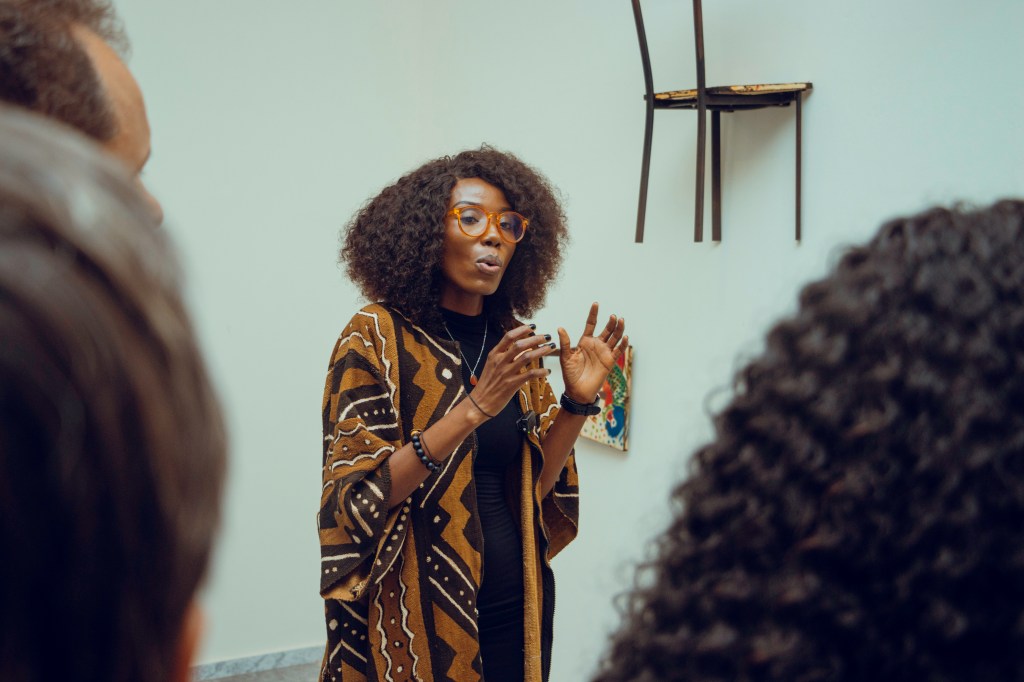
Featured image: ©Damilare Adeyemi, African Artist Foundation (2023)
 Bridging Africa and The World Through Contemporary Art
Leave a comment