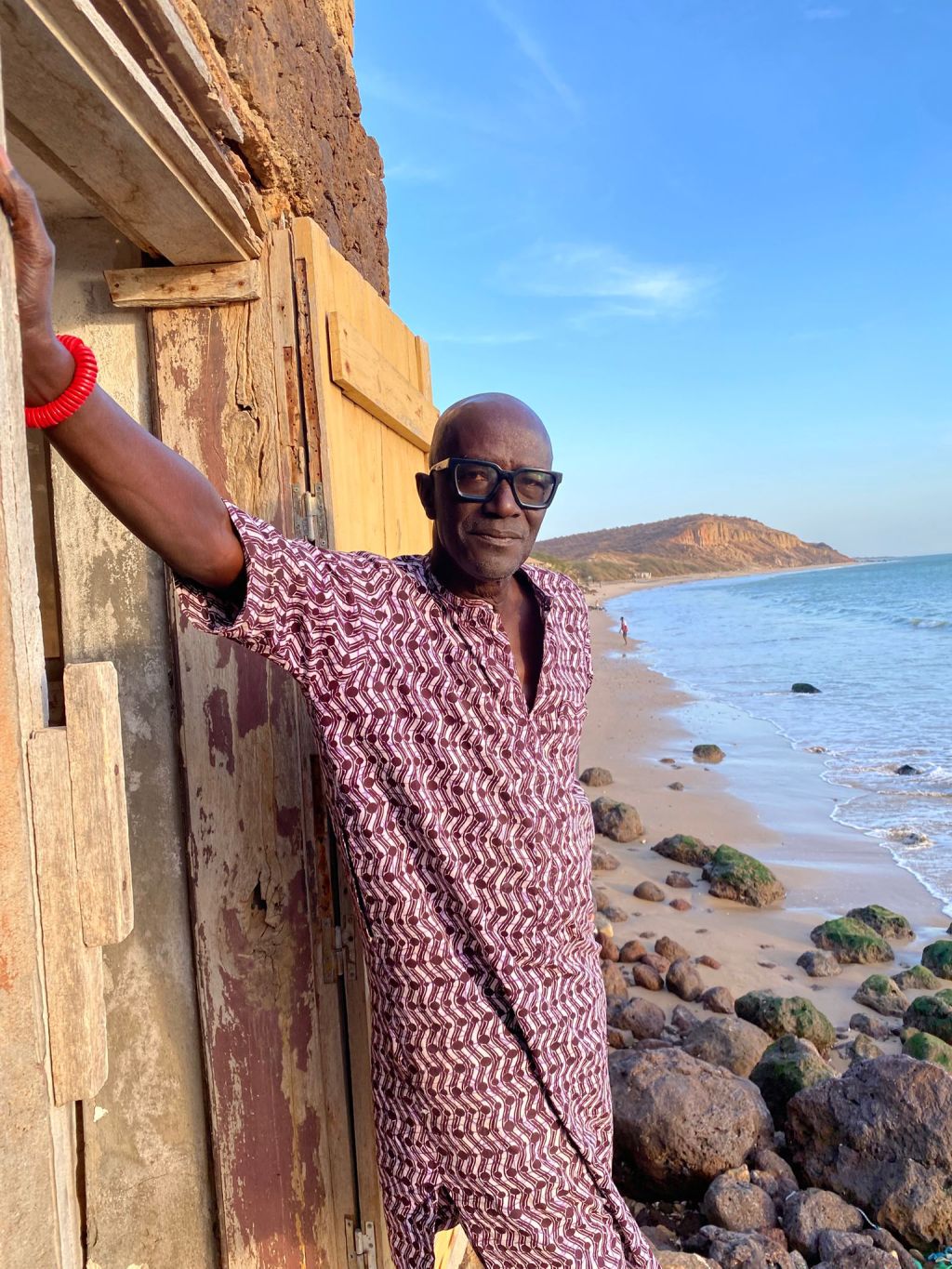

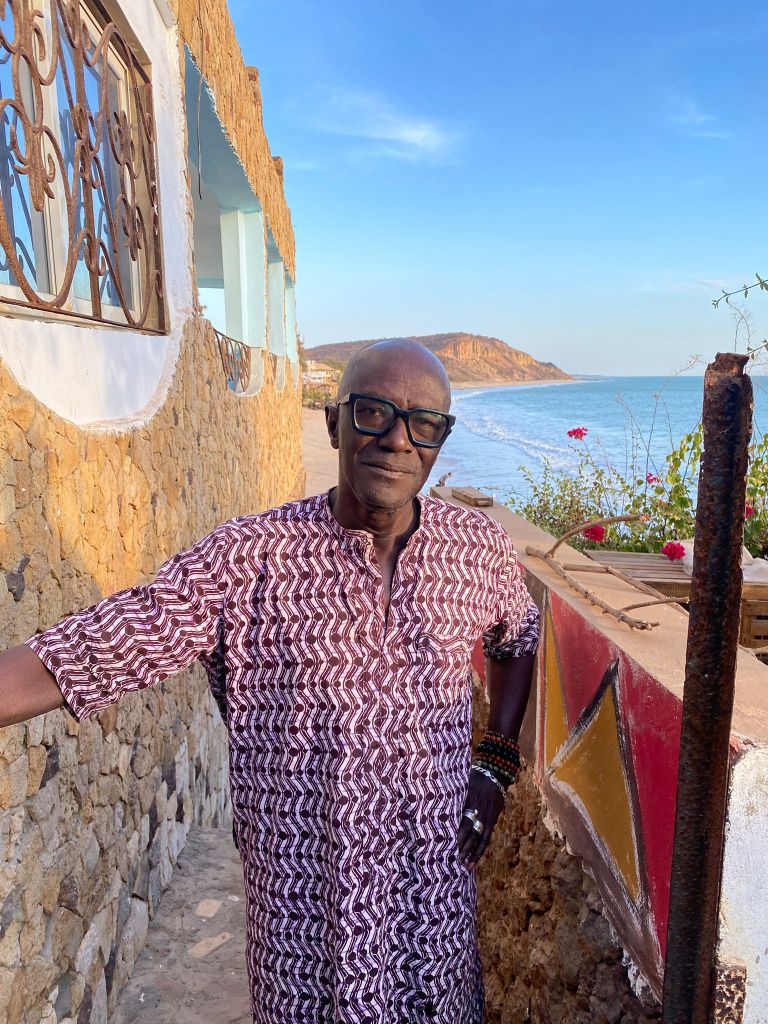
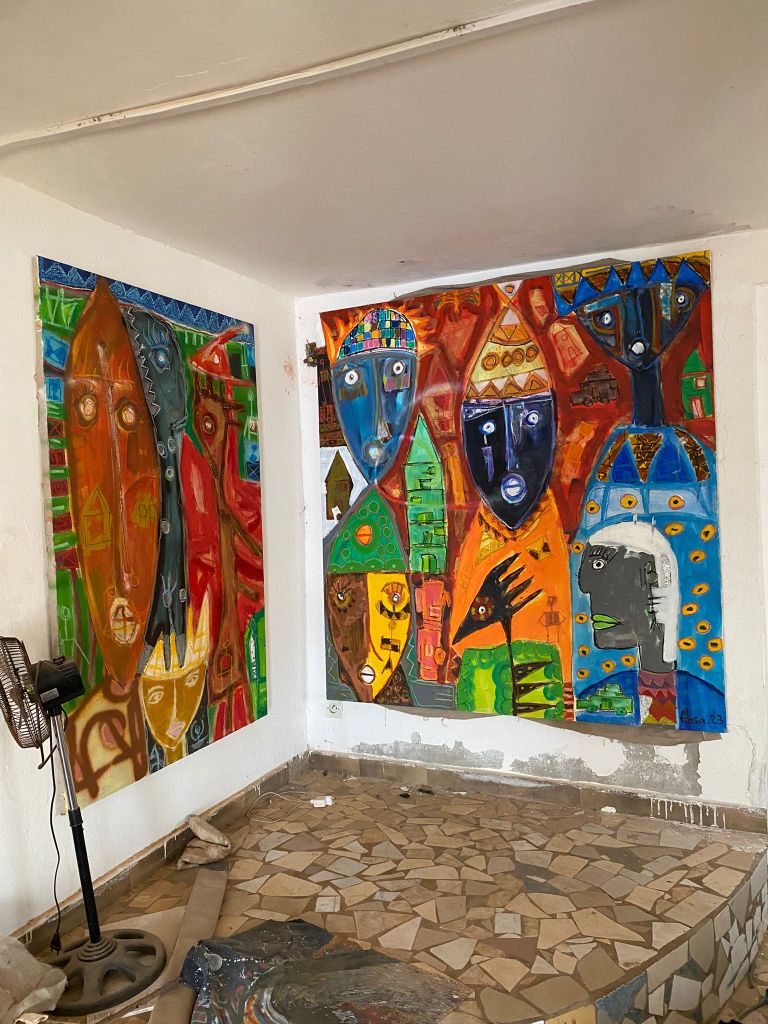
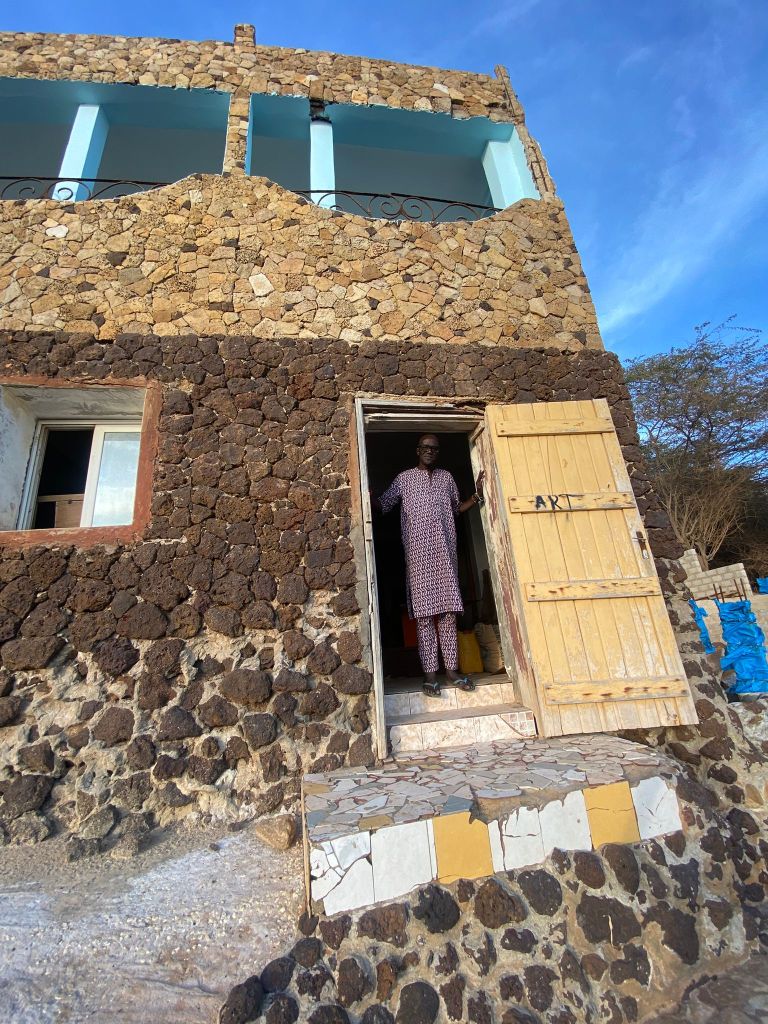
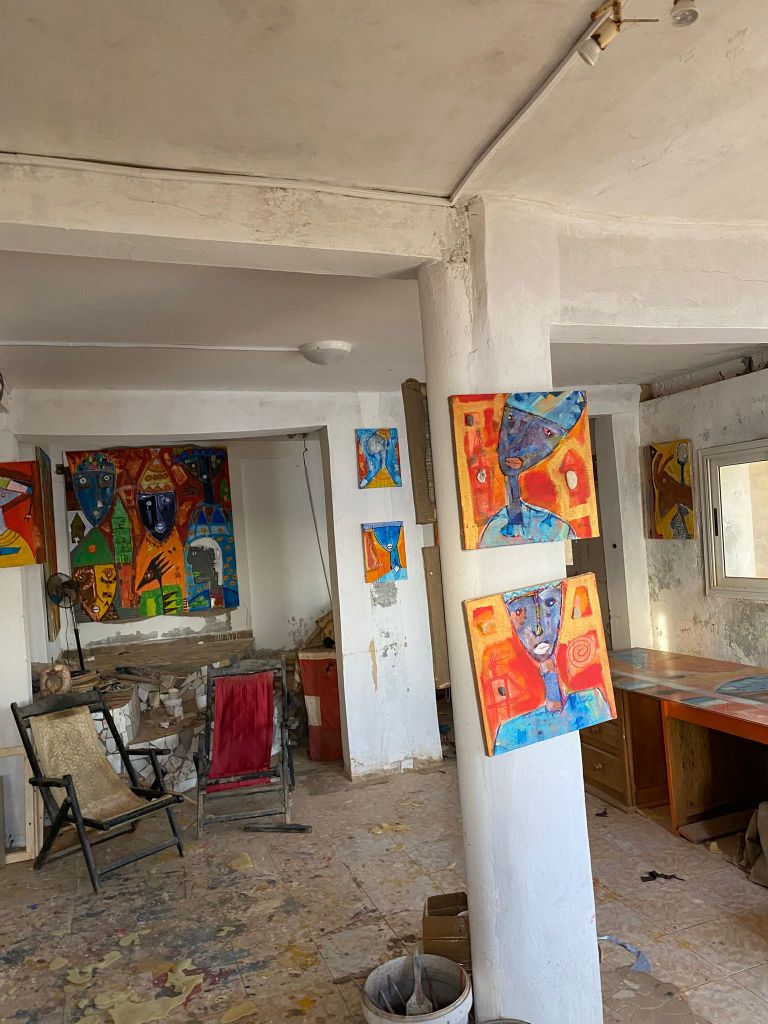
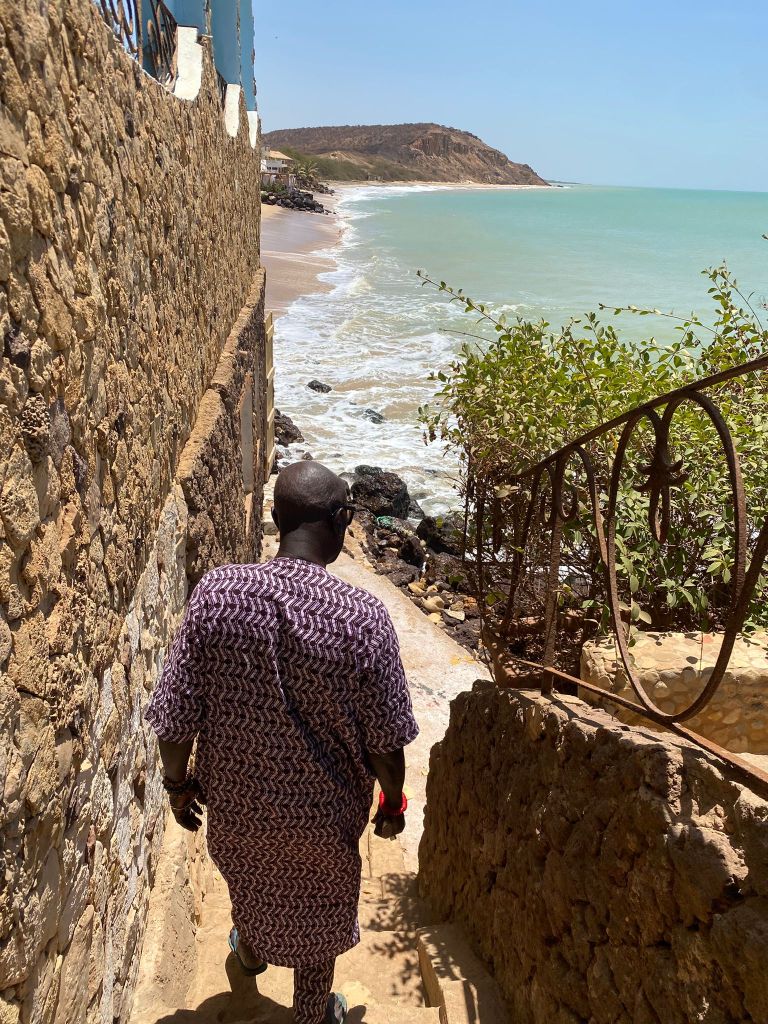
In the heart of Popenguine, a peaceful village on Senegal’s Petite Côte bordered by the Atlantic Ocean, Moussa Sène Absa opens the doors to his world. For more than thirty years, the filmmaker and multidisciplinary artist has chosen to live and create in this house-studio, where his workspace looks directly onto the sea. Painter, director, screenwriter, playwright, and musician, Moussa Sène Absa is a major figure in African cinema, known for landmark films such as Tableau Ferraille, Madame Brouette, and Xalé.
He has never separated his cinematographic practice from his work as a painter. For him, painting and cinema engage in an organic dialogue, two expressions of the same artistic quest. It is in this studio facing the ocean, with the sound of the waves in the background and the shifting light of the coast, that we met him for this studio visit. Surrounded by works in progress, brushes, and notebooks, Moussa Sène Absa spoke with rare sincerity and depth.
In this conversation with DakArtNews, he reflects on the intimate link between his two practices, on creation as an inner journey, on beauty as a fleeting instant of truth, on human finitude, and on the message he wishes to pass on to young African creators facing the challenges of the contemporary world — particularly the rise of artificial intelligence. An encounter in which the artist, far from the bustle of festivals, reveals his deeply inhabited vision of art and life.
How does cinema dialogue with painting in your work?
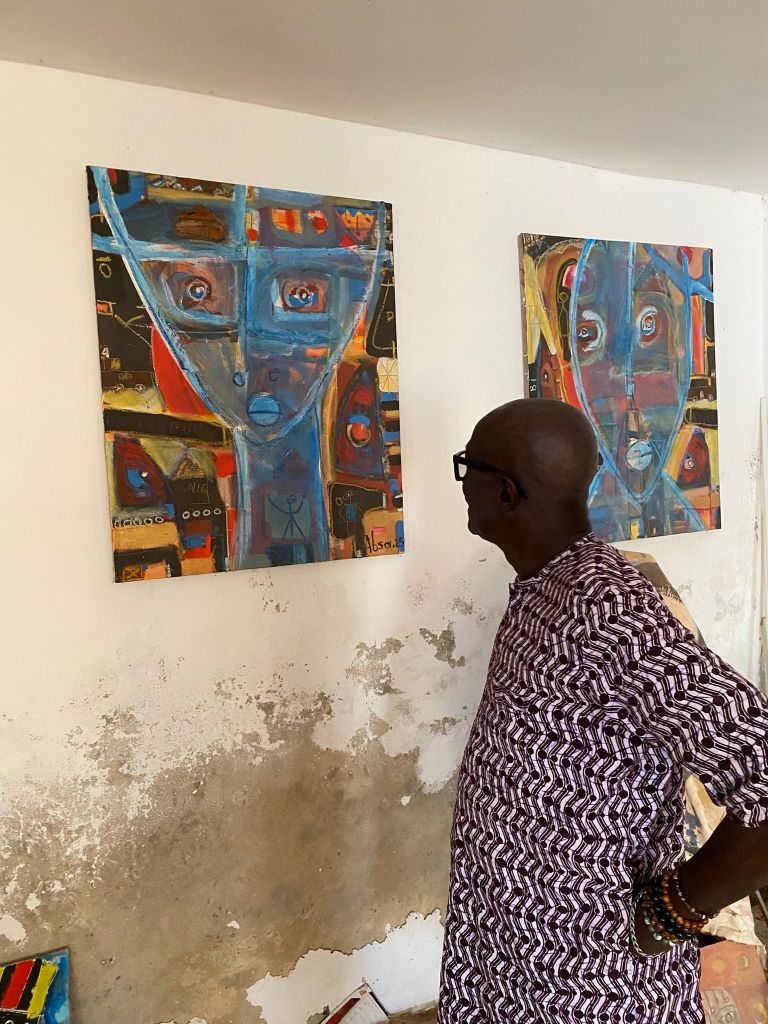
At the deepest level, it’s the same thing. Think of a bird: it flies, it walks, it jumps, it runs — and then it flies again. All art forms are connected in an almost organic way. For me, painting is like laying cinema flat on a surface. Cinema is made of shots, stories, depth, color, and gazes. When I paint, I’m always thinking about the stories I want to tell. I don’t just put paint on canvas randomly. First, an image appears in my mind. That image brings colors, shapes, and an entire universe with it.
My job is to translate that inner world — the stories, sensations, and impulses I carry — onto the blank canvas or whatever material I’m working with, until it becomes something that feeds the viewer’s mind. It’s a truly organic relationship. Cinema is almost holistic: it brings together music, theater, dance, literature, and poetry. But painting is also a complete art in itself. You find movement and depth in it. A single canvas can evoke a book you once read or a universe that once lived inside you. Everything intertwines.
Could one say that you paint your films?
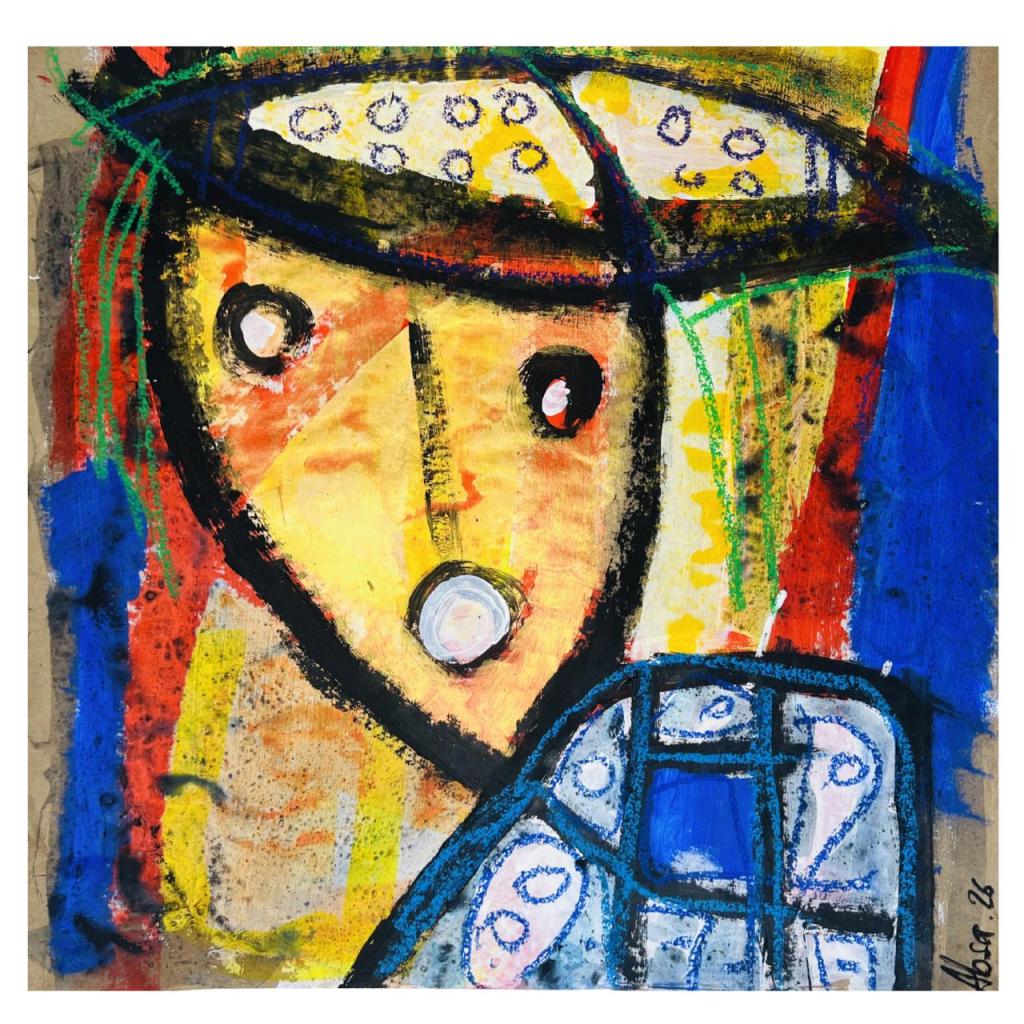
I paint the very substance and texture of the film. I try to capture a scene, a close-up. People often say I paint a lot of characters and faces, but what I’m really painting are expressions. It’s the same feeling I get walking through a forest: no two baobabs are ever alike.
Each has its own character — rough in one place, smooth in another, slender or massive. That’s exactly how I approach screenwriting: as collections of images. I can close my eyes and instantly be in the forest, in the city, facing the sea, or inside a dream. I paint many dreams — hybrid figures, almost otherworldly beings. That’s what I do.
If your paintings were a film, what would be the title?
Life itself. I paint life — its emotions, its sensations, the things that move me and the things that revolt me.It’s like Picasso’s Guernica: you wonder what possessed him to create something so monstrous, yet so monstrously beautiful. It was war, of course, but beyond war, it was about making war beautiful and deeply moving. War destroys lives, bodies, worlds, and dreams.
That whole reality is what I paint: life in its grandeur, its dreamlike quality, its almost immaterial side.It’s like scratching an itch on your skin. At first it feels good, but if you keep going, it bleeds. From pleasure to pain, from pain to death, from death to whatever lies beyond. These are existential questions I explore in my work — like links in an endless chain.
Yet we are finite beings, and it is precisely that finitude I paint. We are here today; in fifty or a hundred years, we will be gone and others will take our place. What matters is to leave traces of our time — to be truly “of one’s time”: to draw from our deepest sources and preserve them for future generations.
You have been painting from Popenguine. What does it mean for you today to create from here?
Popenguine is a healthy, peaceful place — a place where the spirit has wandered freely and where local cosmogony has long attributed strong virtues. It’s no coincidence that Léopold Sédar Senghor loved coming here to write. There is a kind of harmony here between spirit, body, and matter. Pope John Paul II visited in 1992; I saw him pass by, and I’ve always taken pride in that.
Places have their own spirit; they are inhabited. For me, the spirit of Popenguine is one of fraternity and joy — almost an ode to joy. People often ask if I’m not afraid living here alone. On the contrary, this is where I feel safest. There is peace here, a beauty that soothes me. Every time I feel the pull to return, it feels almost mystical. I sometimes joke that I don’t know where paradise is, but if you want to get there, you have to pass through here first.
“When I paint, I forget myself.”
Do you create first to Senegalese people or to the world?
I paint to unload myself. I paint to empty myself of a moment of plenitude, of a moment when I feel something very deep that stirs me. I am almost pregnant with something and I want to bring it out. I bring it out for the world — for the lovers of beauty, for the lovers of things that are not material. When you see this canvas with all these colors, you say to yourself: but this is not material. Can we create that? Of course we can. In another world, it exists. But that world belongs to everyone. It is not only my world; it is the world of the moment.
You ultimately have a mystical vision of creation?
When I paint, I don’t think about anything. I enter another world. It’s an inner journey. I forget myself completely. Sometimes I’m so absorbed that someone could walk in and I wouldn’t even notice. I’ve gone off on what I call my pictorial wandering — my mind is elsewhere, in a place that feels incredibly good. I feel comfortable, fully alive, even loved. It’s a protective bubble, far from revolution or violence.
I might start painting at six in the morning and suddenly realize it’s noon. I look up and wonder what happened. I had simply gone on a journey. The more I paint, the more clearly I see the spirit that inhabits the canvas. That spirit isn’t with me right now, but it was present while I worked.
For you, what is art?
Art is like an anointing from God upon our forehead. It is when God blesses us. For me, art belongs to the divine order. It is God’s gift, allowing us to marvel and to imitate Him in some small way. After all, the greatest Artist is the Lord — the One who created human beings, breath, speech, the verb, the sea, the sky, and that perfect balance that lets us stand on two feet and walk without falling. All of this invites us to reflect: Who are we? What are we made of? What makes us unique? Even siblings or twins have different DNA. What makes each of us a fragment of God? To me, human beings are sacred.
So art, for you, is something divine?
Yes, absolutely. Art has something divine about it. Just look at a sunset. Like the sunsets here. Sometimes you look at the colors and you say: but God is an extraordinary painter.
What is art for?
Art helps us to live, art helps us to be happy, art helps us to reflect on our condition. In fact, art is what makes us human. If there is no art, there is no humanity. A dog does not know how to contemplate a beautiful sunset. The human being can. What makes him look at the sun and be moved by so much beauty, by so much grace? The animal does not have that. At least, no one can know if a dog looking at the sea or the sunset sees that it is beautiful. The human does.
Some Senegalese billionaires fill their homes with Chinese artworks or reproductions of Picasso. They have millions, yet they haven’t been touched by this grace. They are fed only by material things. They see only money. They don’t know how to marvel at God’s gift — the sublimation of beauty that can bring tears to our eyes. People who look at a canvas — even a Dali, Picasso, or Matisse — and say “What is this? It’s nothing” simply haven’t been visited. They lack that sensitivity. They have sensitivity for beautiful clothes, cars, or houses, but not for art. That, to me, is the coldness of matter.Art irrigates the spirit. It is the fertilizer of the soul. It creates radiant people rather than closed ones. This grace is what makes life truly beautiful.
Is there a message that your art carries?
My quest is more about wonder than delivering a message. I paint to inhabit my own consciousness, to beautify it, and to become more human. The more I paint, the more human I feel.
What is the part of beauty in this quest?
The part of beauty is the moment when you feel it is finished and you sign. That moment is the moment of truth. It is that quest for truth. You paint and paint, and at one point you look at the canvas and it is finished. That is the instant that is there — the moment of truth, the moment when you say: I stop here.I stop here, not for the work, because the work continues. The work will be shared by others. You put it in your living room, a visitor comes, he sees something in it; another person comes and sees another detail. It multiplies, it irradiates the space, it gives meanings. It is a multiplier of meanings in the universe in which it is placed. It helps to travel in the mind.
What is beauty for you?
Beauty is the moment. Beauty is the moment and the gaze. It is the moment of the gaze. It is a moment of sensation. It is a moment of dream. It is in the dream. For me, beauty is the moment of Truth.
In what way does painting influence the way you see cinema or your artistic direction in cinema?
Cinema is a complex art with many layers — narrative, visual, emotional, musical. It has rhythm, almost a theological dimension. Painting helps me find equivalences across all art forms: music, dance, theater, poetry. There is poetry and rhythm in a painting, and even literature behind it. My quest, whether in cinema or painting, is to touch things that humans struggle to express or name — deep feelings, impulses, images in the mind that are hard to materialize.
It’s about recovering the spontaneous freedom of a child drawing without overthinking. That, for me, is beauty: a close-up where you witness the blossoming of truth in a single instant. But I won’t start with the close-up. I’ll begin with a very slow, almost imperceptible tracking shot. As the dialogue unfolds and emotion settles on the face, I gradually move into the extreme close-up — and there, the truth of that moment reveals itself.
In the current African and Senegalese context, do you think we should prioritize engineers or artists?
It’s good to train engineers, but without soul, what’s the point? I was recently speaking with a friend I deeply admire — a mathematician and agrégé who also writes poetry. He sees poetry and mathematics as closely related.
Strangely, all the great scientists I know possess great sensitivity and even spirituality. It comes from approaching the absolute, from coming close to God, to perfection. Engineers need beauty, justice, and the divine. The beauty of a bridge or a building follows mathematical rules, yet there is profound beauty in that rigor. Art and science are not opposites — they are complementary. They nourish and accompany each other, like the different fingers of one hand.
What advice would you give to young creators?
Be yourself. Don’t try to resemble anyone else. You can draw inspiration from others, but you will never be them. You are unique, like a fingerprint. You came into this world for a reason. You have a role to play and traces to leave. You are not here merely to eat, have children, and sleep. You have a mission.
What is that mission?
It is to deconstruct. To dismantle the heavy negative baggage we inherited — the idea that Africans were once seen as savages, less than human — the weight of slavery and colonization. To do that, young people must know themselves, know their history, and understand the stakes of today’s world.The greatest urgency is to create their own opportunities, to multiply, to leave indelible marks, and to truly inhabit their time — without chasing bling or superficial trends.We are entering the era of artificial intelligence, and it frightens me. Where is this journey leading? Will robots replace humans? Will we lose the need for one another? The idea that we might no longer need to communicate, to look at each other, terrifies me.
In 100 years, how would you like people to remember you?
In a hundred years, I would like to be remembered as someone who carried stories, who marked his time, who left paintings, images, films, and ways of seeing the world. I hope people will say: “Moussa had already sketched that…
Moussa was right. He was ahead of his time.”I dream of a reunified Africa, sovereign over its resources, that brings a “supplement of soul” to the world — the essential things the technological world may have forgotten. Africa as the primordial continent, a source of life and humanity once again.
 Bridging Africa and The World Through Contemporary Art
Leave a comment