
HEALING: Connecting Threads of Traditional Wisdom is a celebration of the spiritual ties that unite peoples, cultures, and histories. Through the art and indigenous spirituality of Jim Yellowhawk, a Lakota Sioux artist from the USA, and Baye Ndiaga Diouf, a Senegalese artist deeply rooted in both African traditional spirituality and his Sufi (Mouride brotherhood) Muslim faith, this unique artistic encounter offers profound reflections on the dialogue between traditional spiritual expressions and their associated cultural identities and histories. The exhibition is presented as part of the 14th edition of Partcours in Dakar.
Resonating with the philosophy of the noted Senegalese philosopher Souleymane Bachir Diagne, who calls for reinventing a “universal enriched by all particulars” and celebrating “the affirmation of the world’s plurality,” this exhibition charts a new path. Here, the universal is not a uniform abstraction but a living space enriched by the diversity of cultures. This unprecedented dialogue between Senegalese and Native American artists echoes historical encounters, such as the expedition of Abubakari II, the Malian emperor who, in the early 14th century, is believed to have crossed the Atlantic to engage in respectful and equal exchanges with indigenous peoples of the Americas.
In a world of growing complexity, HEALING: Connecting Threads of Traditional Wisdom serves as a powerful reminder of the need for connection, understanding, and mutual respect, offering an antidote by exploring how art can transcend divides and unite us in a shared humanity.
The works resulting from this artistic collaboration are exhibited to illustrate how art serves as a spiritual bridge between histories, a balm for wounds, and a call to universal connection. Jim Yellowhawk, inspired by Lakota spiritual teachings, and Ndiaga Diouf, reflecting ancestral African rituals and Mouride Sufism, take viewers on a journey blending the spiritual and the material world. Their works demonstrate the healing and unifying power of art.
Co-curated by Rémy Mallet, founder of DakArtNews, and Paul G. Chandler, president of CARAVAN Arts, HEALING: Connecting Threads of Traditional Wisdom reaffirms the power of art to connect us to ourselves, to others, and to what transcends us. More than an artistic collaboration, it is a call to honor our diversities and unite in our shared humanity.
The Artists
Jim Yellowhawk
Biography
We Are All Related (“Mitakuye Oyasin”)
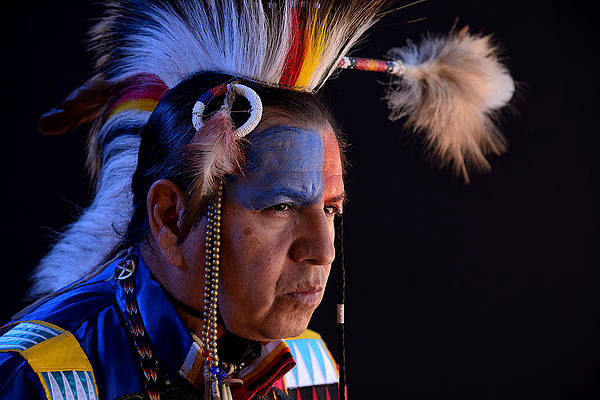
Jim Yellowhawk is an enrolled member of both the Itazipco Band of the Lakota, Cheyenne River Sioux Tribe, and the Onondaga, Iroquois Nation. He grew up on the Cheyenne River Reservation in South Dakota, immersed in the artistic traditions of his ancestors. The grandson of master beadworker Annie Yellowhawk and son of artist Jerry Yellowhawk, Jim learned early that art can be ceremony – a way to honor memory, preserve cultural identity, and heal.
His formal study of art at Marion College and the Ohio School of Art and Design deepened his skill across media, but his work remains guided by traditional spirituality. Horse, buffalo, elk, geese, and eagle nations often appear alongside the medicine wheel and the flowing lines of ledger art, an historic form used to record Native American experience.
Yellowhawk’s practice is animated by what exhibition co-curator Paul G. Chandler describes as a call to “restore sacred harmony,” to reawaken awareness of our deep kinship with the earth and one another. His works invite viewers to walk gently, to remember that all things share the same breath, and to envision a wholeness beyond division.
For HEALING: Connecting Threads of Traditional Wisdom in Dakar, Senegal, Yellowhawk presents fifteen works – from The Great Race around He Sapa/Black Hills to Dragonfly Nation (self-portrait) – that chart a journey through grief, resilience, and gratitude.
During his three-week residency in Dakar, he created a diptych that opens a dialogue between his Lakota culture and broader African spiritual traditions, and co-created a collaborative work with Senegalese artist Baye Ndiaga Diouf, weaving together Lakota and Senegalese wisdom traditions.
Together these works offer a visual bridge across the Atlantic: an invitation to healing, to honoring ancestral wisdom, and to seeing that Indigenous vision belongs fully within the global contemporary art conversation.
Shannon D. Smith, Historian, Author and Director of Program Development, CARAVAN Arts
Exhibited Works

Toksha Ake / Till we meet again, 2011 Acrylic on ledger paper (Giclée canvas print), 20 X 18 inches 
Morning Prayer Song, 2017, Pencil, ink on ledger paper (Giclée canvas print), 8.5 x 40 inches 
Do you think they had FB back in the day?, 2017 Acrylic on ledger paper, 36 X 36 inches 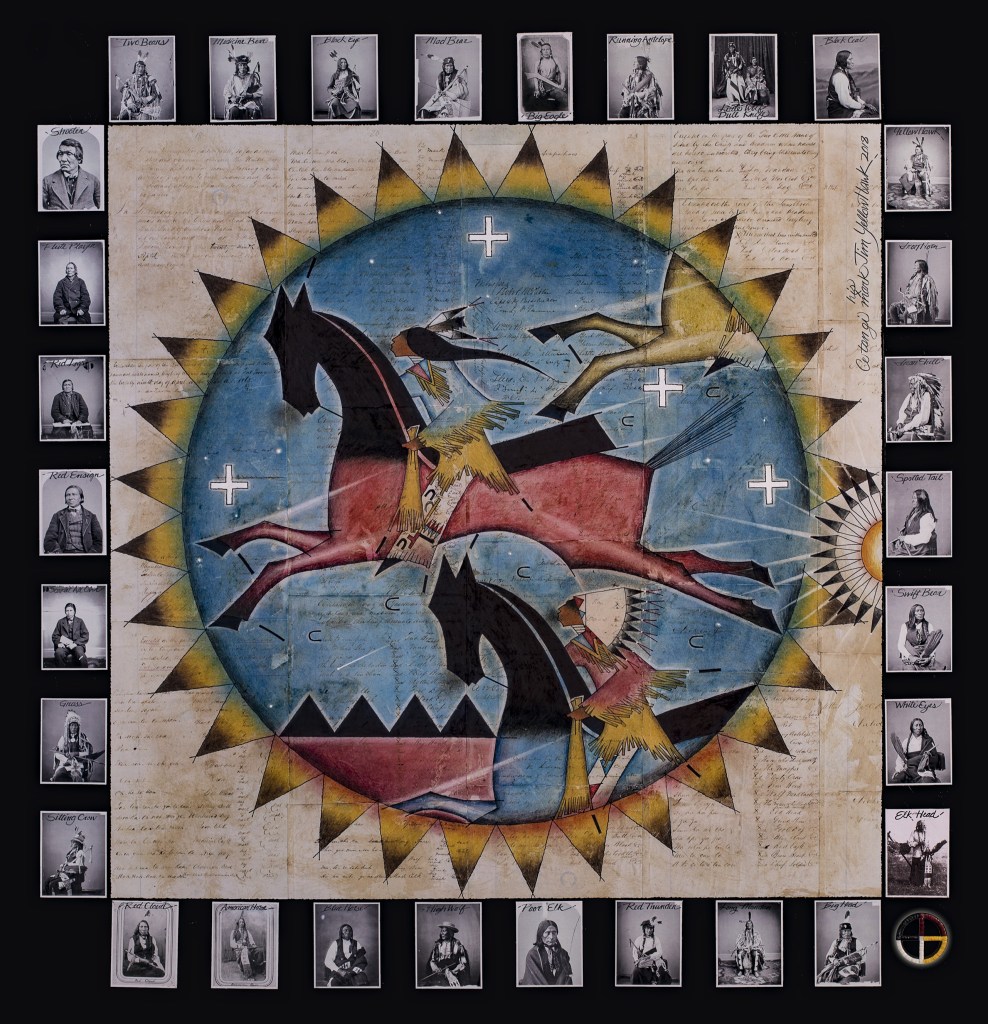
His X mark, 2018 Pencil, ink on Ft. Laramie documents (Giclée canvas print), 36 x 36 inches 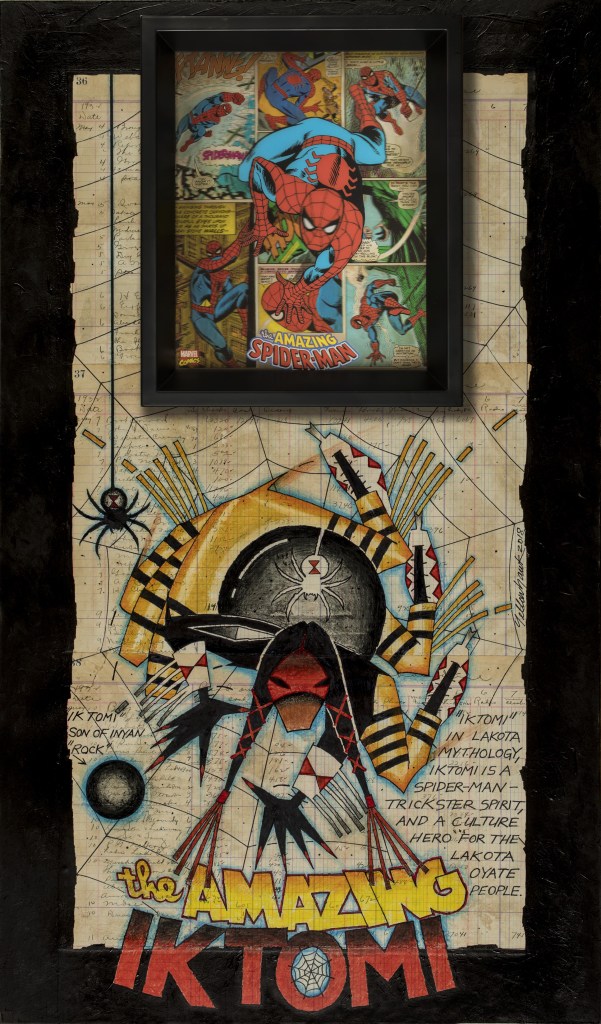
The Amazing Iktomi / Spider Man, 2018 Pencil, ink on ledger paper (Giclée canvas print), 14 X 24 inches 
Hehaka Pa – Elk Head, 2019, Pencil, ink on ledger paper (Giclée canvas print), 29 X 36 inches 
Facing the storm – Covid 19, 2020 Acrylic on ledger paper (Giclée canvas print), 16 X 20 inches 
We heard your whispers little ones, 2021 Pencil, ink on ledger paper (Giclée canvas print), 24 X 24 inches 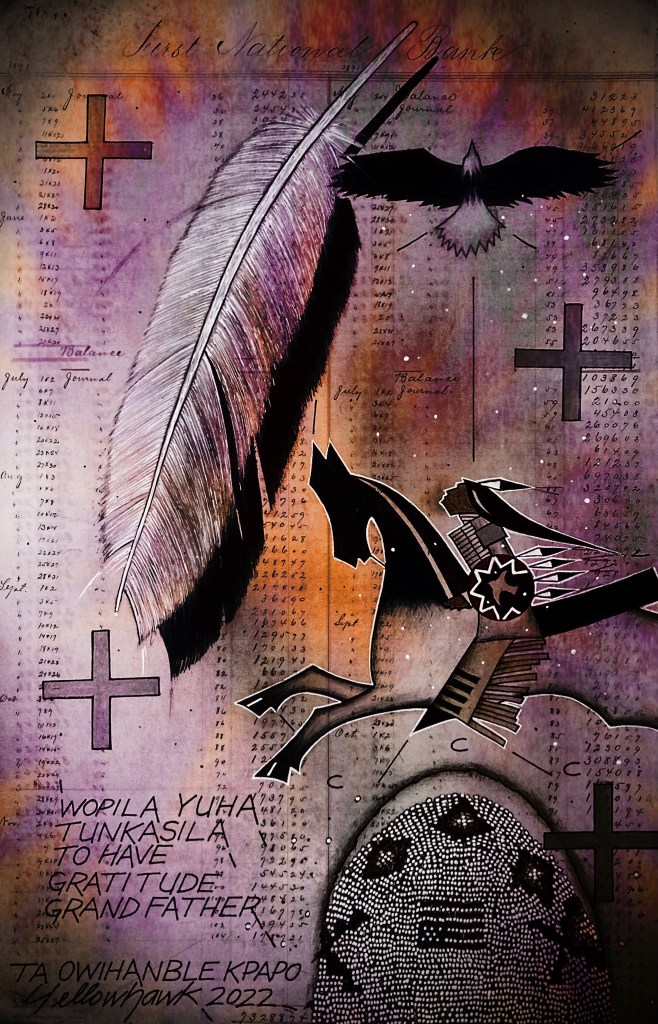
Gratitude, 2022 Pencil, ink on ledger paper (Giclée canvas print), 11 X 18 inches 
Pipe Carrier, 2023 Acrylic, pencil, ink on ledger paper (Giclée canvas print), 24 X 48 inches 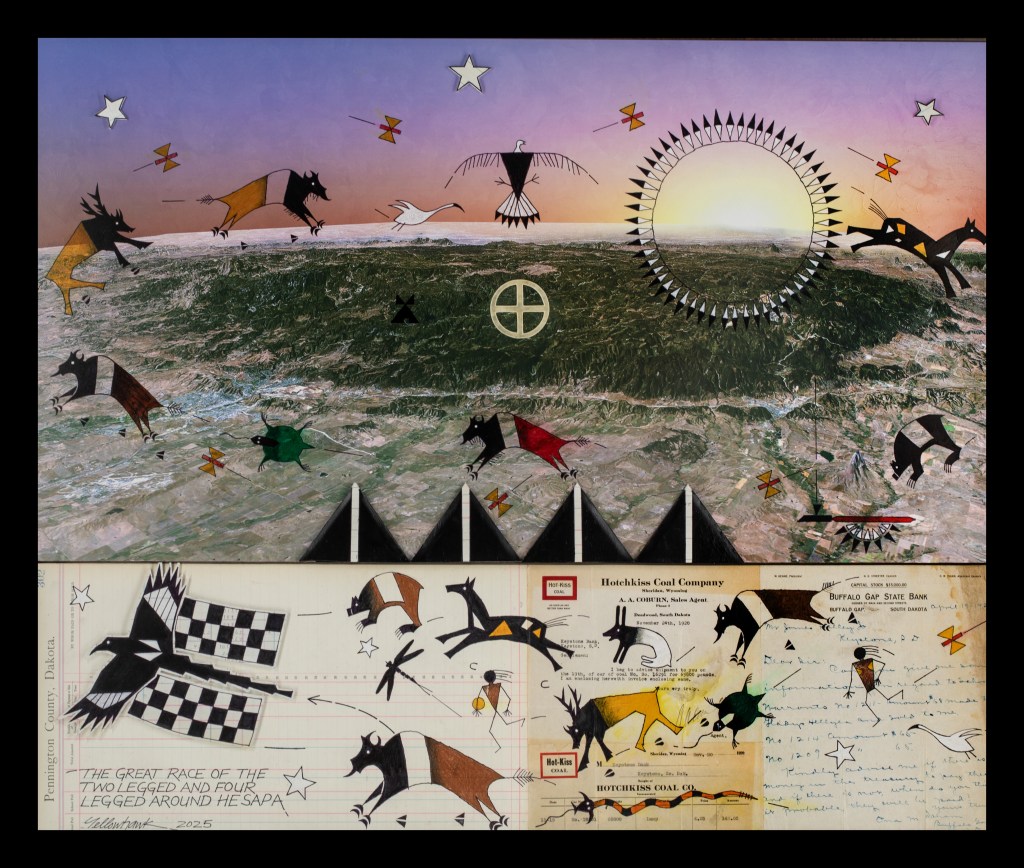
The Great Race around He Sapa/Black Hills, 2025 Mixed media (Giclée canvas print), 20.5 X 23.5 inches 
Makes them yellow, 2025, Acrylic, pencil on ledger paper (Giclée canvas print), 24 x 42 inches 
Pipe Carrier, 2023 Acrylic, pencil, ink on ledger paper (Giclée canvas print), 24 X 48 inches 
Dragonfly Nation (self-portrait), 2021, Pencil, ink, ledger paper (Giclée canvas print), 22 X 44 inches 
Dancing with My Ancestors, 2016 Acrylic, ink, quilled medicine wheel (Giclée canvas print), 20 x 20 inches
Baye Ndiaga Diouf
Biography
Baye Ndiaga Diouf (born Makhtar Diouf in 1991 in Dakar, Senegal) is a visual artist based in Nguekhokh, about 70 km from Dakar. From an early age, he nurtured a deep passion for drawing, tracing his first forms on baobab trees and the walls of his village using stone, wood, and charcoal. This visceral bond with nature continues to nourish the spirit of his work today.
In 2012, he left high school to devote himself entirely to art. Initially self-taught, he later refined his practice at the National School of Fine Arts of Dakar, from which he graduated in 2016. At the same time, he immersed himself in the workshops of Agit’Art and Espace Médina, under the mentorship of influential figures such as the late Ndoye Douts and designer Cheikha Siggil.
His practice—at the crossroads of painting, sculpture, and installation—explores spirituality, social issues, and environmental imbalance. He favors organic and symbolic materials such as Touba coffee, charcoal, clay, and kola nuts, which root his creations in cultural and spiritual memory.
His works have been featured in major events, including the Dakar Biennale (2022) with his Crisis of Values series and a monumental installation of iron shoes; the 1-54 Contemporary African Art Fair in London; and the 10th Salon des Arts Visuels du Sénégal (2019), where his work Cri de cœur was praised by the President of the Republic. He has also exhibited at Ségou’Art (Mali, 2018) and at the Institut Français of Dakar (2020, Gueew-Bi and Li Nu Bokk).
His journey has been enriched by artist residencies, notably at Alkebu-Lan (Marrakech, 2025) and the Maison Nzima in Grand-Bassam (Côte d’Ivoire, 2025). Today, Baye Ndiaga Diouf stands out as one of the promising voices in contemporary African art.
The Remedy of Man

Makhtar Ndiaga DIOUF’s painting mirrors the man himself. He seems to have stepped straight out of one of his own works. Like many of his figures and compositions, he is tall and slender, enigmatic, not easily deciphered — colorful both inside and out — and far more philosophical and wise than he allows to appear. Born in Dakar in 1991, he spent his early years in a village near Thiadiaye, at the heart of Serer country. Drawn from childhood to art, painting, drawing, and every form of expression, he entered the École des Beaux-Arts in Dakar, where he studied effortlessly from 2013 to 2016. He experimented with woodworking and design, but painting ultimately became his true language. Only painting allows him to express the richness of a personality that seems reserved on the surface, yet conceals a fascinating inner complexity — something one can only perceive through his work.
The artist quickly rose through what we call the stages of “success” in art: exhibitions in Senegal and abroad, residencies, glowing reviews. He could easily have continued along that comfortable path. But that would be to overlook his spiritual depth — a dimension that goes far beyond the kind of stylized “folklore” many young artists of his generation adopt when seeking to assert an identity. Two distinct forces coexist within him: a revolt against society and its excesses — its cruelty, its jealousies both real and imagined — and a contemplative spirituality that almost contradicts that rebellion. Having grown up away from the city, in a family environment where animist mysticism still holds power and meaning, blending harmoniously with revealed religions, he has forged a world in balance between these opposing forces — a synthesis whose secret and depth he alone understands.
We await with great curiosity his encounter with a thaumaturge from across the ocean — an artist with his own myths and methods for capturing and transforming them into works of art. Let us wager that this dialogue will be fruitful, for all that rises, converges.
The deeper layers of Senegal still know and practice, in their own way, a form of universal shamanism made of signs and symbols — one that requires initiation and an ongoing, fertile dialogue with those who preceded us in the march of time. The body and soul often serve as battlegrounds for antagonistic and negative spirits, and learning to recognize and confront them comes through genuine knowledge — whether inherited from others or forged through life’s experiences, however painful they may be.
All of this — and much more — resonates through Makhtar Ndiaga Diouf’s captivating work, which carries its message far beyond the visible, into the realm of the felt and the unseen.
Sylvain Sankalé, Writer, Art critic
Exhibited Works
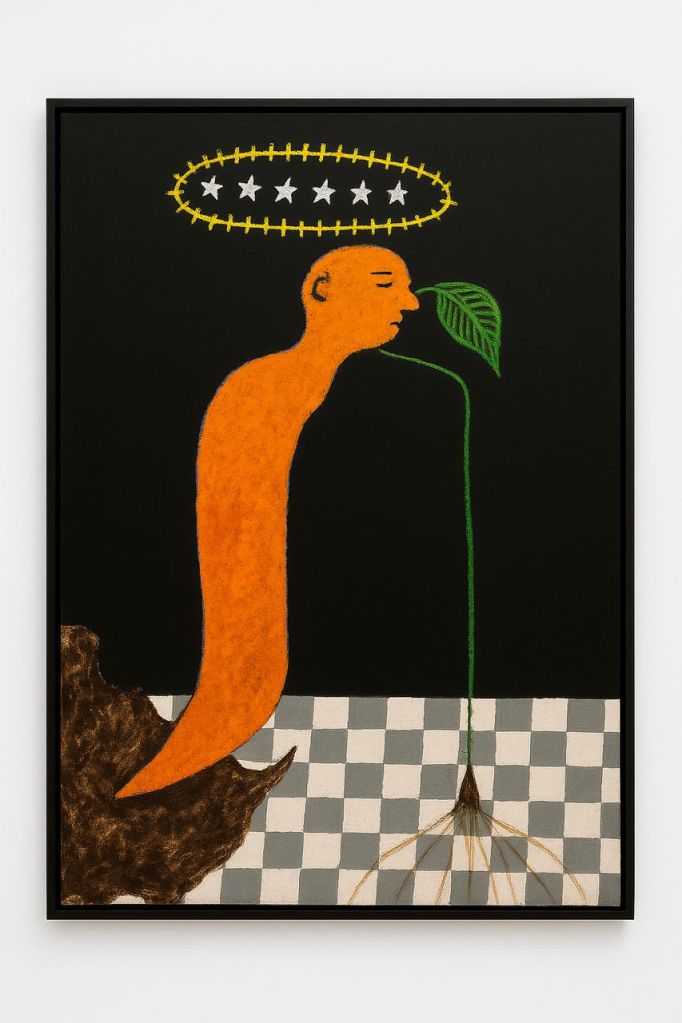
Alif Premier, 2025 Acrylique, Kola, poudre de café Touba et pastel sur toile, 80 × 120 cm 
Abandonner son ancien, 2025 Acrylique, Kola, poudre de café Touba et pastel sur toile, 95 × 155 cm 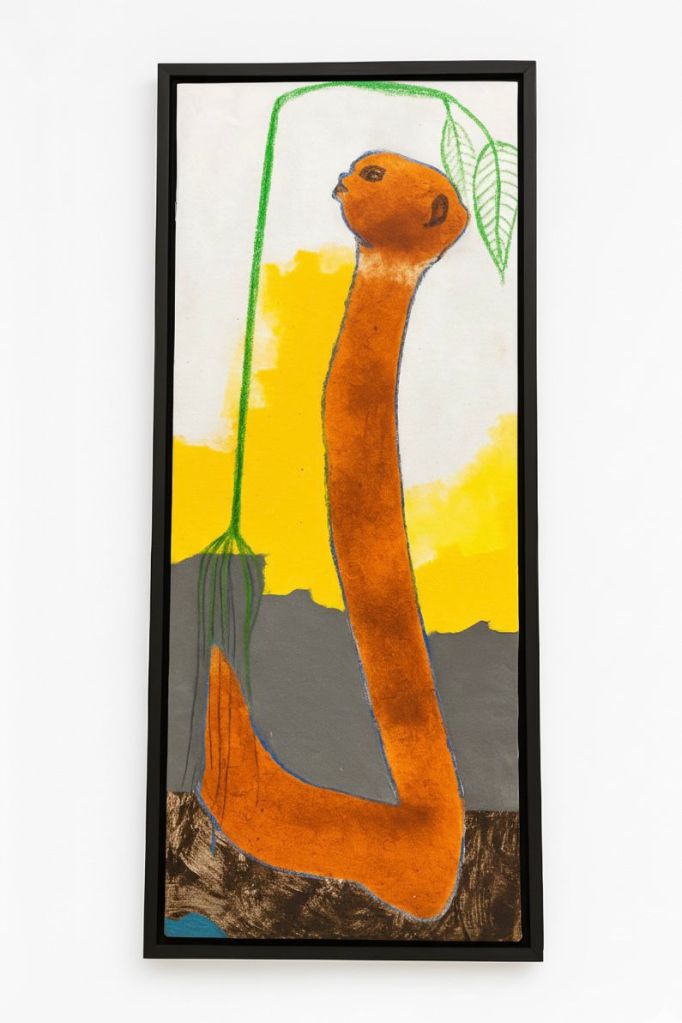
Lām, 2025 Acrylic, kola, Touba coffee powder, and pastel on canvas, 16 × 41.5 inches 
Les trois pilons sérère, 2025 Acrylique, pigments naturels de kola, poudre de café Touba et pastel sur toile, 95 × 155 cm 
Mon nouveau corps, 2025 Acrylique, kola, poudre de café Touba et pastel sur toile, 95 × 155 cm 
Jallalug Mīm, 2025 Acrylique, Kola, poudre de café Touba et pastel sur toile, 80 × 120 cm 
Alhassane 1er, 2025 Poudre de café Touba, charbon et pastel sur papier, 32 x 34 cm 
Légende de la rivière, 2025 Kola, poudre de café Touba, charbon et pastel sur papier, 32 x 34 cm 
Souffle du destin, 2025 Acrylique, Kola, poudre de café Touba, charbon et pastel sur papier, 40 x 30 cm 
La montée, 2025 Kola, poudre de café Touba, charbon et pastel sur papier, 39 x 29 cm 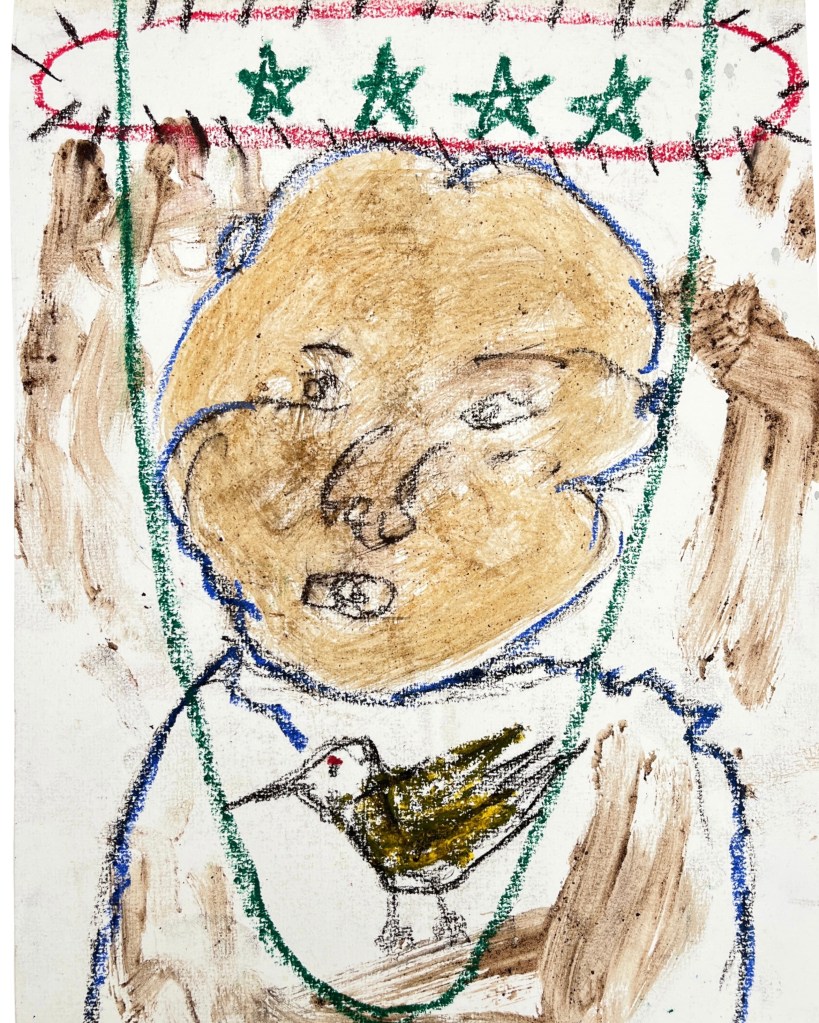
L’ancêtre Saliou Diouf, 2025 Kola, poudre de café Touba, charbon et pastel sur papier, 32 x 34 cm 
Boomerang cosmique, 2025 Acrylique, Kola, poudre de café Touba, charbon et pastel sur papier, 40 x 30 cm 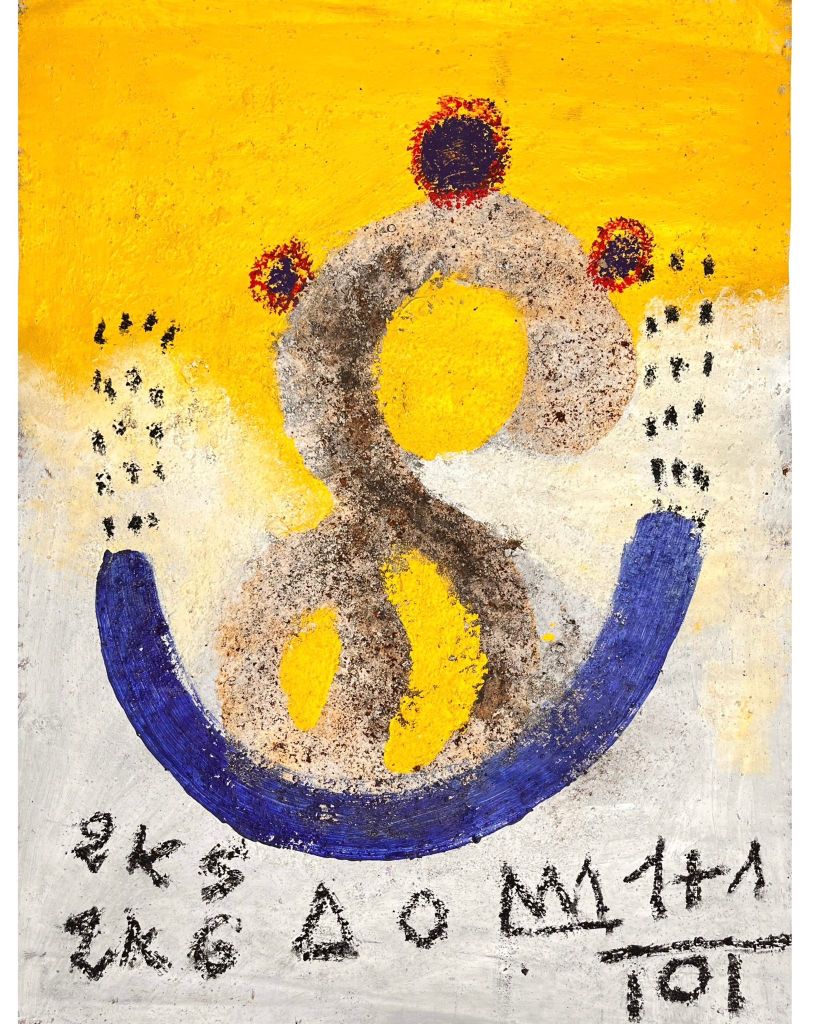
Galaxie des ancêtres, 2025 Acrylique, Kola, poudre de café Touba, charbon et pastel sur papier, 40 x 30 cm
Curation

DakArtnews exists to bridge Africa and the world through contemporary art. It promotes African artists, nurtures cross-cultural dialogue, and opens new pathways for global engagement with African creativity. Our curatorial approach is informed by a deep engagement with Africa’s artistic landscapes — from emerging practices to established voices — and by the conviction that art is a space for encounter, reflection, and transformation. DakArtnews offers artists a platform to connect with diverse audiences and with one another, while inviting critics and art professionals to exchange ideas and rethink the narratives of contemporary art.
CARAVAN, an international arts NGO/non-profit, is recognized as a global leader in using the arts to build bridges between diverse cultures, peoples and spiritual traditions, toward fostering a more harmonious future, both with each other and with the earth. CARAVAN’s mission is based on the belief that the arts can be one of the most effective mediums to heal our world and to creatively foster peace and harmony, by enhancing understanding, bringing about respect, enabling sharing, and deepening relationships between those of different backgrounds and worldviews. CARAVAN’s artistic initiatives have resulted in unprecedented partnerships with renowned and emerging artists from all over the globe, using art to transform our world.
Host Partner

Hôtel Le Djoloff is considered one of the most visually striking Art Eco hotels in Dakar, Senegal. A true architectural gem, it blends tradition and modernity with a West African-inspired design, featuring artwork and furniture crafted by renowned Senegalese artists. This distinctive venue, with its terrace overlooking Soumbédioune Bay, offers an experience that marries elegance and comfort with an ethical and ecological ethos, including buildings made of compressed earth bricks and an environmentally friendly air conditioning system. Beyond the visual arts, it has earned a musical reputation through its vibrant jazz club. Recently, Le Djoloff hosted the latest DakArtNews and Caravan Arts exhibition during the 15th edition of the Dakar Biennale, reinforcing its role as an artistic hub. This cultural prominence draws a vibrant mix of art-oriented travelers and celebrated artists, fostering an inspiring and intimate atmosphere. With this artistic foundation, Le Djoloff stands out as a premier “Arts hotel” in Dakar.
Partcours

Partcours is an annual artistic event held in Dakar, Senegal, typically in November. Founded in 2012 under the initiative of Italian artist Mauro Petroni and Cameroonian curator Koyo Kouoh, Partours brings together various artistic spaces such as galleries, museums, cultural centers, and foundations, offering the public a unique opportunity to explore a variety of exhibitions and artistic events throughout the city. This initiative aims to promote contemporary art and strengthen the local art scene by facilitating access to art for a wide audience. During the 13th edition of Partcours, which took place from November 8 to 24, 2024, alongside the Dakar Biennale, 33 artistic spaces participated, offering a diverse program of exhibitions and events. Partcours is a dynamic platform that highlights the richness of the Senegalese art scene and provides both local and international artists with a showcase for their work.
 Bridging Africa and The World Through Contemporary Art