
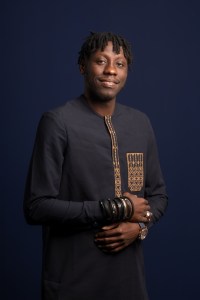
Alioune Diagne, creator of the figuro-abstro artistic movement, combines abstraction and figuration in his work. A native of Senegal, he is representing his country at the Venice Biennale for the first time. Dakartnews met the 39-year-old artist and father of 3. He reveals the inner workings of his creative process. His canvases, imbued with symbolism and mystery, arouse the curiosity and admiration of art lovers the world over.
After arriving in Somone—some 80 kilometers south of Dakar—I am warmly welcomed into Alioune Diagne’s place of residence for the past two years. The studio is situated on the terrace of a duplex apartment and bathed in light due to a large bay window facing the rooms at the front. A counter splits it into two, with the materials for the artist’s work at the back. The studio, with its swimming pool, brings in an effect that refreshes the serenity.
When I met Alioune, he was deep into his work. He is working on a cross-cultural exploration, Senegal and the United States, due for exhibition in New York some months later.

Installed on a small plastic chair in front of his canvas, he draws symbols with disconcerting speed. His vertical and horizontal strokes, inserted in circles, repeat themselves tirelessly. Gradually, these ideograms metamorphose into a variety of shapes and colors.
These graphics evoke the mystery of the Voynich manuscript, captivating and indecipherable. Are we in the presence of secret, esoteric codes or mystical symbols?
“Some people say it looks like Amharic, Arabic, or even Hebrew or Armenian. Everyone is free to see what they want. I don’t want my signs to look like anything specific. It’s my own writing, my own language,” says Alioune.
When stepping back from the canvas, these abstract strokes and signs reveal two Senegalese wrestlers and American basketball players from the Celtics and New York teams.
Illuminating the Invisible: Alioune Diagne’s Creative Process
One of the most remarkable features of Alioune Diagne’s work is the light that radiates from it. He obtains this by leaving white places in his paintings, and after piling up his signs and calligraphies, he expresses a part of the unconsciousness to obtain this effect.
Read : Saadio: The « Senegalese Basquiat » Shaping African Pop Art
By this technique, clarity and brightness come natural to his work.
Alioune Diagne often finds inspiration through sketches he may have scribbled earlier or through snapshots he has taken with his camera. Most importantly, he is searching for movement—capturing the momentary—later to be frozen on canvas. He starts tracing the outline of his work with a pencil, shaping the essence of his inspiration. It is at this point that he starts applying colour, breathing life and expression into his signs and symbols with spontaneity that characterizes his style.

An Evolving Technique
Alioune Diagne’s artistic style developed gradually over time. Born in Fatick in 1985, he grew up in Kaffrine, a town in central Senegal more than 200 km from Dakar. Despite the absence of museums or galleries in Kaffrine, his passion for drawing remained undeterred. From a young age, he drew incessantly, even though his classmates teased him, saying that “drawing is for losers.”
Read : The World of Senegalese Contemporary Art Through Sylvain Sankalé’s Eyes
His mother, separated from his father, tolerated his passion but was initially hesitant about him pursuing a career in art. In 2008, she finally relented, persuaded by his stepfather, and allowed him to attend the Dakar School of Fine Arts. However, two years into his studies, Alioune left without completing his course due to ongoing strikes. He then moved to Vienne in the Isère region of France with his ex-wife.
In France, Alioune encountered racism and discrimination for the first time. To make ends meet, he took on a series of odd jobs but never stopped drawing. His style at the time was figurative, focusing on portraits, still lifes, and landscapes, which he displayed in his French ex-wife’s craft studio. Despite modest sales, he persevered, taking private lessons to refine his technique, even experimenting with finger drawing. “I never wanted to do what other people did when I was growing up,” he says. “I always wanted to do something original.”
The birth of the “Figuro-Abstro” style
The death of his grandfather in 2013, a Koranic master with whom he was very close and whose name he bears, marked a significant artistic turning point for Alioune. Unconsciously, he began painting in the “figuro-abstro” style, as if his subconscious had absorbed the Arabic letters his grandfather wrote on wooden boards to teach his pupils the Koran.
That same year, he exhibited a piece in this style at the Lomanart in Dakar. “The painting was about education. It was a portrait of a child learning the Koran,” he recalls. “It mirrored my own situation as I explored this new technique. I traveled to Dakar to gauge the public’s reaction and received positive feedback from visitors. I couldn’t wait to return to France. When I got back, I said to myself: this is it, I’ve found my technique, this is what I’m going to develop.”
In the years that followed, he had a string of exhibitions in Europe, Asia, and Senegal, notably taking part in the Offs at the Dakar Biennale. In 2017, his unique style was highlighted in Aosta, Italy, during the Journées de la Francophonie, in an exhibition entitled “Un Nouveau Regard”.
From 2018 onwards, Alioune began to professionalize his career, a process catalyzed by his encounter with his current agent Gary Grauzamm, founder of We Art Partners. By 2022, he had secured a prestigious spot on the official list for the Dakar Biennale. That pivotal year, his exhibition “Ëttu Kër – inner courtyard” captivated visitors, among them President Macky Sall and several political figures, immersing them in a nostalgic portrayal of Senegal’s past through meticulously reconstructed traditional houses.
Scenes of daily life, childhood, women, memory, racism: all themes he explores with a unique sensitivity.
Dialogue with the Impressionists
Alioune Diagne’s work can be described as a search for dialogue between cultures and artistic currents. Like the Impressionists, he seeks to capture the essence and atmosphere of a moment through vivid colors and a spontaneous technique, but with abstract forms.
In 2023, he enriched this approach with a series of works inspired by the theme of the river, which he painted en plein air on the banks of the river in the village of Nguet Ndar, in northern Senegal.

This series, entitled “Ndox -Glint” (Sparkling Water), engages in a subtle dialogue with canvases by the great Impressionist masters housed at the Musée des Beaux-Arts in Rouen. His works suggest variations in light and color, combining spontaneity, abstraction and light to create a modern, personal aesthetic.
Bokk Bounds: Universal resonance in Venice
In 2024, Alioune Diagne made a remarkable debut for his country’s first participation in the Venice Biennale, representing Senegal with a monumental work entitled “Bokk Bounds”. “Bokk”, in Wolof, signifies that which we have in common. Consisting of 17 paintings and a broken pirogue, this installation is a narrative mural addressing significant contemporary themes such as migration, poverty, resource exploitation, racism, and communal living.
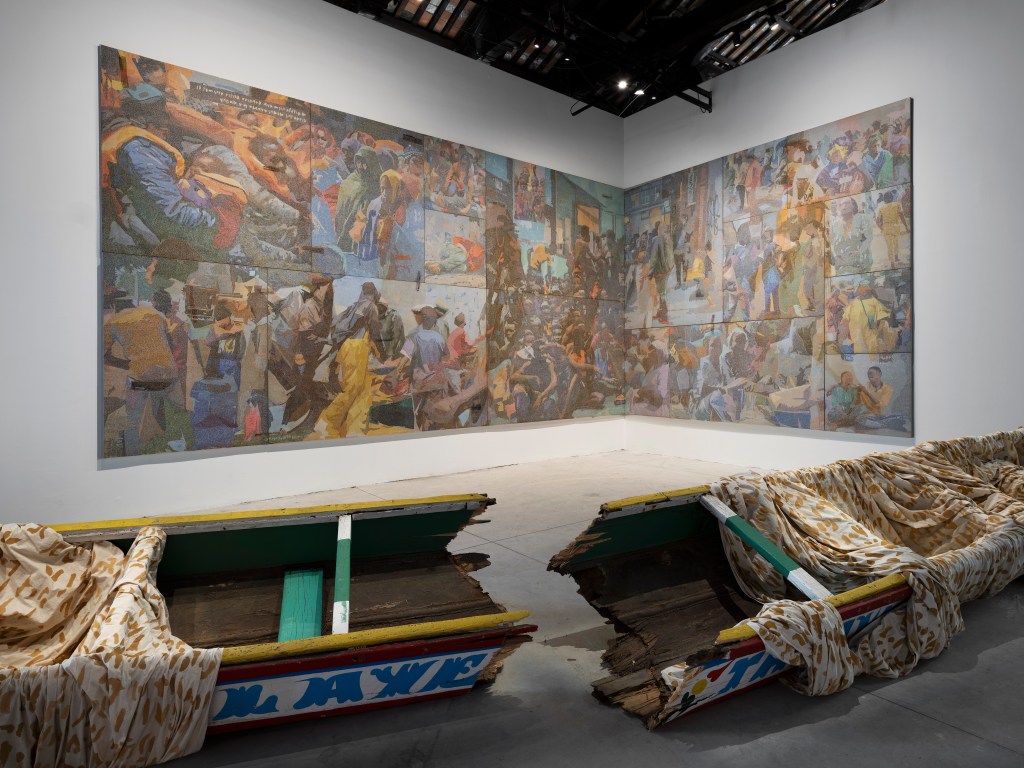
The fresco spans the corner of the Senegal pavilion wall, featuring a darker left side portraying scenes of exploitation and migratory despair, juxtaposed with a right side illustrating themes of freedom, cohesion, and education. Through the use of real-life scenes, potent symbols, and inverted narratives—such as George Floyd’s evocation of an African dominating a white man—the artwork offers incisive social critique, prompting questions about racial injustice and systemic bias.
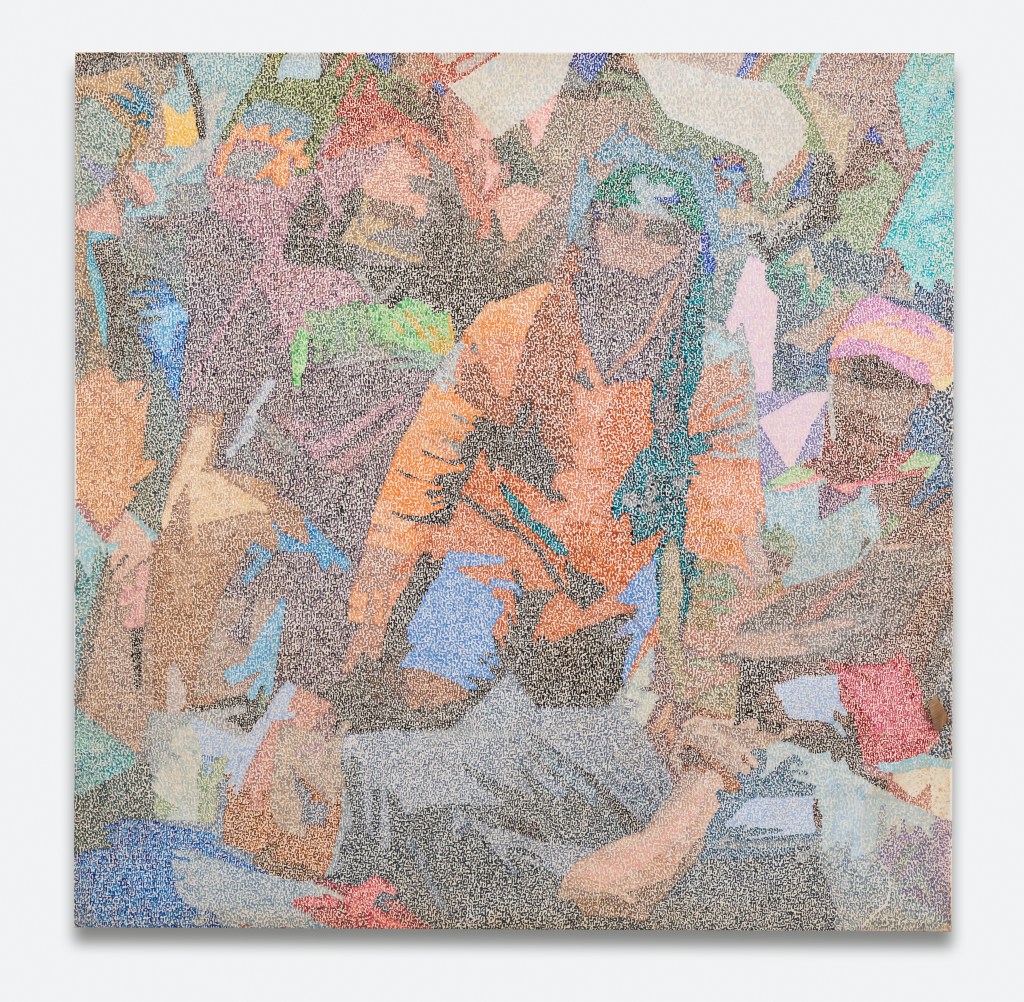
The broken pirogue at the center of the installation symbolizes humanity’s fractured bond while also invoking Senegalese identity, as the term “sunugal” translates to “our pirogue”. Through a fading effect, the artwork subtly incorporates the theory of evolution, depicting a monkey’s head gradually transforming into a human, symbolizing both biological and societal evolution.
With this work, Alioune Diagne achieves a profound reflection on contemporary challenges and the hope for reconciliation. He skillfully combines visual narrative and symbolism to encapsulate the essence of human struggles and aspirations, inviting viewers to engage deeply with the complexities of the modern world.
The Cryptic Language of “Figuro-Abstro
In Alioune Diagne’s artistry, technique unveils itself as a cryptic language wherein signs, akin to hieroglyphs, serve as gateways to a realm simultaneously clearer and more enigmatic. This interplay, this delicate balance between the visible and the invisible, appears to lie at the core of his creative journey. The artist delves into the labyrinth of the unconscious, unveiling strata of significance concealed beneath ostensibly abstract forms.
It’s as though each stroke, each motif, emerges from an intimate dialogue between the conscious and the elusive, bridging the realms of the tangible and the abstract. Indeed, these codes serve as the very voice for the characters inhabiting his canvases. The result is a profound sense of heritage, where traditional wisdom intertwines with the teachings of his grandfather. In this manner, Alioune Diagne’s art becomes a reflection of a nuanced reality, where the external seems to emanate from the internal, and where visible elements are imbued with unfathomable symbolism. Through the exploration of this duality, the artist unveils the hidden truths of existence—those nestled within the depths of the soul and finding their unique expression in his creations.
I refuse to have limits, barriers.
Alioune, which exhibition has had the greatest impact on your career?
The Venice exhibition was a crucial moment for me. Beyond my own experience, this exhibition has left its mark on Senegal’s artistic history. The 17 paintings I created for this exhibition were conceived in this studio here in Somone, despite the challenges I encountered, notably with the construction work outside that was bringing in the dust. The themes are inspired by Senegal, which gives this event a special significance. The Rouen exhibition is also memorable, being my first solo show in a museum. The experience was made all the more special by the fact that my paintings were placed in dialogue with works from centuries past by the great names of the Impressionist movement, an immense honor for me. The “Ëttu Kër” exhibition at the Dakar Biennale in 2022 remains engraved in my memory, because although it was part of the OFF, it was brought closer to the IN because of its exploration of Senegalese memory, featuring the country’s traditional houses in the 19th century. Each of these exhibitions has played a significant role in my artistic career.
The themes you explore are vast. How do you explain your choice of a wide range of subjects?
Contrary to the tendency that often prevails among artists, I refuse thematic limits and barriers. My ambition is to embrace cultural diversity through my work. I’m interested in Senegalese and French market scenes, memory and the essential role of Senegalese women in society. The over-exploitation of fishery resources is also a subject close to my heart, and one that I denounce through my art. My desire is to create a cultural mix that reflects the richness and complexity of our world.
How has your time in France influenced your art?
My experience in France was decisive in my artistic development. It’s where my artistic style emerged and where I found the tranquillity I needed to cultivate it. I’m grateful to France for the opportunities it offered me. My interest in the dialogue between cultures has grown, and I aspire to integrate this diversity into my work. If I agree to do paintings with Senegalese wrestling scenes and basketball scenes, it’s because I’m interested in dialogue between cultures. Of course, we’re all foreigners from somewhere, but at the same time we’re all linked by something: the land, the environment… In today’s world, if something happens in one part of the world, it has repercussions elsewhere. I’m all for living together and accepting others.
What motivated you to return to Senegal?
My return to Senegal is motivated by my desire to contribute to my country’s art scene and inspire the younger generation. I aspire to be a role model for young artists and encourage them to pursue their dreams, despite the obstacles. My presence here also aims to raise awareness among parents of the importance of supporting their children’s artistic aspirations. Given the difficulties I have encountered in entering the art world, I believe it is possible to succeed as an artist.
—————————————————————————–
Remi Demi
DakartNews
 Bridging Africa and The World Through Contemporary Art
Leave a comment