
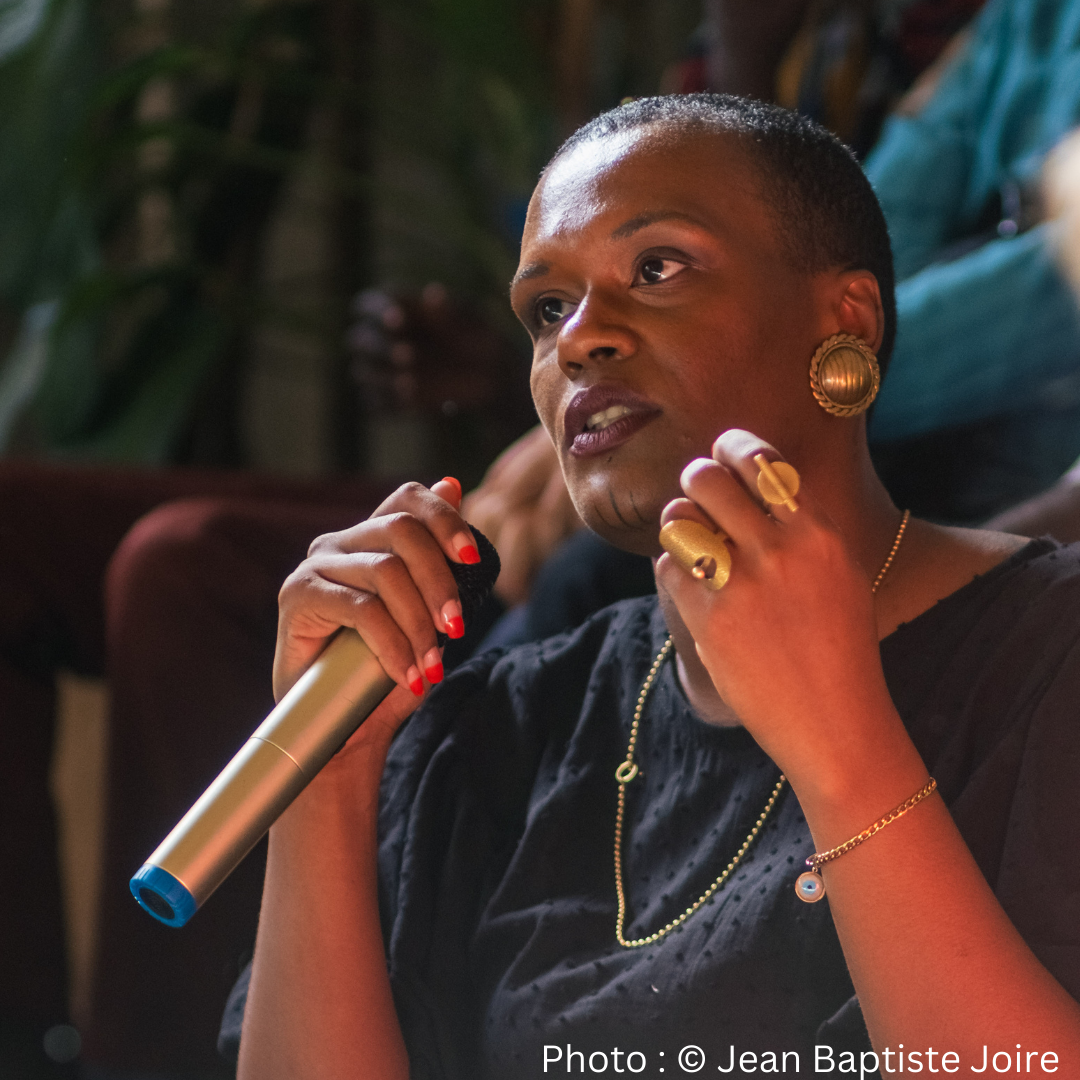

Ken Aicha Sy, founder of the cultural platform Wakh Art, is a leading voice in the fight for the recognition and appreciation of women in Senegalese art and culture. At just 35, this dynamic researcher and cultural activist has dedicated over a decade to elevating the role of women in the arts. Through her groundbreaking initiative, “Women in Art,” she facilitates powerful public discussions that bring together women from diverse cultural fields. DakartNews met with her on the sidelines of a public discussion at Raw Material Company.
Who is the female artist who inspires you the most and why?
It’s a difficult question because there are many who inspire me. But credit should be given where it’s due. The first person who helped me develop and encouraged me in my artistic career is my mother, who was a cultural journalist during her lifetime and contributed greatly to the construction of the Senegalese cultural scene. She always encouraged me to seek answers to my questions without passing judgment on what I could become. So she is my first source of inspiration. Apart from that, of course, there are many women who inspire me in the Senegalese cultural milieu. They are numerous and come from different generations. I am researching the history of contemporary Senegalese art, and I know that there have been women active in this field since the 1960s. Even now, there are women active in cinema, literature, music, dance, sculpture—really in all artistic domains.
But at the same time, they are not very visible. How do you explain that?
That is part of the questions I posed in the exhibition I am currently presenting at the Théodore Monod Museum on the contemporary history of Senegalese painting. I opened a section titled “The Survivors,” and I took the example of Younousse Seye, who is the first Senegalese female painter. She has been present with the pioneers of the “School of Dakar” since the 1960s, but no one has talked about her. This is an example to show that the history of contemporary art in Senegal includes women. There have been women, and there are many whose names have been erased, but when we look for them, we find them. Now, why does our society erase women? That is another question. I don’t claim to have all the answers, but these are questions I raise. I think it is time to take an interest in this because they have unlocked important things for Senegalese society.
Read also : The World of Senegalese Contemporary Art Through Sylvain Sankalé’s Eyes

Where can we see Younousse Seye’s paintings?
Younousse Seye has not exhibited in Senegal since 1996, and this is one of the tragedies we discuss in the film presented about her in this exhibition at the Théodore Monod Museum. It is visible until September 15, and I invite everyone to see it. She has not exhibited since 1996 because people have fought against her existence as a female painter. They fought against her existence as an actress because she acted in the film “Xala” by the Senegalese filmmaker Ousmane Sembène. I think it was a clear objective to render her invisible. During my research on contemporary Senegalese arts from 1960 to 1990, I found very few women, apart from Anta Germaine Gaye and Awa Seyni Camara. This is problematic. How is it that today no one could name a female visual artist if we conducted a vox-pop? I think these are questions to consider. To ensure this doesn’t happen again, in my current work, I give the floor to women. To ensure that in 10, 15, or 20 years, no one says there were no female photographers, gallery owners, or curators. The goal of my work is to liberate the voices and provide the necessary visibility to the women in this field who fight much harder than men to do quality work and honor the country both nationally and internationally.
What is the best way to support female artists?
I think it is important to give them the floor. Attend programs that concern them. If you have cousins, women, or sisters interested in cultural professions, encourage them. Tell them that these are respectable professions and that they can also succeed if they work in these fields. Tell them that working in this profession does not mean they will be looked down upon, that they won’t be good Muslims or good Christians; it has nothing to do with that. I think it is necessary to deconstruct the clichés we have about women in culture in general.
Do you think spaces for exchange like “Women in Art” are a way to achieve this?
I am happy that Raw Material Company welcomed us. That is why I developed Women in Art, which exists online. Today, we held a physical meeting and received support from the German Foundation Heinrich Böll to meet.
Is it not surprising that the support comes from Germany?
I have been in culture for 14 years, and very sincerely, I have never received any help from my country for the work I have done, and I have never waited for such help to do things. We have programs, we talk to people who will listen to us, and if the programs align with their values, why not collaborate? When I organize an exhibition at the museum and the Ministry of Culture commits to supporting the exhibition with 5 million Francs CFA, and the exhibition was inaugurated 3 weeks ago and no one from the ministry has contacted me, it is very clear, it says everything.
How do you feel about this situation?
I feel very well because I don’t have to wait for anyone. I do my projects and I have the chance and the ability to find solutions elsewhere. We don’t wait for anyone. It’s just unfortunate and sad that adults and respectable people make commitments and, in the end, do not honor them. It damages the credibility of the institution, and that I find deplorable.
Read also : How Alioune Diagne Forged the “Figuro Abstro” Style: His Journey from Senegal to the Venice Biennale
What would you advise a woman who wants to pursue a career in culture?
The first thing I would tell her is to hold on tightly to her dreams and give herself the means to succeed. This means learning, equipping herself, knowing what she is getting into, researching, doing internships, talking to mentors, talking to people in the field. People tend to want to do something, and when questioned, we realize they have done no research. Doing research in the field one wishes to work in is very important. When you want something in life, you have to give yourself the means. Talk to people, discuss the projects you want to implement. We have been led to believe that discussing would endanger our projects. But there have been people before us who have done things we would like to do. You have to talk to these people who can share their experiences, encourage you, and help you avoid the mistakes they made. Then you need to stay focused on your objectives and continue to train yourself.
After years in the field of culture, do you think you have had an impact?
I am grateful for what I have done. I am also grateful to continue doing it. I am thankful for the feedback we receive daily. Yes, I think we have an impact because that is what people tell us. Just as the women before us did important things, it is also necessary for us to do our part. The most important thing is that each generation does its part.
Interview made by Remi Demi
DakartNews
Leave a Reply