
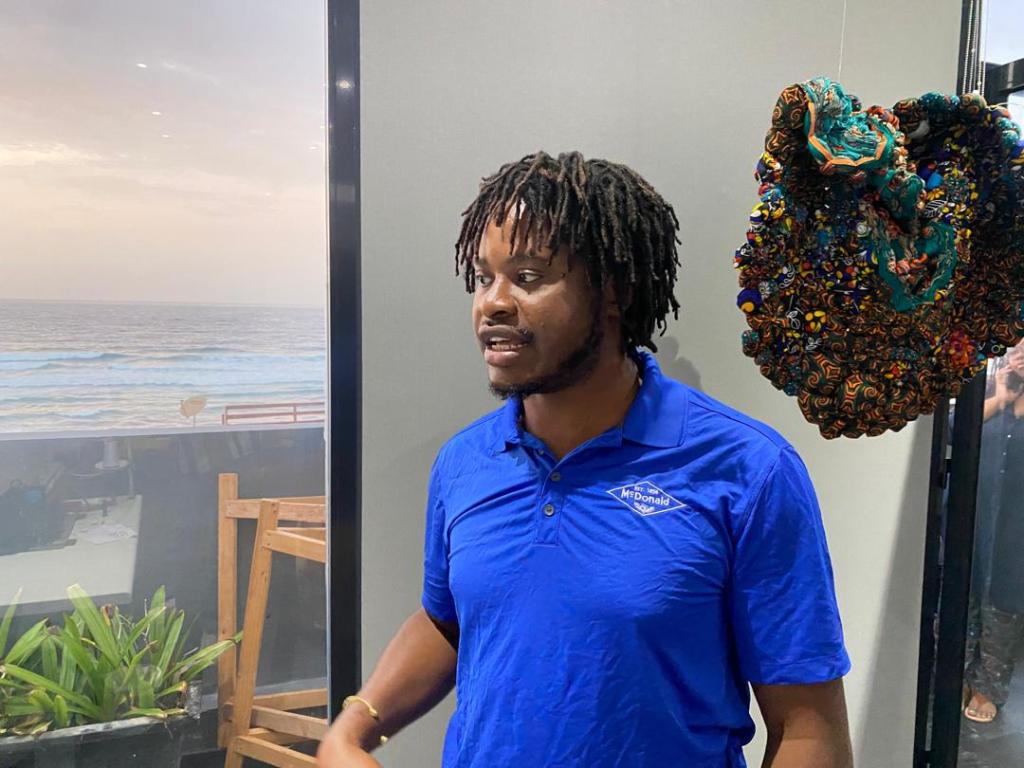

Born in Nigeria in 1990, multi-award-winning artist Samuel Nnorom opened the doors of his studio to Dakartnews shortly before the end of his artistic residency at Black Rock Senegal in Dakar. His artistic journey is deeply rooted in the exploration of metaphors, particularly through his concept of bubbles as symbols of uncertainty and the intricate layers of human complexity. Nnoroma’s work poetically crosses tapestry-like sculpture and pre-loved fabric. Recently exhibited in the group show “Encounters” during Dakart OFF, Nnoroma meticulously weaves sculptures with Ankara wax fabric, symbolizing these bubbles that represent health, psychology, or social dynamics that encapsulate our lives. His artworks invite viewers to reflect on societal norms and hidden truths within themselves and their communities.

My work is about looking at people as bubbles. It’s about individuals as structures that hold secrets, fears, mysteries, histories, and all that together. Then we live in the bubble’s world, which is a world of uncertainty. Even humans are uncertain by nature. I use my bubble to describe that idea of uncertainty. We put on clothes to cover some parts of us, our nakedness. We are living in bubbles, not exposing that which is inside.
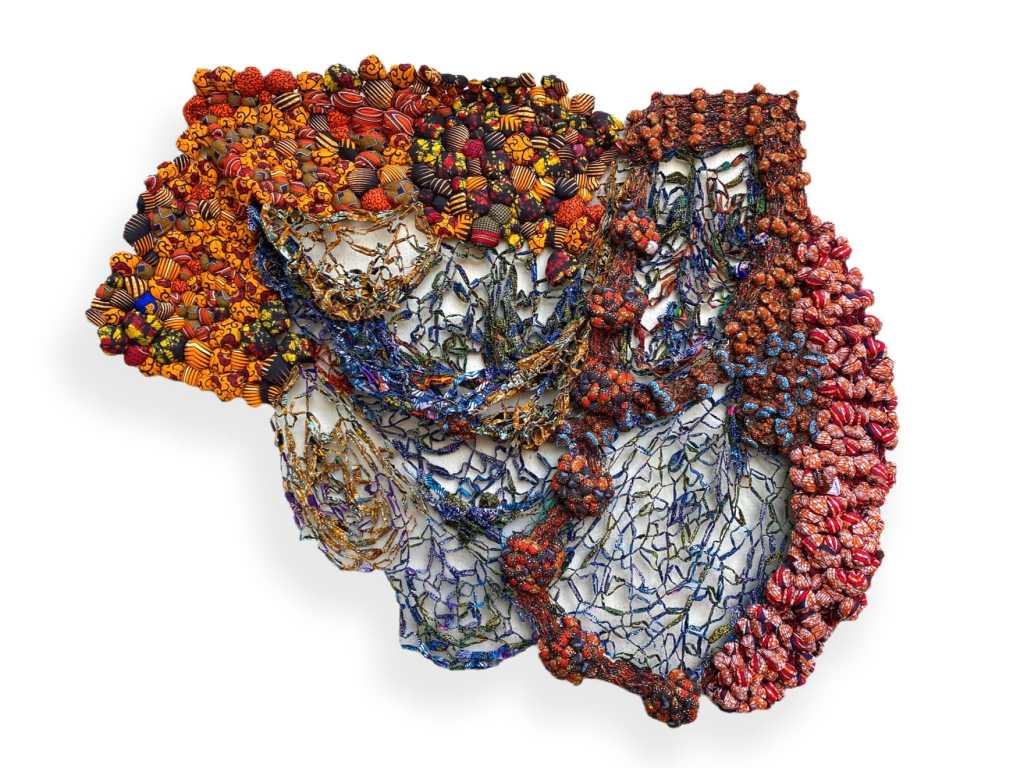
Textile mural sculpture
Photo Credit : Galerie Revel
I also use this as an idea of how we store history, how we store secrets. So for me, the bubble becomes a metaphor to describe all these events, to describe how things can be stored and held for a particular time. It could be a health bubble, a psychological bubble, or social bubbles. Every work of art is like bubbles in terms of coverage, secrets that have been hidden. Looking at the atom that has a bubble form, at the electromagnetic forces that bump things and make the earth.
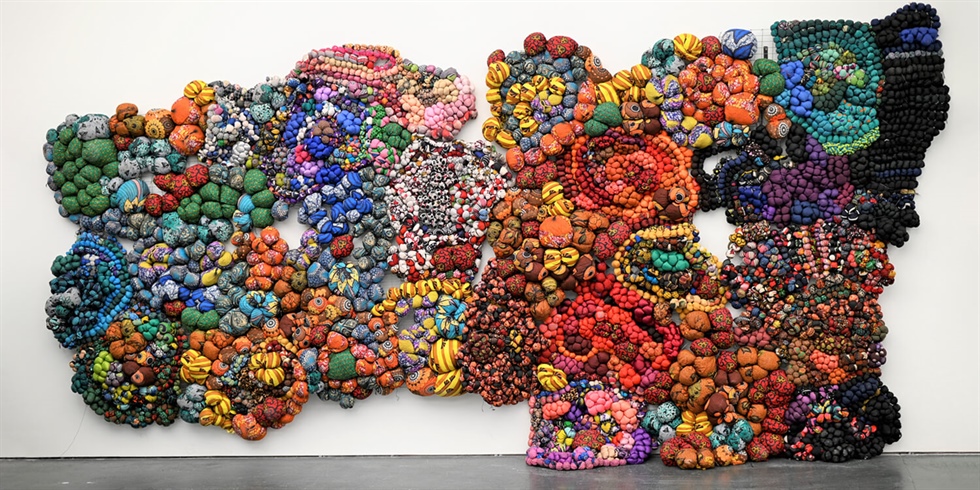
All these things are still mysteries that need to be uncovered. So these are the bubbles. Even the earth itself comes as a bubble form, the universe as well. So there are things that are held together just for existence. That is what my bubbles are about. My work explores people’s daily activities to survive, as well as nature’s daily activities to survive. Stitching them together is like calling for unity. We can still stitch ourselves together to survive even though we have different colors, different shapes, and different individualities.
Textiles and Human Identity
Textiles are one of the most primary needs of humanity to shelter ourselves, to cover ourselves. Textiles trace the history of mankind right from the beginning. Humans trying to cover themselves. Textiles talk about status, they talk about culture. It’s a way of identifying places, humans. Textiles are one of the elements I consider as one of the material cultures of mankind that has existed throughout time.

So, I use textiles to represent identity, to represent humans, and life in general. I want my audience to look at the possibility of asking logical questions and engaging in critical reasoning. I want them to think while they look at my work. I want them to see themselves in my work. When you ask questions, it begins to unveil several secrets, several ideas we never thought of. So, that’s the essence of my work: to engage people through questioning. It’s through questioning that we can really find possibilities or answers to our lives as people.

 Bridging Africa and The World Through Contemporary Art
Leave a comment