

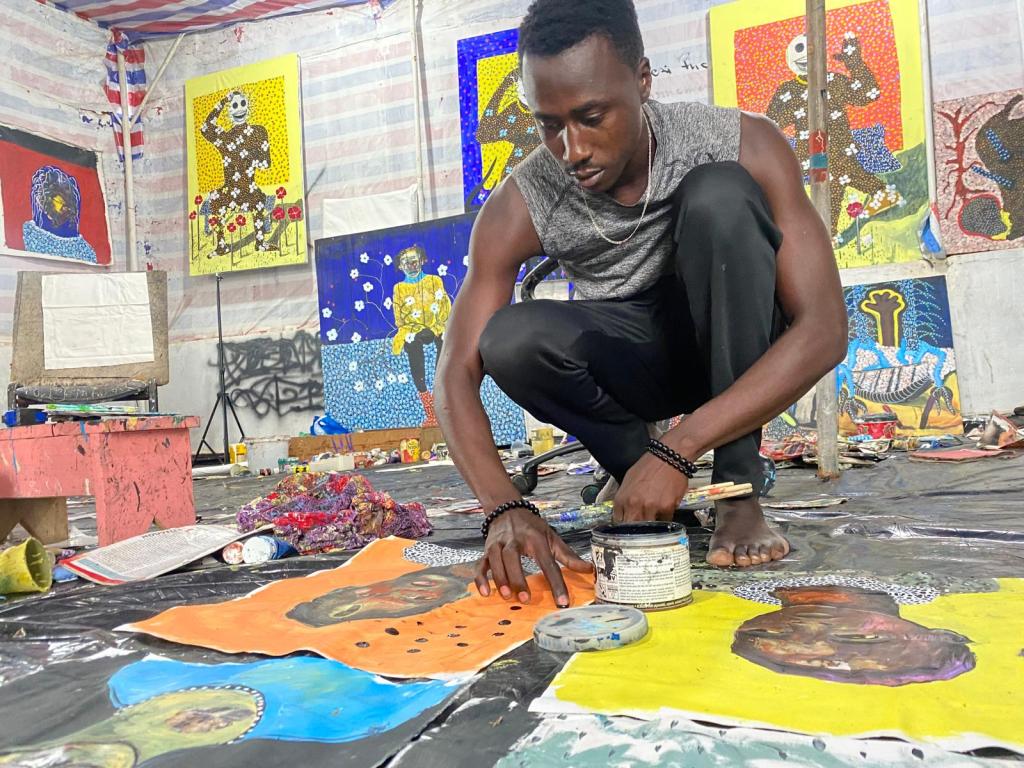
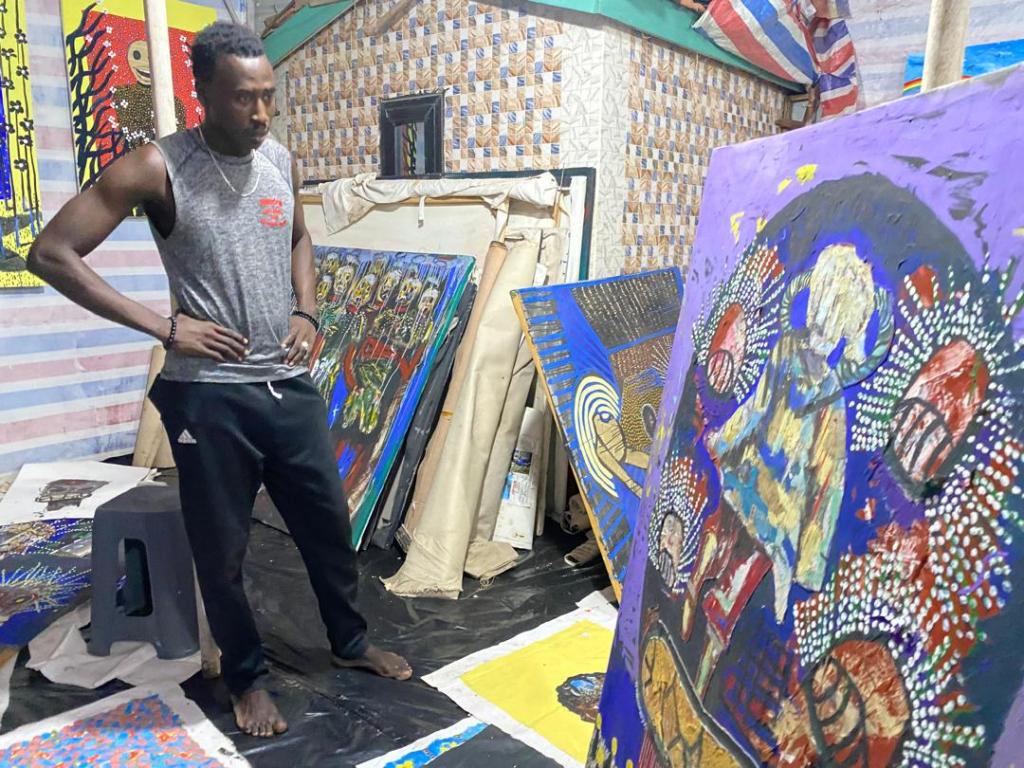
Khalifa Mané was born in 1998 in Casamance, southern Senegal. He began his artistic journey in the studio of French painter Le Guenne, where he spent several years learning the basics of painting. This early training, combined with his desire to break away from the norm, has shaped him into a unique and outspoken artist. During our visit to his studio in Nguekhokh, around 70kms south of Dakar, Khalifa greeted us with an infectious energy. Surrounded by his tools and unfinished works, he shared how his art reflects the struggles and dreams of African youth. Through his paintings, Khalifa addresses issues that affect his generation, creating art that speaks both to local challenges and global concerns. This visit offers a glimpse into the world of a young artist whose work captures the spirit of his time, blending personal expression with a strong social message.
There’s a paradox that anyone who knows anything about Africa has no doubt been confronted with. How can a continent with such a rich subsoil be so desperately short of basic infrastructure? How can an oil-producing country suffer from electricity shortages? How can such a young continent be ruled by such old people, who cling to power for decades? Why do young, energetic Africans occupy so few positions of responsibility, and struggle to win the confidence of previous generations? Why do such vigorous young people risk their lives crossing the Mediterranean Sea, when the continent’s potential is so obvious?
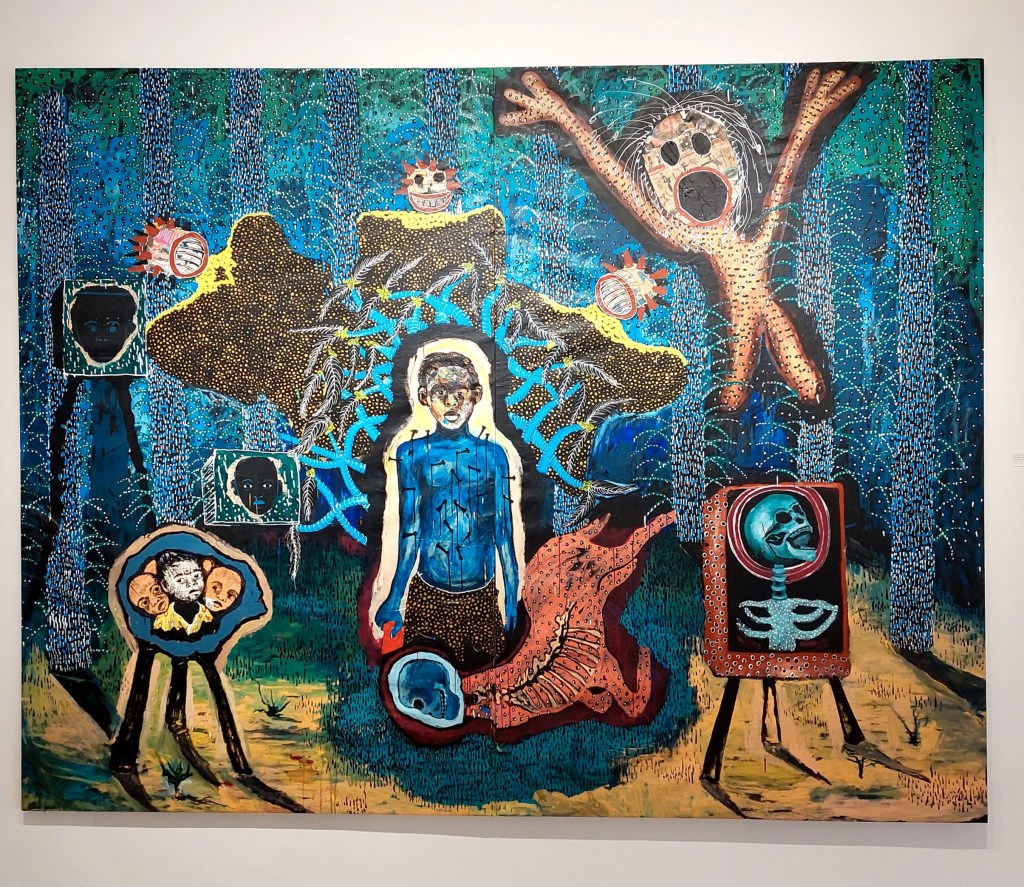
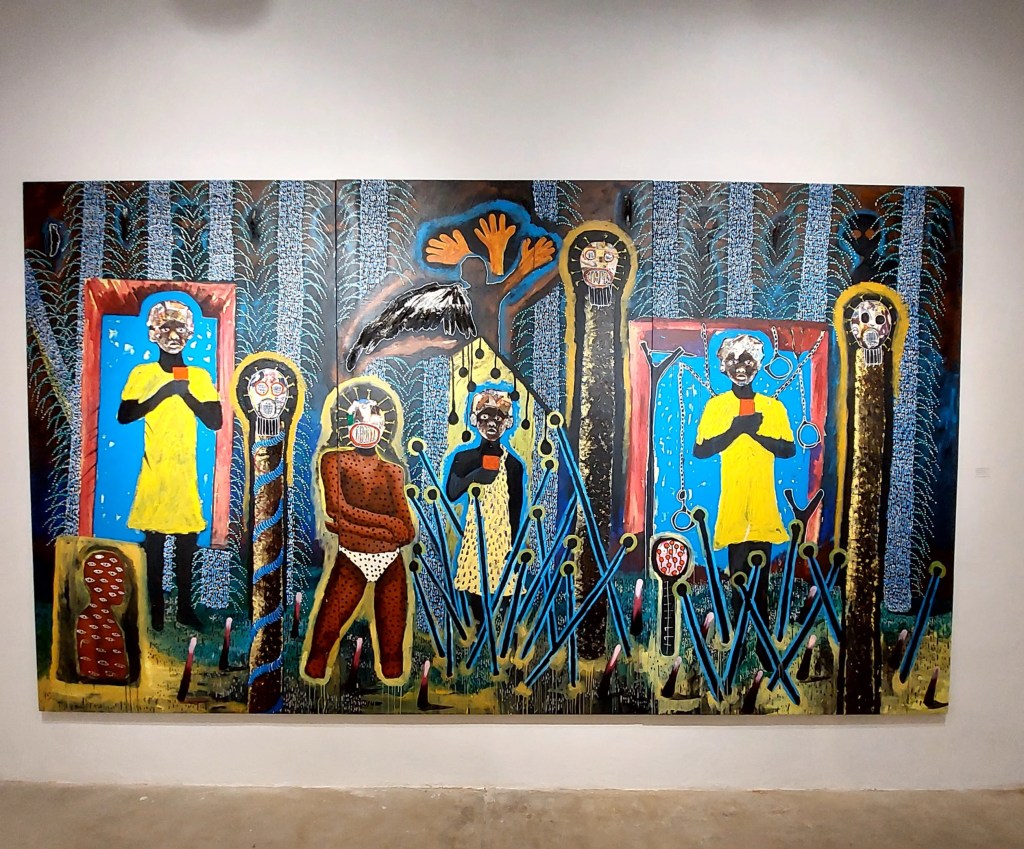
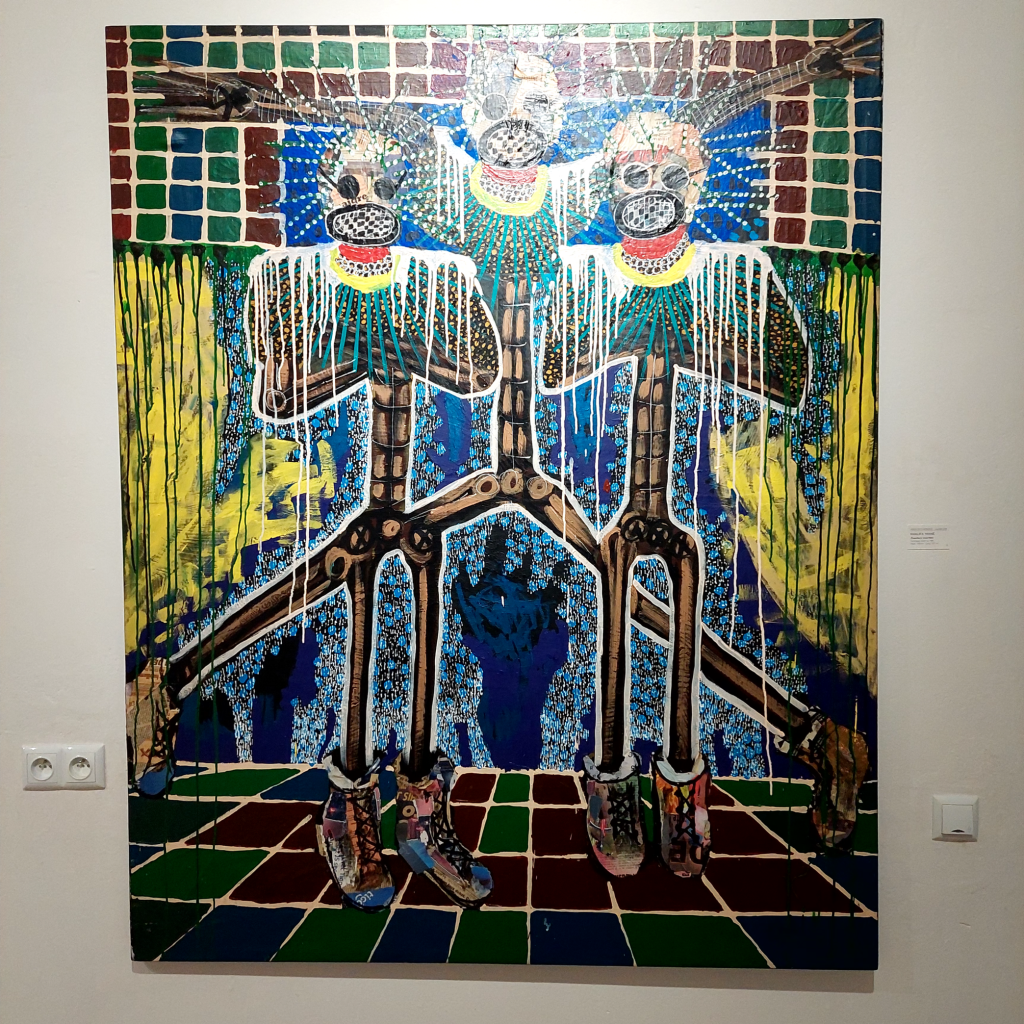
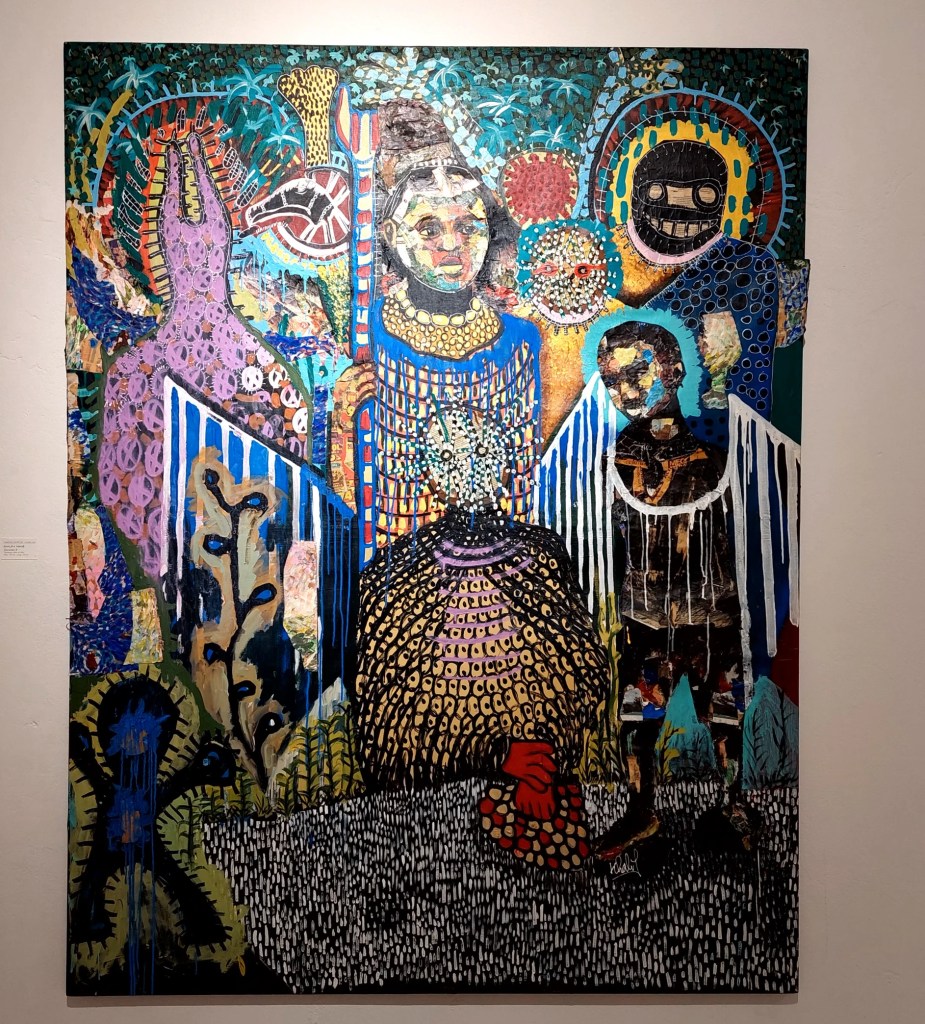
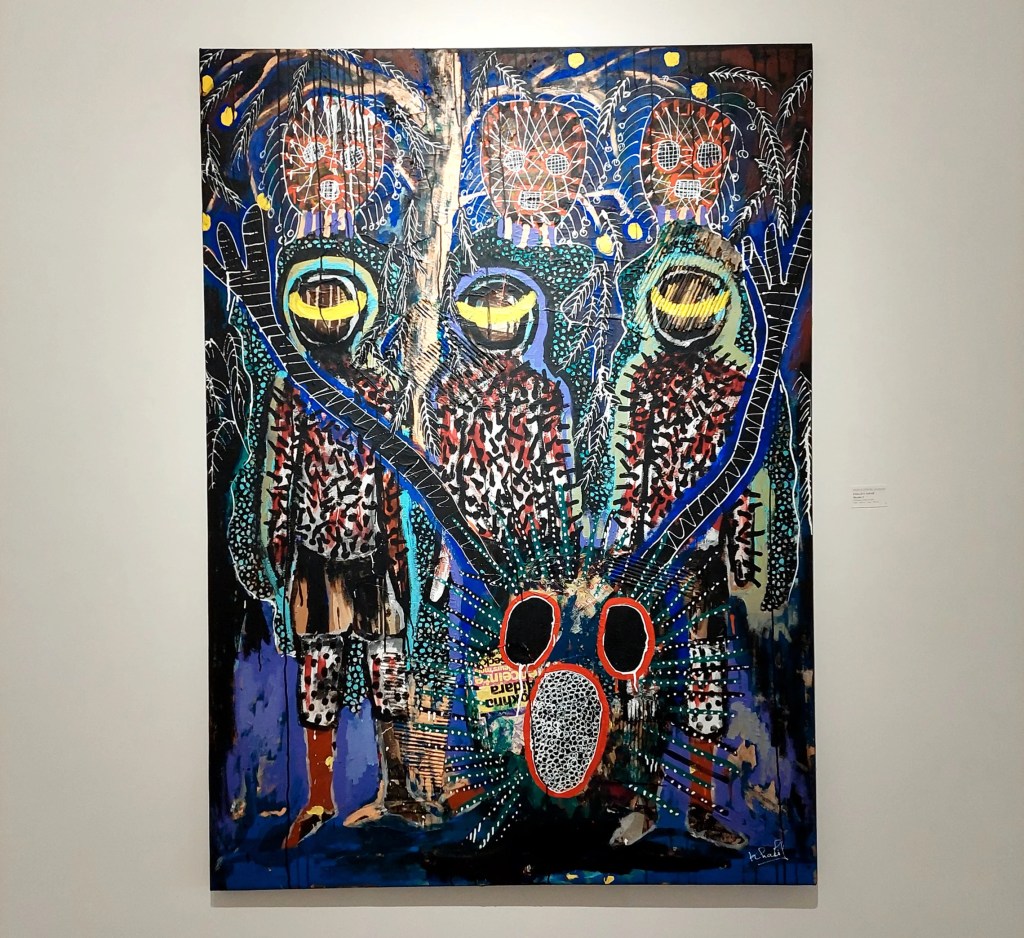
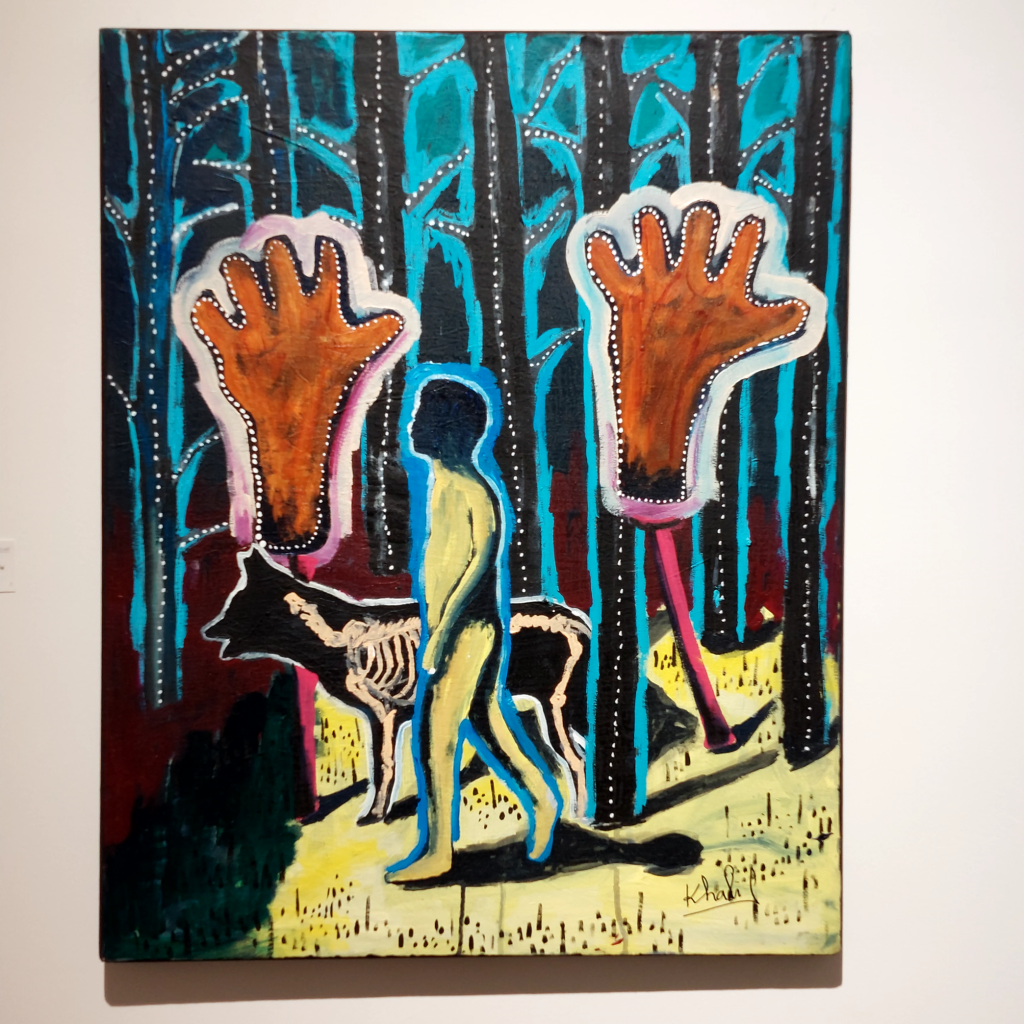
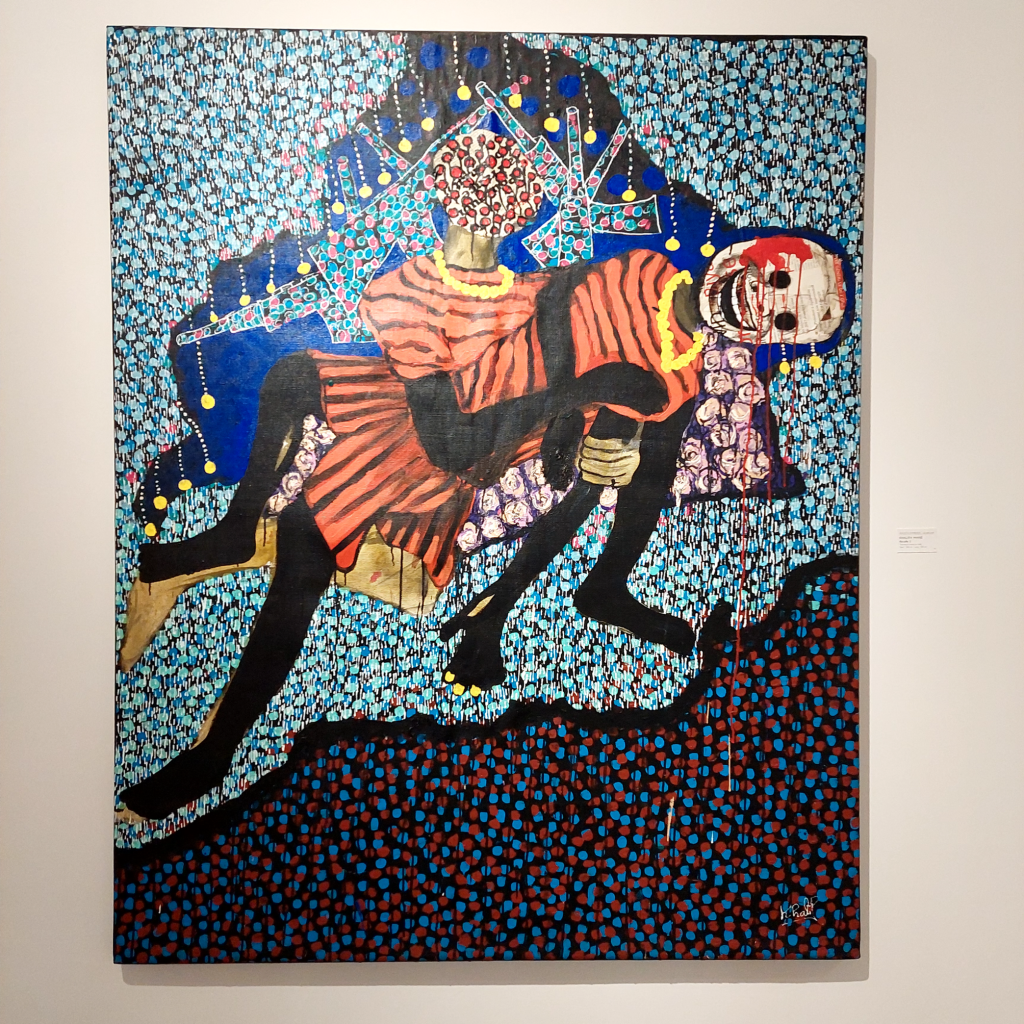
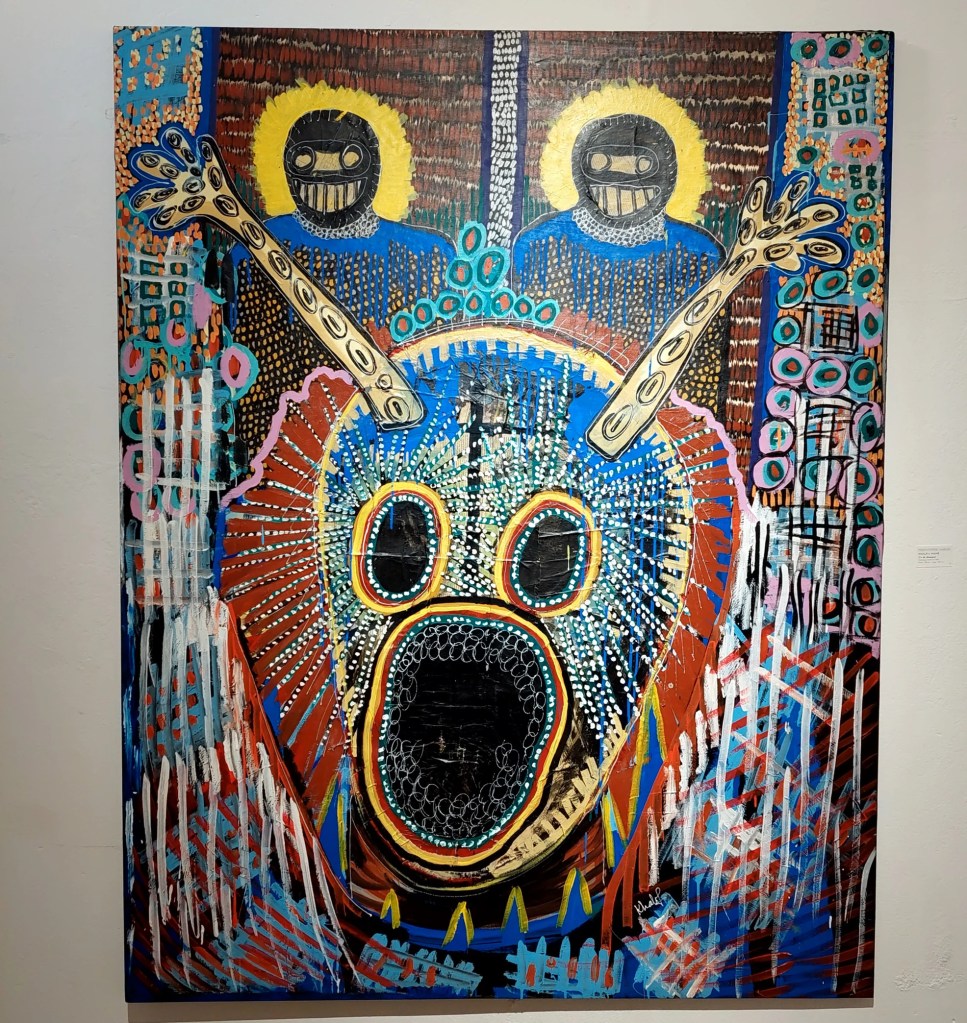
Khalifa Mané’s work raises a thousand other questions. His creations recall the words of Anton Chekhov: “The role of the artist is to ask questions, not to answer them.” The questions raised by Khalifa Mané are resolutely contemporary and go beyond the borders of Senegal. They question the place of young Africans in society. In West Africa, young people are increasingly organizing themselves and trying to impose a new discourse on the old school of thought. The youth movements against neo-colonialism that abound in the region are the expression of a profound disenchantment with those in power.
A nonconformist attitude
For anyone wishing to understand the state of mind of today’s African youth, Khalifa Mané’s works offer a striking reading.They reflect a lack of confidence in the elites, often tinged with disgust. Why trust a generation that has produced such a disappointing present? A question that many disillusioned young people, hungry for change, are asking themselves.
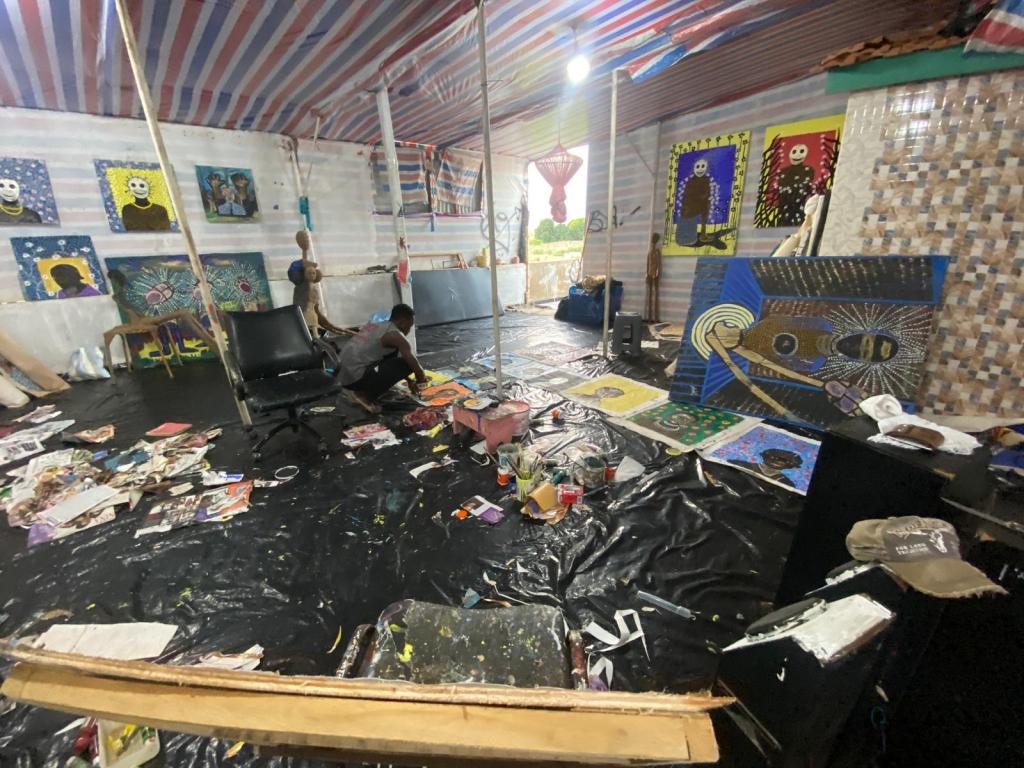
Khalifa Mané is a non-conformist artist. Like many young people of his generation in Africa, he has lost faith in those who lead and shape the continent.The leaders symbolize a certain academicism and a rigid system. So it’s not surprising that Khalifa left the Fine Arts School in Dakar after just one year.
“It was because of the rules that I decided to quit. You know, there’s not enough freedom.That held me back, so I quit after a year to devote myself to painting,” he told DakartNews.
This rejection of convention and quest for creative freedom are the common thread running through his career. His works are a direct response to Nina Simone’s famous question: “How can you be an artist and NOT reflect the times?” Khalifa Mané doesn’t just reflect his times; he questions them, criticizes them and brings them to light. Through his art, he invites us to confront the uncomfortable truths of a generation torn between immense potential and profound disenchantment.
And this can be achieved only with a dose of compassion, as Paul G. Chandler, President of CARAVAN Arts, observes: “There are individual SOS distress signals going out all the time – at the governmental, societal and individual levels – saying ‘help’. Those who are rooted in compassionate thinking can see right through the walls and screens that are often constructed to prevent needs from either being observed or addressed seriously.”
Revolutionary art
At the start of his career, like many Senegalese artists, Khalifa Mané concentrated on realistics portraits, mainly of African women and scenes of daily life. Yet, everything changed in March 2021, during violent protests against high living costs, corruption, and the arrest of Ousmane Sonko, the former opposition figure, who is now the Prime Minister. The country went up in flames for five days, and a dozen young people lost their lives in the police crackdown. “There were dead youths in front of me and injured policemen with arms cut off. I witnessed all these scenes,” he recalls. He adds: “I couldn’t go out because I can’t stand tear gas. I said to myself: since I paint, why not express what I feel in my painting?”
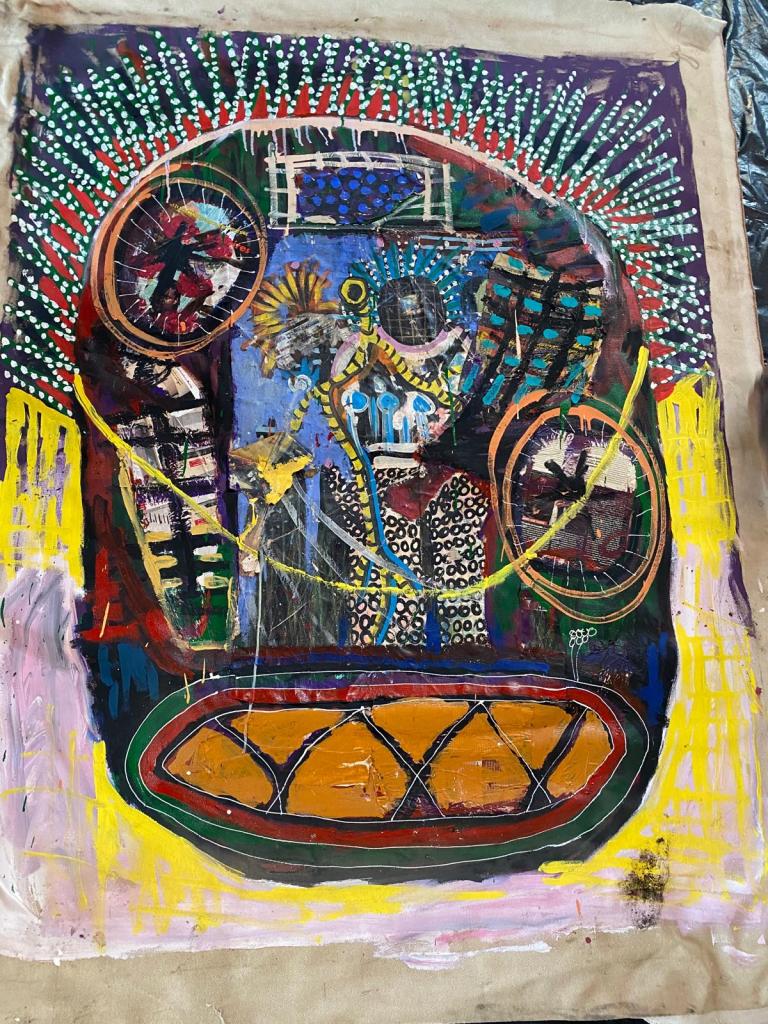
The events of March 2021 catalyze a radical change in his artistic approach. He created the Revolt series, including powerful self-portraits.
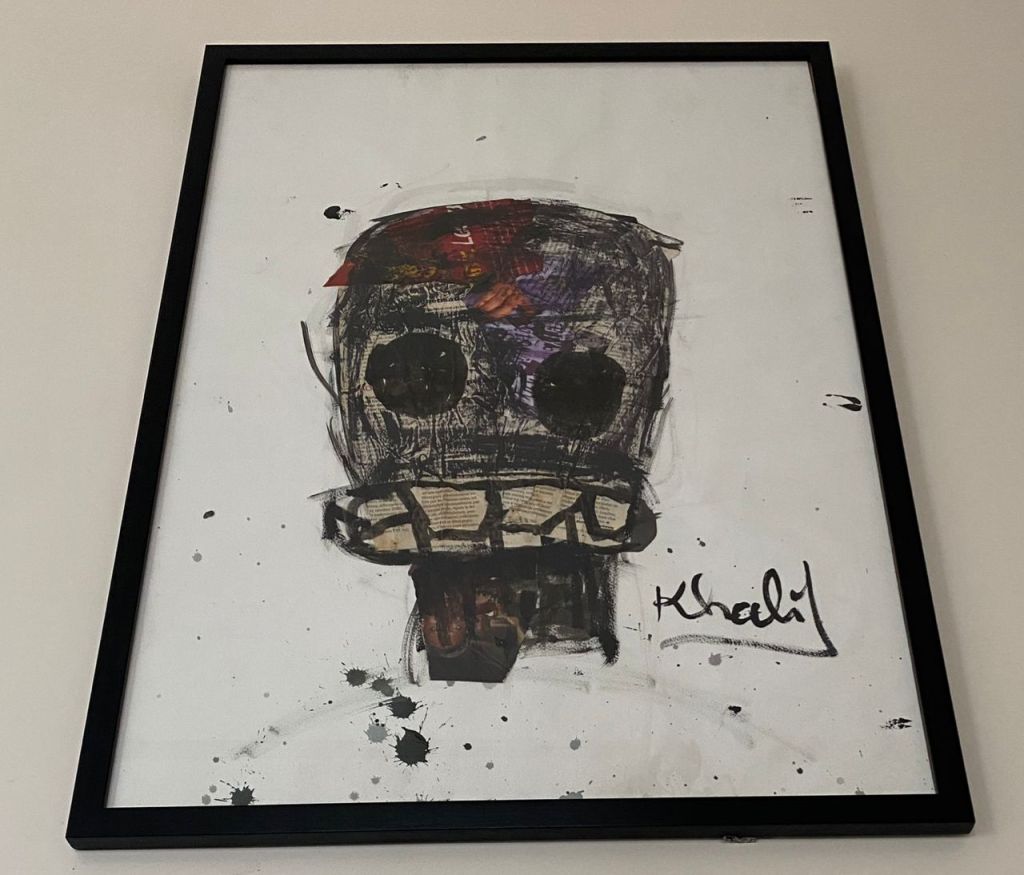
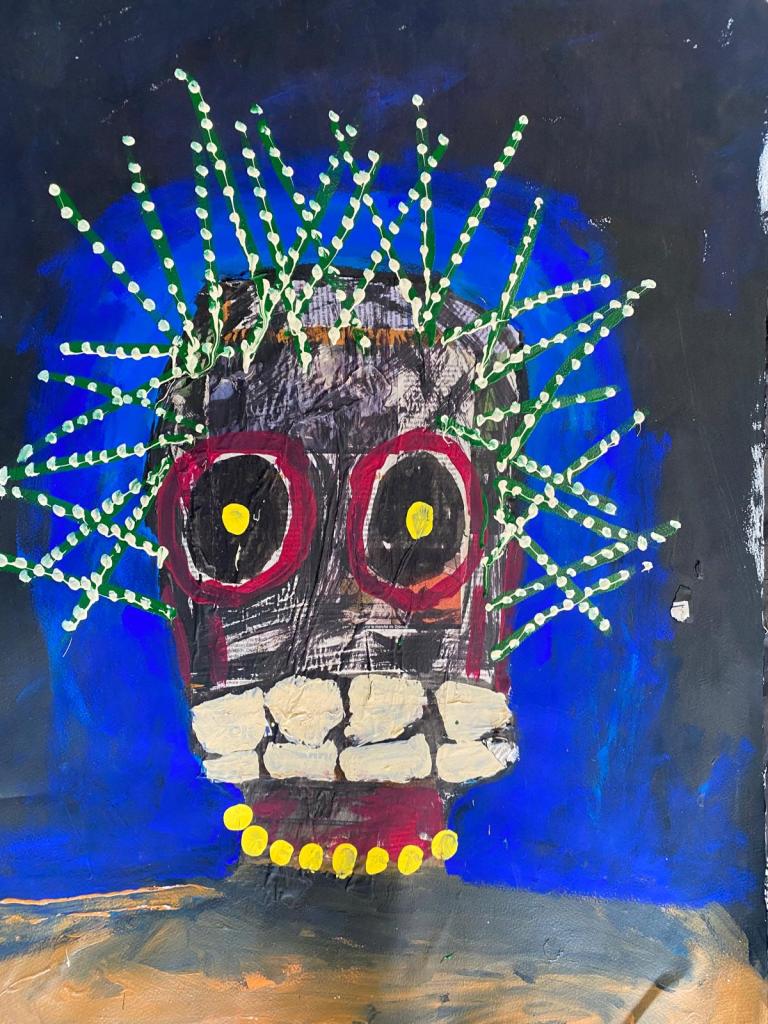
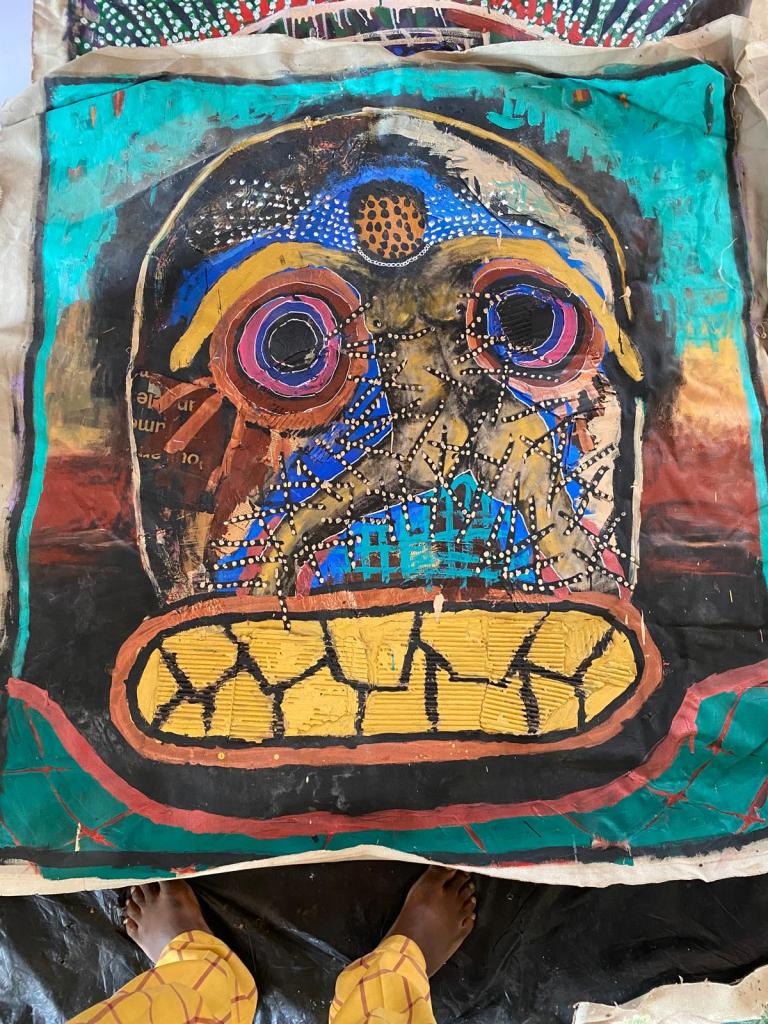
His self-portraits reveal an introspection in the face of social upheaval. They testify to the physical and emotional suffocation experienced by the artist. Confined to his bedroom, he is a powerless spectator of a revolution in the making. The gaping mouth, as if fractured, embodies an inner cry. It is contained and stifled. It symbolizes an attempt at expression muzzled by a repressive context. The eyes, circled in red, penetrate the viewer, bearing witness to an “awakened generation determined not to be fooled again”.
Newspaper collages, integrated into the texture of his works, evokes the omnipresence of media narratives around the protests. Fragments of text and image become visual testimonies to a troubled socio-political context, a way for the artist to make palpable the systemic violence he denounces.
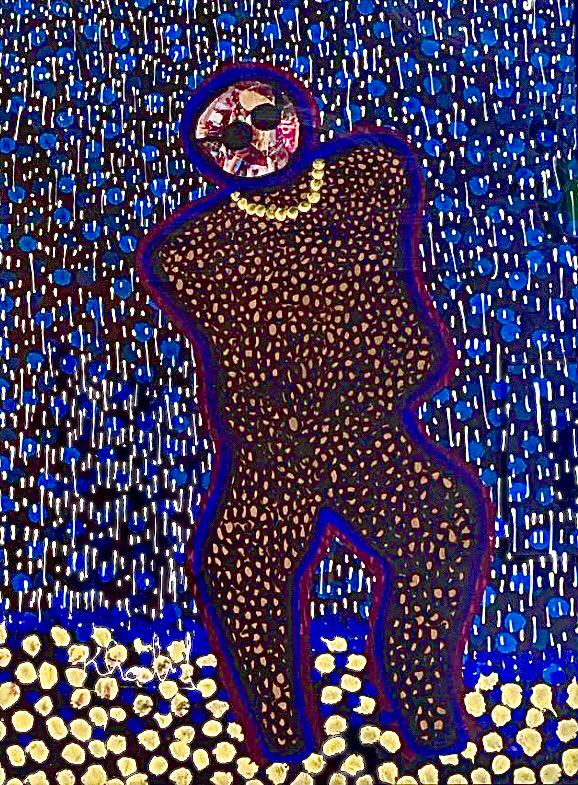
Red Card
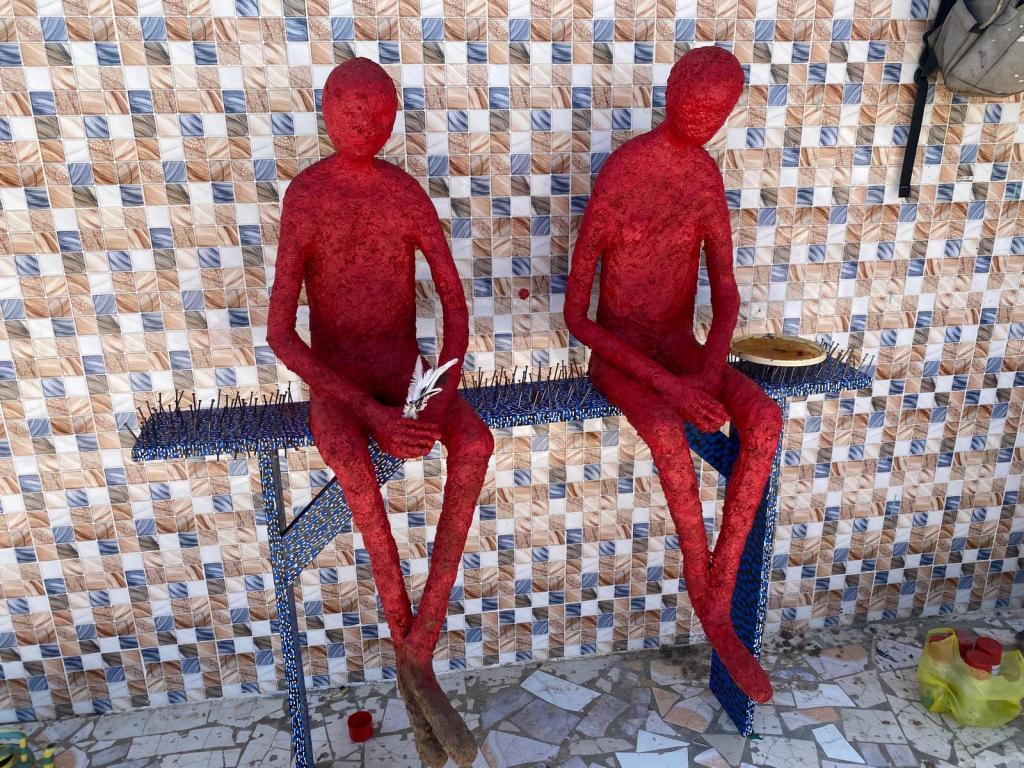
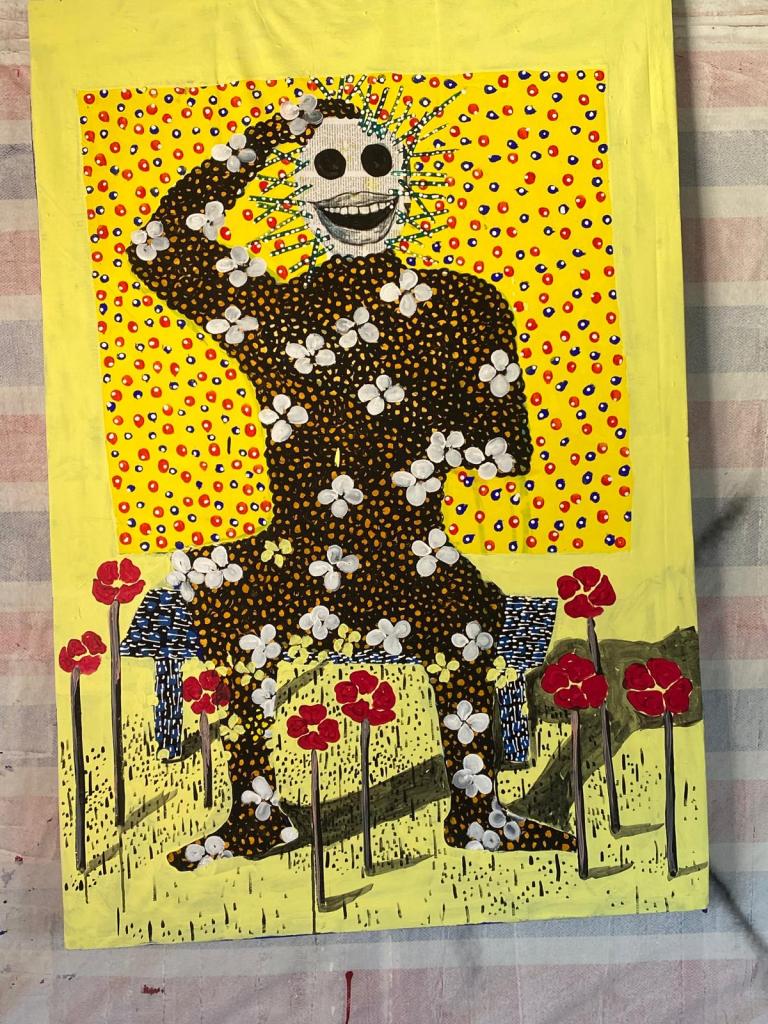
Some of his works, such as those in the Red Card series, directly question the socio-political dysfunctions and frustrations of a youth in search of change. In one of the artworks of the serie, the central silhouette, with no arms or a pretence of concealing them, becomes a symbol of inaction and paralysis in the face of the expectations of revolutionary youth.
This artistic choice sends a clear message. Leaders’ inaction in the face of youthful aspirations is perceived as a refusal to act. It reflects a denial in the face of urgent demands for social justice.
Paul Chandler, after visiting Khalifa Mané’s Red Card exhibition, writes: As I wandered through the exhibition, contemplating Mané’s numerous works, allowing them to do their magic on me, it was clear that he truly embodies the best of revolutionary thinking. Mané is visibly sensitive to the needs around him. I sensed he has “feelers” out, or “antenna” up, and is able to discern Africa’s present-day social, political and environmental challenges. His work demonstrates insightful perception as to the current context, and the pain that is being felt as a result.”
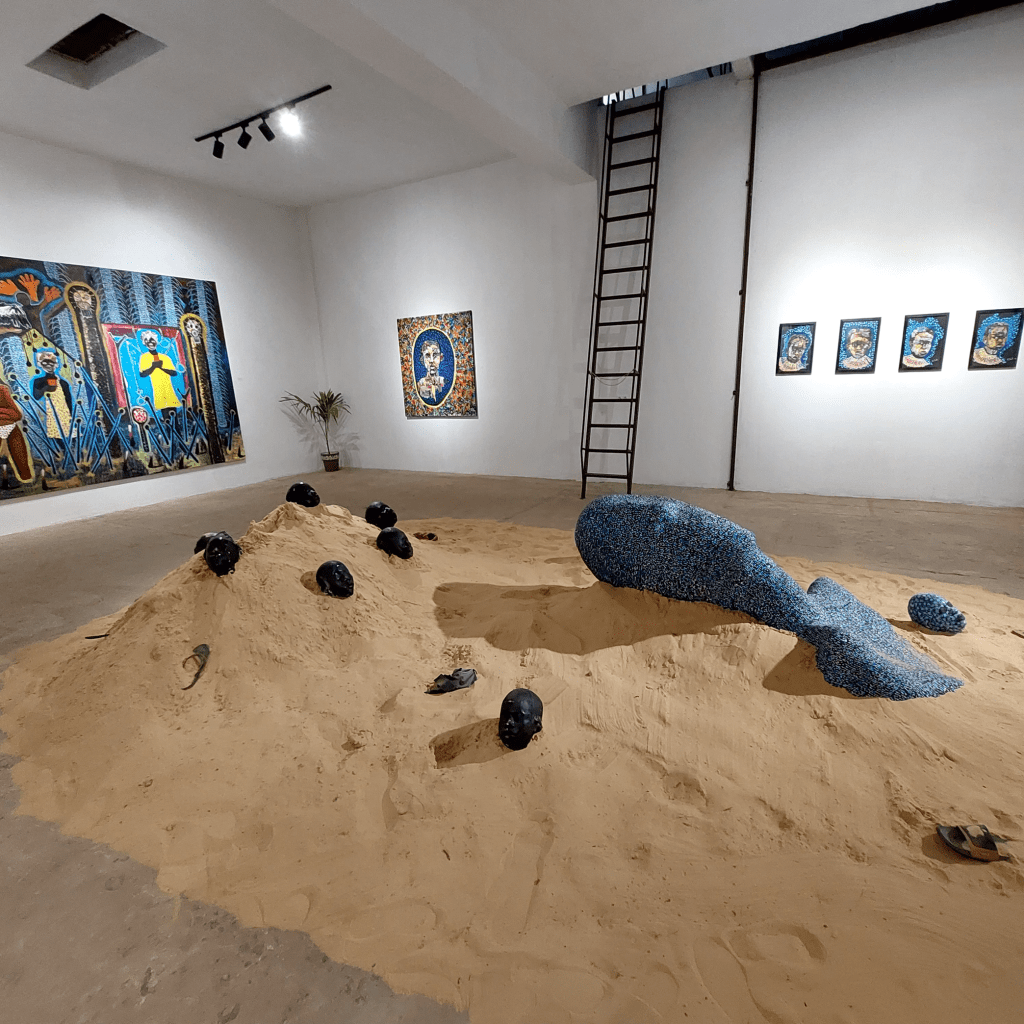
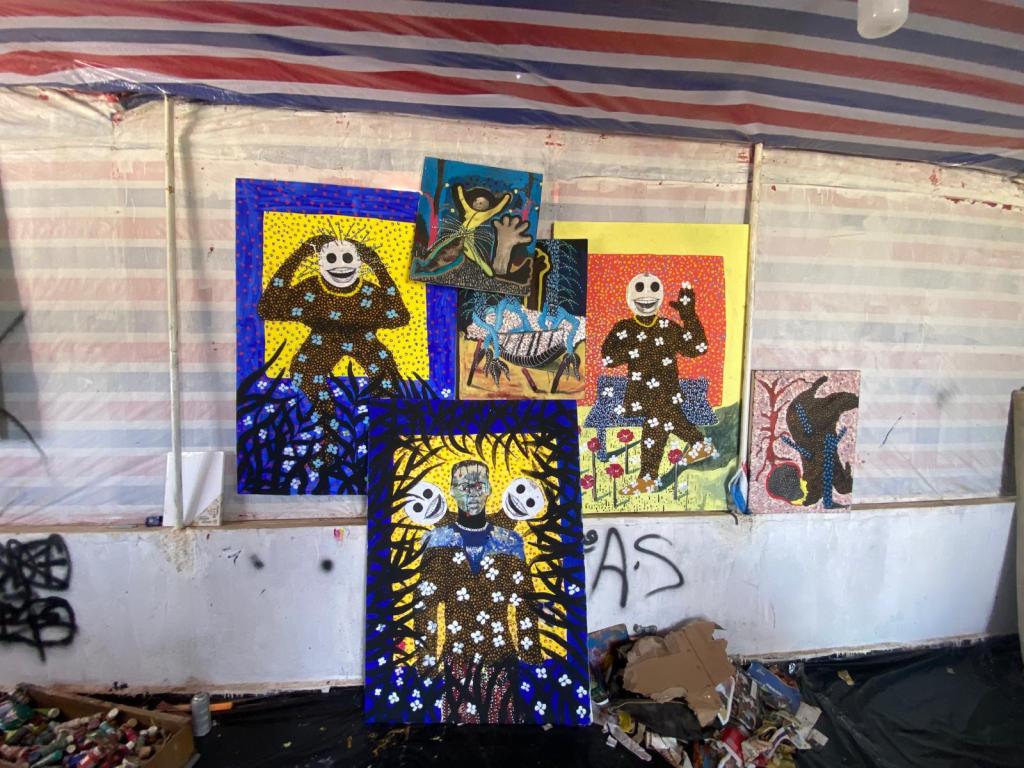
In Khalifa Mané’s studio, some works catch the eye with figures displaying an apparent smile. This smile, far from being an expression of joy or lightness, is a deeply subversive manifestation. Behind this smiling façade lies a contained rage, an anger that is hard to verbalize in the face of government inertia and persistent injustices. This ambiguous smile reflects astonishment and bewilderment. It is an ironic response when words seem insufficient to express the magnitude of disillusionment.
For Franck Privat Gonné, cultural worker and young researcher in heritage management at UQAM in Canada, Mané embodies the essence of subversion.
“Art and culture carry political stakes. They are arenas of subversion, ways of challenging the established order. Here, Mané shows this subversion. He does not conform to the established order. He becomes something of a nonconformist. He should be understood as a free man, defining his own path, his destiny, as the author of his own story, working on themes he feels most compelled to tackle. That’s why his work touches on current issues of emancipation, revolution, and subversion. He brings a fresh perspective to society. He does this through a powerful visual language. It’s an expressive artistic writing filled with meaning and symbolic elements.”
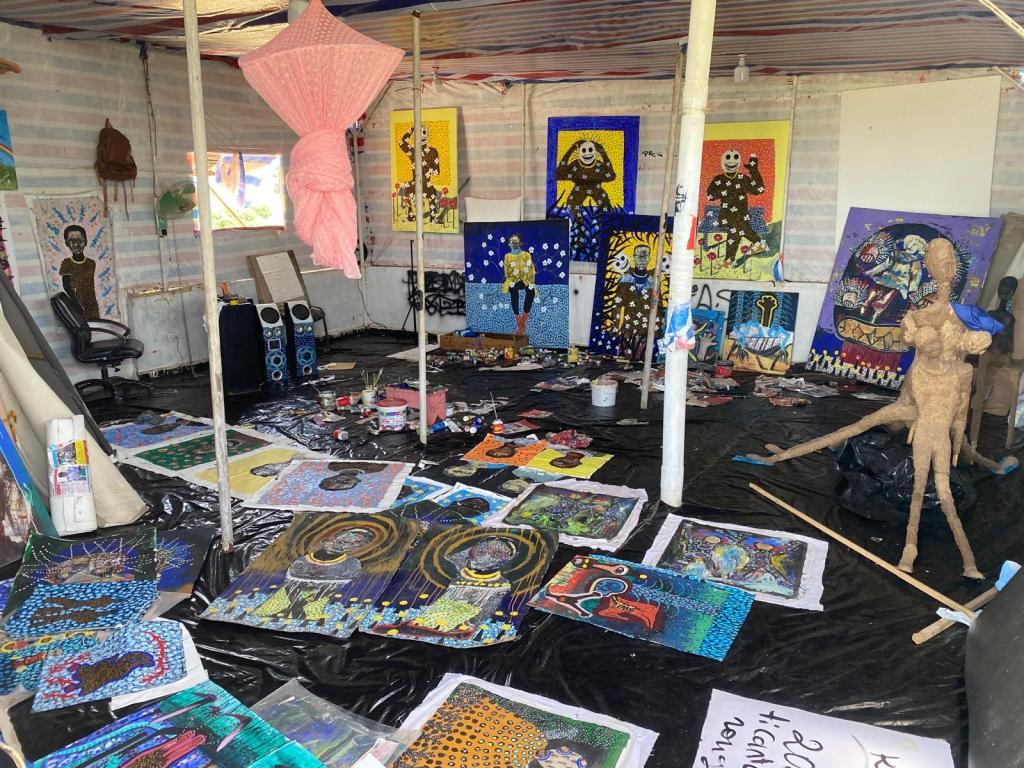
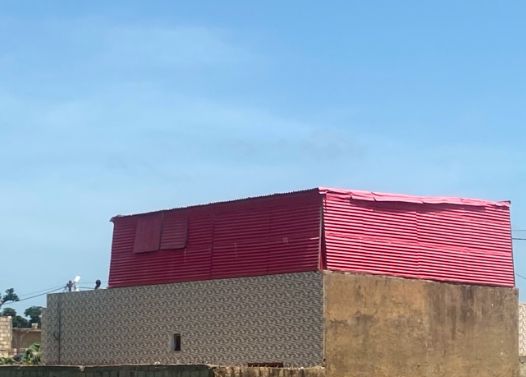
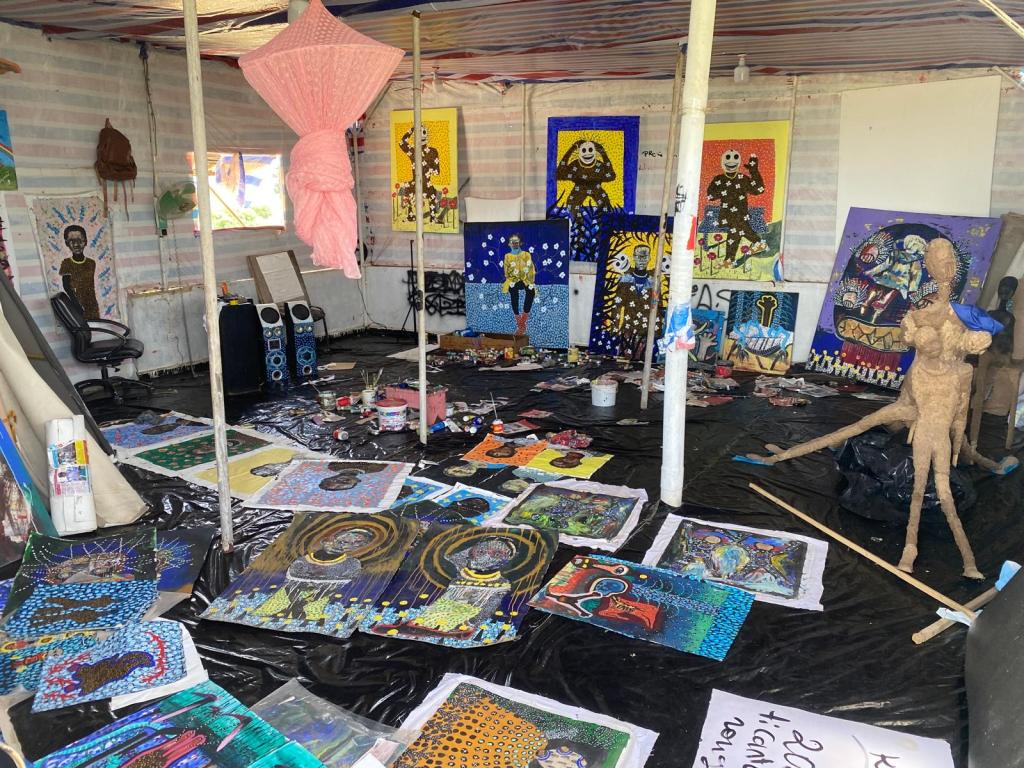
As we meet Khalifa Mané, just a few months are left until the November 2024 biennale of Dakar, and the artist is busy preparing some of his paintings and sculptures. His studio, located on the rooftop terrace of a building, provides a unique space that influences his artistic process. In the following interview, we explore how this setting shapes his creativity and delve into the themes that are central to his work. In the following interview, we explore how his studio influences his artistic creation and the themes that are dear to him.
Studio’s Visit Interview
“I see myself as a revolutionary artist“
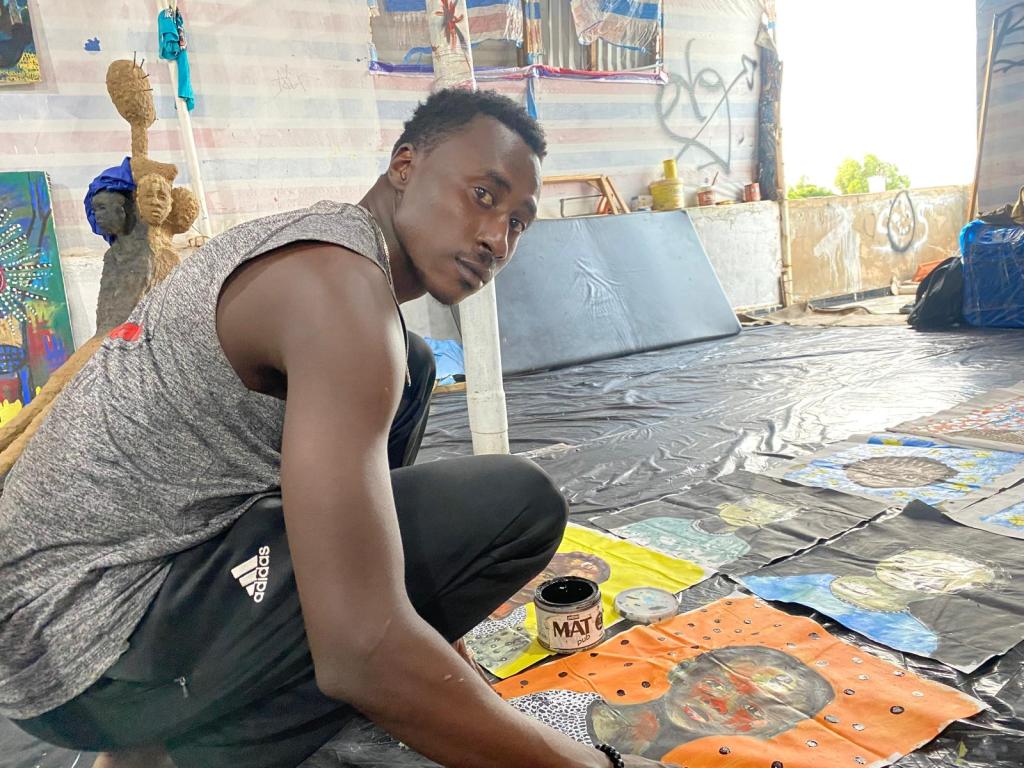
How does your studio influence your creative environment?
I’ve been working here since 2020. I’m currently based in Nguekhokh. It’s a calm and quiet place. There isn’t much activity here, which is perfect for an artist. I have all the comfort I need to work effectively.
Are there specific objects in your studio that hold importance for you?
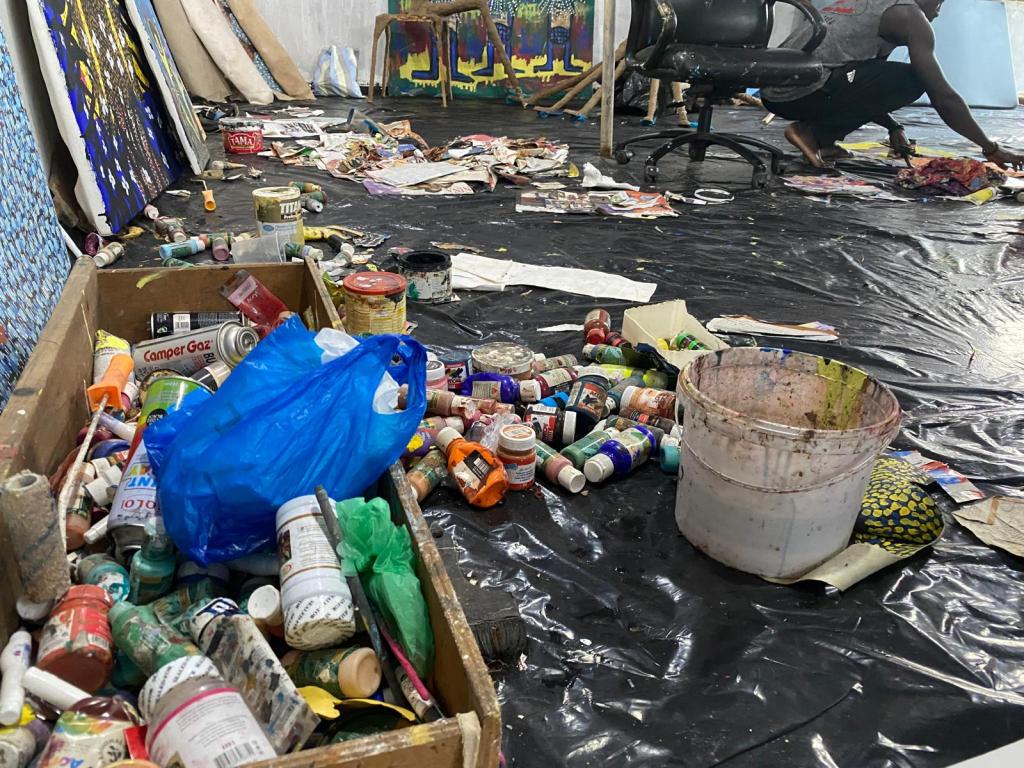
My main material is recycled paper. I also use cardboard—even my sculptures are made from cardboard. When you step into my studio, you might think it’s a trash bin, but for me, these are my tools. In almost all my works, the heads are made from paper. My primary materials are paper and glue.
Has your studio evolved over time?
At first, I was working on the ground floor. But as I started to gain recognition and receive more commissions, I came upstairs.
What time of day do you usually work?
I work mostly at night. At night, the house is quiet—my uncle’s family is asleep, and I’m the only one awake. That’s when I can really focus and be productive.
What do you love most about your studio?
The tranquility and solitude. An artist needs solitude to take a step back and reflect on everything that surrounds us.
What are the themes that are important to you?
Illegal immigration, African emancipation, and as a third theme, I focus on African youth. I work based on the news, the current events.
Why did you choose to become an artist?
At first, I wasn’t an activist artist. I used to paint portraits of African women, focusing on African beauty. But one date deeply marked me: March 6, 2021. There was a protest in Dakar that resulted in several deaths and injuries. At the time, I was a student in Economic and Social Management at the University of Dakar. The university was also caught up in the unrest. During the protests, I couldn’t leave my room because I had difficulty breathing due to the tear gas. I thought to myself, since I paint, why not express what I feel through my art? It became my way of participating in the protests happening around me. That’s when my art began to take on a more activist dimension. I also see myself as part of this revolutionary generation—a generation that is awakening, emancipating itself, and can no longer be deceived.
Was it in this spirit that you created the Revolt series?
The Revolt series came to me during a time when the entire African youth was in revolt. I felt that I had to make my contribution. I needed to find a technique that was much more aggressive, something brutal to convey the rage I felt inside and the urgent need for change. I used cardboard, fabric, and paper, which I glued together, and my brush moved in every direction to release all the desire for change I had within me.
What does art mean to you?
Art is simply a way to express myself. For me, I see myself first and foremost as a revolutionary artist. I reflect on social issues in Senegal and across Africa. My work explores the struggles of Africa, especially the challenges holding back our continent. More often than not, my focus is on the future of African youth. Through my art, I aim to contribute to these conversations. I want to awaken young people, particularly on issues like illegal migration. I want them to understand that this path is like suicide and that Europe doesn’t necessarily guarantee success. I hope my art can make them realize that Africa needs its children. If all Africans leave, who will remain here to drive progress? For example, my series Mirage of Freedom addresses this illusion many young people have about migrating.
Can you tell us about your creative process?
I work primarily with metaphors. My characters are part human, part animal. It’s my way of portraying reality in my own style. I use recycled paper mixed with acrylic on canvas as my base. I start by sketching, focusing on the characters, then I add glue. After that, I tear and paste pieces of paper until the faces emerge. I work primarily with metaphors. My characters are part human, part animal. It’s my way of portraying reality in my own style.
Which artists have influenced you?
In the beginning, Van Gogh inspired me a lot, especially with his use of pointillism. There’s also Bernard Buffet, a French artist, whose silhouettes have had an impact on my work. I’ve been influenced by Omar Ba as well, whom I’ve met twice and who even attended my exhibition at the 2022 Biennale. Soly Cissé is another artist I admire. There are many others as well.
Read also
The Evolution of Contemporary Art in Senegal: A Conversation with Bara Diokhané
ArtSpeaks: Africa #9 – Saly, Senegal: “Art as Revolution”
The World of Senegalese Contemporary Art Through Sylvain Sankalé’s Eyes
 Bridging Africa and The World Through Contemporary Art
Leave a comment