

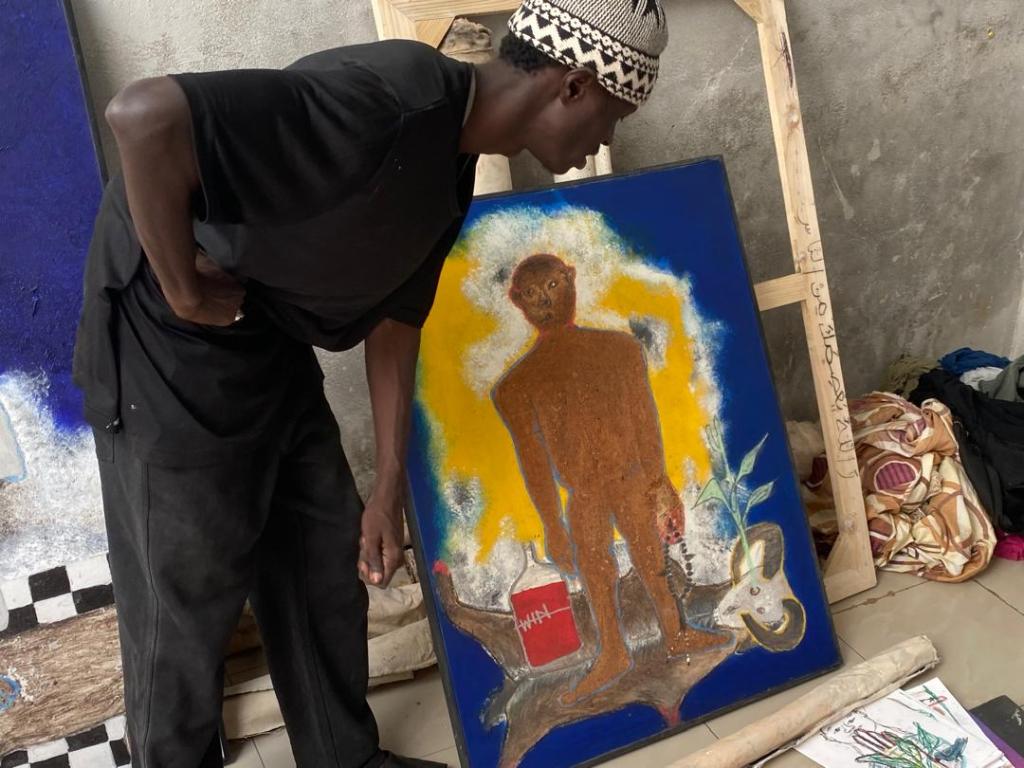
In his studio located in Nguekhokh, around 70kms south of Dakar, Baye Ndiaga Diouf shares the essence of his art, which draws on natural materials like Touba coffee, cola, and charcoal. His works reflect his spiritual journey within Mouridism and explore themes of human connection, social justice, and spirituality. Ndiaga’s paintings offer a unique form of healing, resonating on both a personal and societal level. In this interview, we discover an artist whose work invites deep reflection and connection.
Makhtar Diouf, better known as Baye Ndiaga, honors his family heritage by bearing the first name of his grandfather, a central figure in his personal and artistic history. This Senegalese artist, born in 1991 in Dakar is one of the most remarkable creators of his generation. His work, which blends modern influences with ancestral traditions, bears witness to an ongoing dialogue between past and present.
Growing up in the rural environment of Thiadiaye – a town nestled south-east of Dakar – Ndiaga’s childhood was marked by nature and the simplicity of village life. As a young shepherd, he spent his days watching over the herds, while letting his imagination run wild by drawing on the trunks of baobab trees. This early connection to nature and art shaped his first creative experiences, which continue to resonate in his work.
His use of organic materials such as Touba coffee (coffee beverage that is a popular traditional drink from Senegal), cola and charcoal is not simply an aesthetic preference; it is deeply rooted in his history and environment. These natural elements, imbued with cultural and symbolic meanings, lend his canvases a raw authenticity.
Spiritual heritage: between tension and creation
The grandson of a traditionnal healer, Baye Ndiaga grew up observing the rituals of his grandfather, a master of plants and the secrets of the earth. However, his path led him to Islam, and more specifically to Mouridism, a Senegalese Sufi branch founded by Sheikh Ahmadou Bamba. This spiritual choice left him torn between two worlds: on the one hand, the heritage of his ancestors; on the other, the Muslim faith.
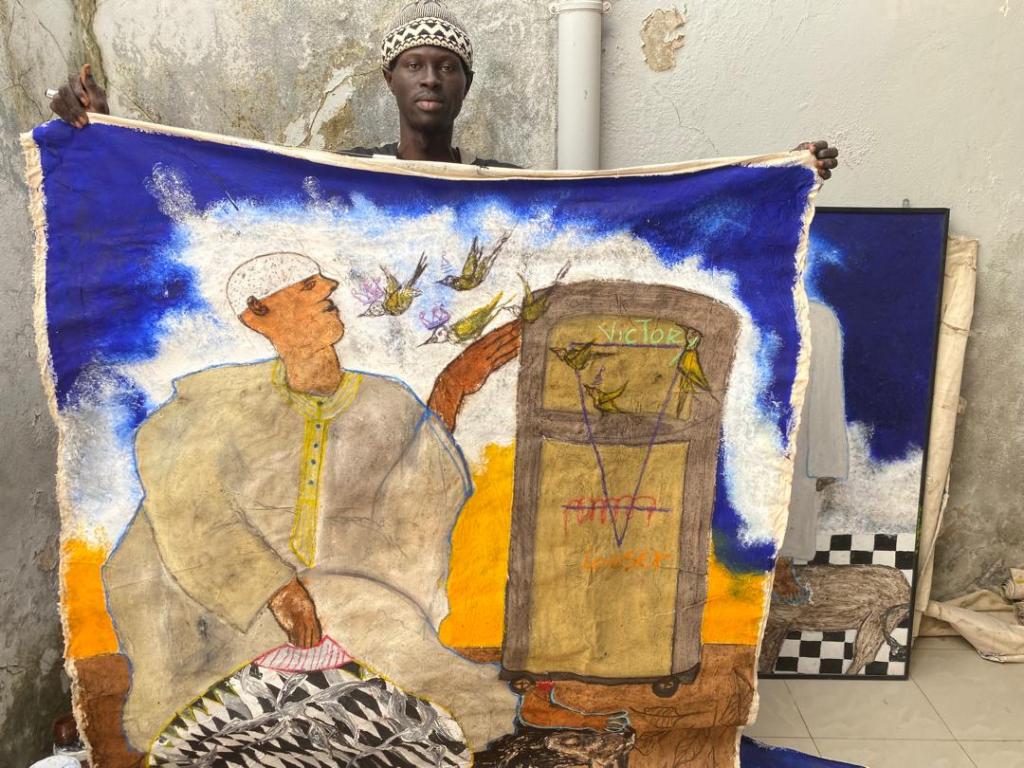
The tension between these two worlds leads to a real confrontation. His works thus become places of dissensus, inner battles and symbolic confrontations. It is precisely this raw and sometimes painful struggle that gives his works their emotional power. In this, Ndiaga expresses a universal experience: that of the inner conflicts that punctuate our lives and the difficult choices that mark our paths.
Metaphors of sacrifice and violence
One of the main threads running through Ndiaga’s work is the exploration of sacrifice, in both its spiritual and anthropological dimensions. The animal figures that populate his canvases are not mere ornaments, but powerful symbols, summoning up the sacrificial rites inscribed in traditional African practices.
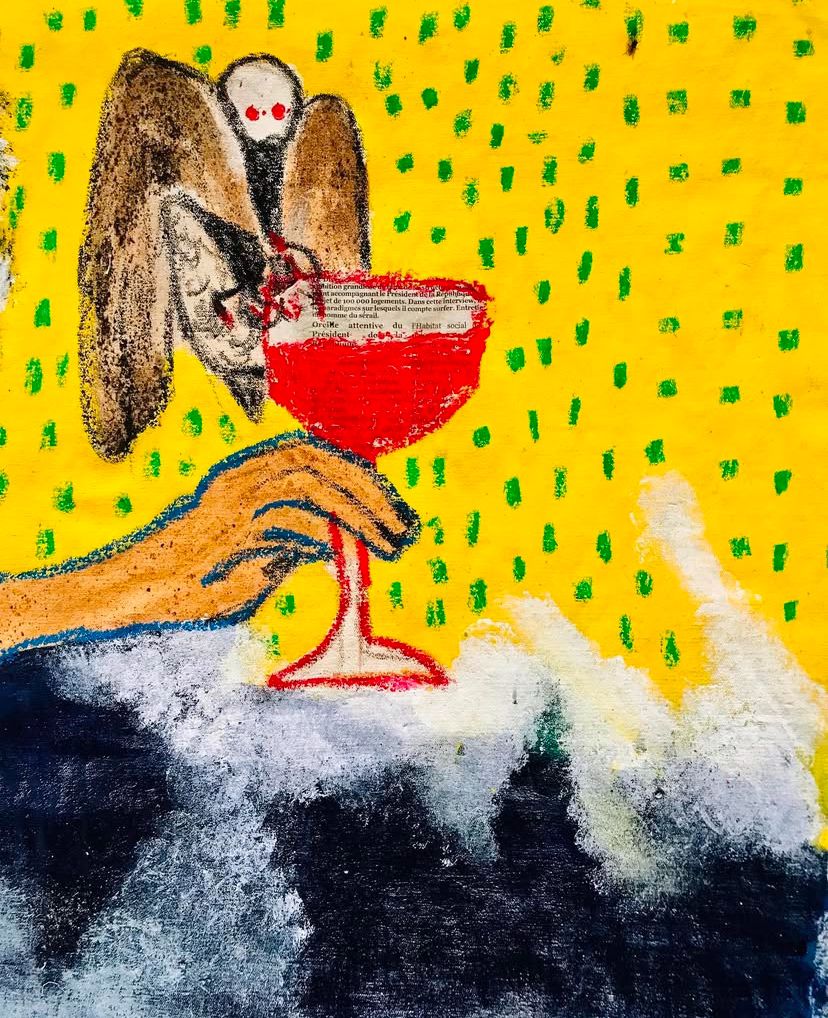
These animals question the human condition, reminding us that the path to our highest aspirations is often marked by renunciation and loss. Through these representations, Ndiaga offers a meditation on the violence inherent in human desires, but also on the possibility of transcending this violence through collective awareness.
His commitment does not stop at the spiritual realm. Ndiaga is an artist deeply rooted in his time, a lucid witness to the dysfunctions of society. Corruption, political hypocrisy, social inequality: his works forcefully denounce these shortcomings, while proposing paths towards a fairer, more respectful humanity.
An introspective and universal quest
Baye Ndiaga’s works are not merely aesthetic, but invite a careful reading of details that convey profound reflections on themes such as social justice, spirituality and respect for others.
Every detail – every brushstroke, every texture – becomes a gateway to collective introspection. His figures, often depicted in meditative postures, embody this inner quest that transcends cultural and historical contexts. Birds, omnipresent in his universe, symbolize both freedom and the link between the human and the divine, between the profane and the sacred.
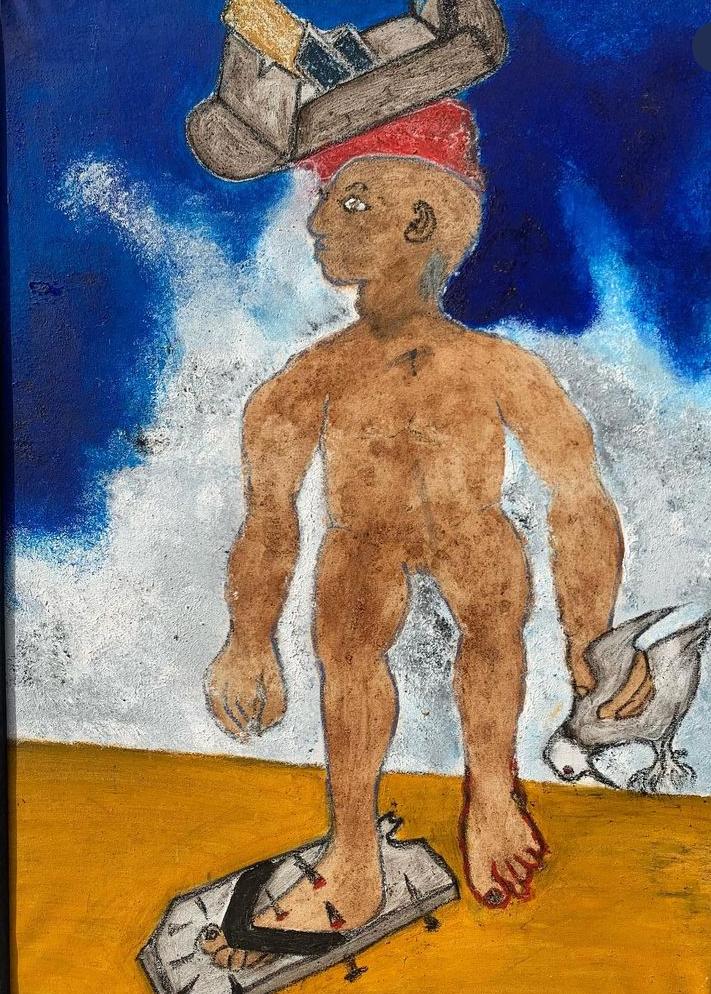
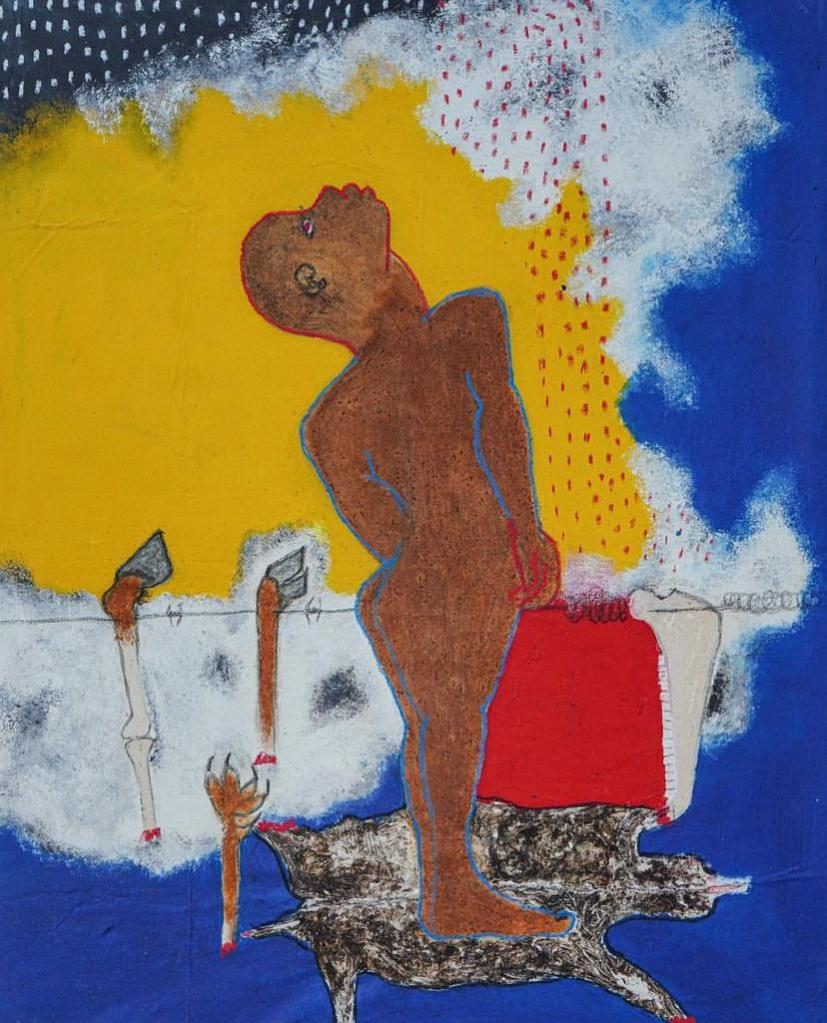
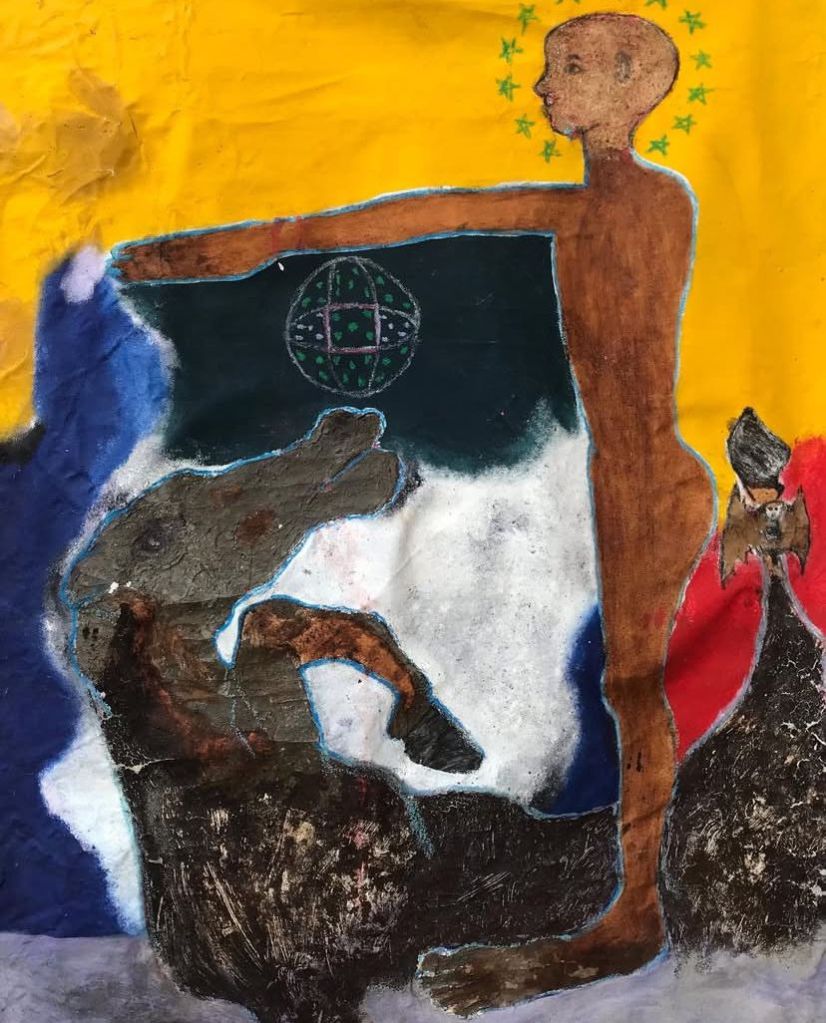
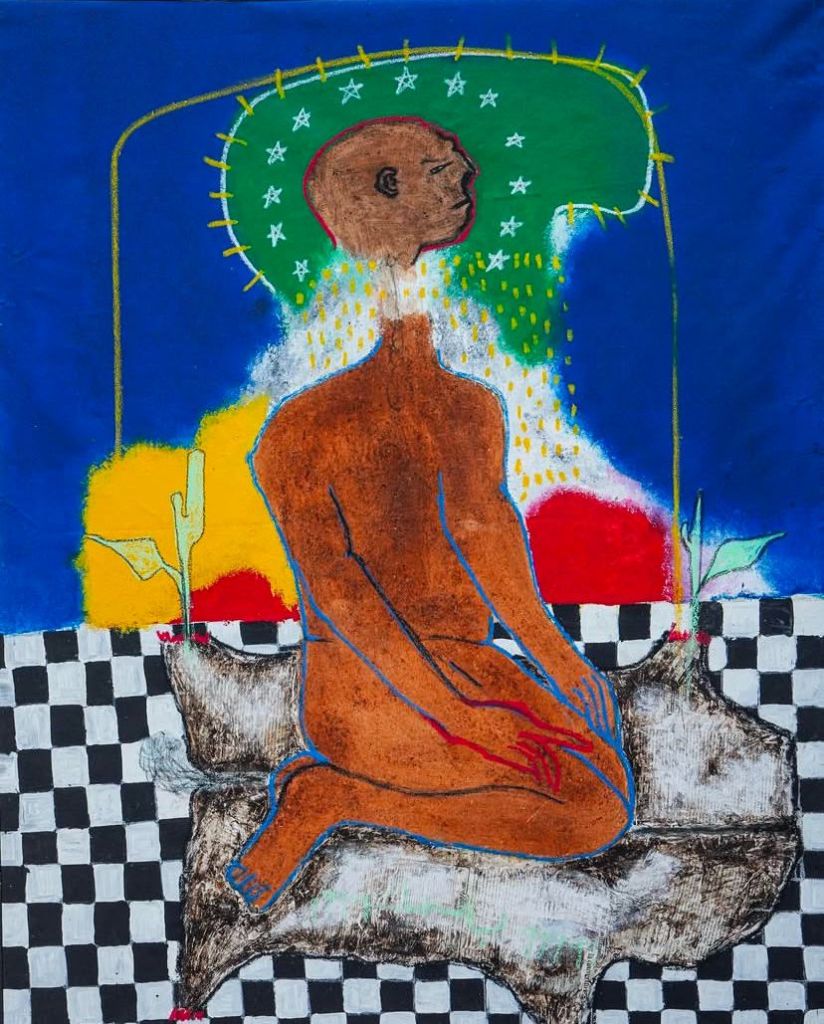
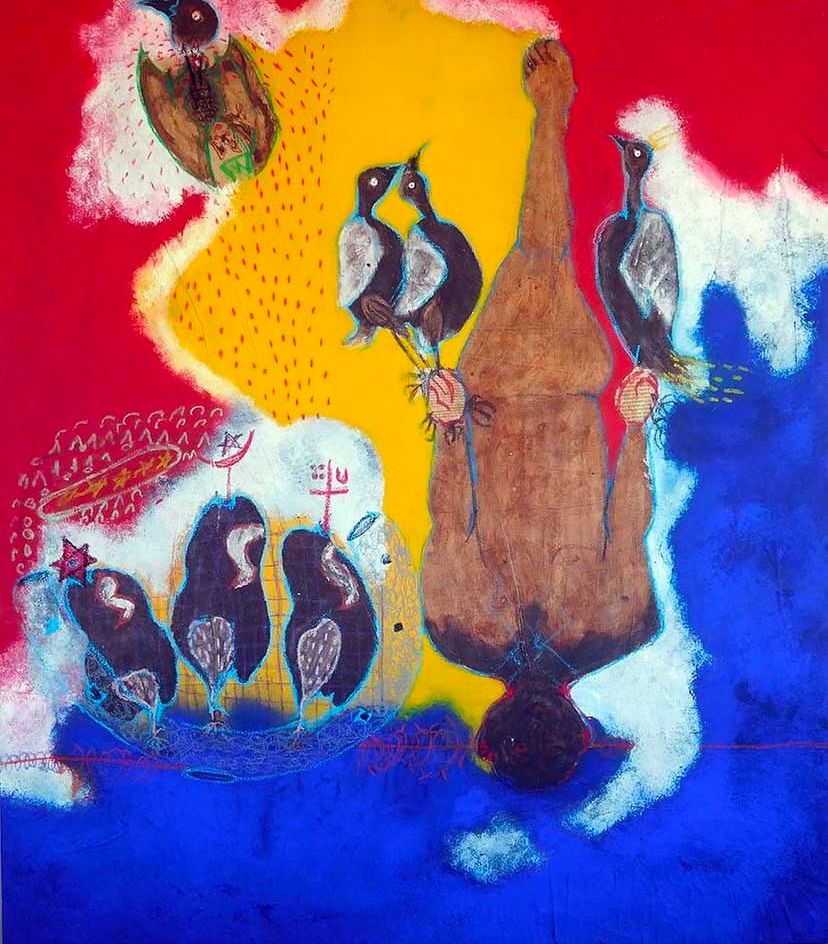
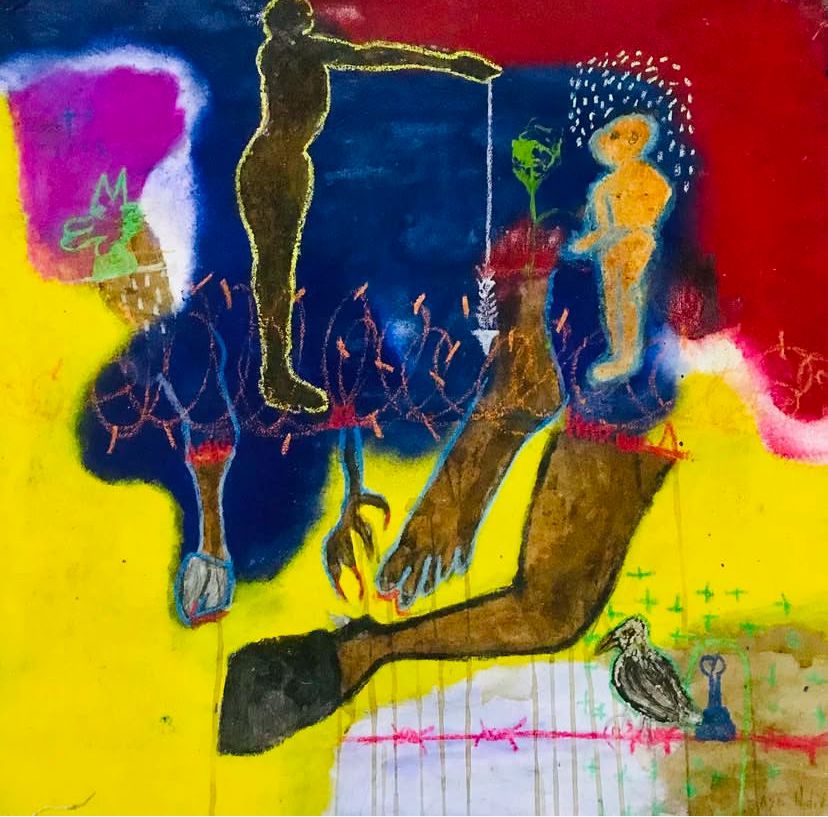
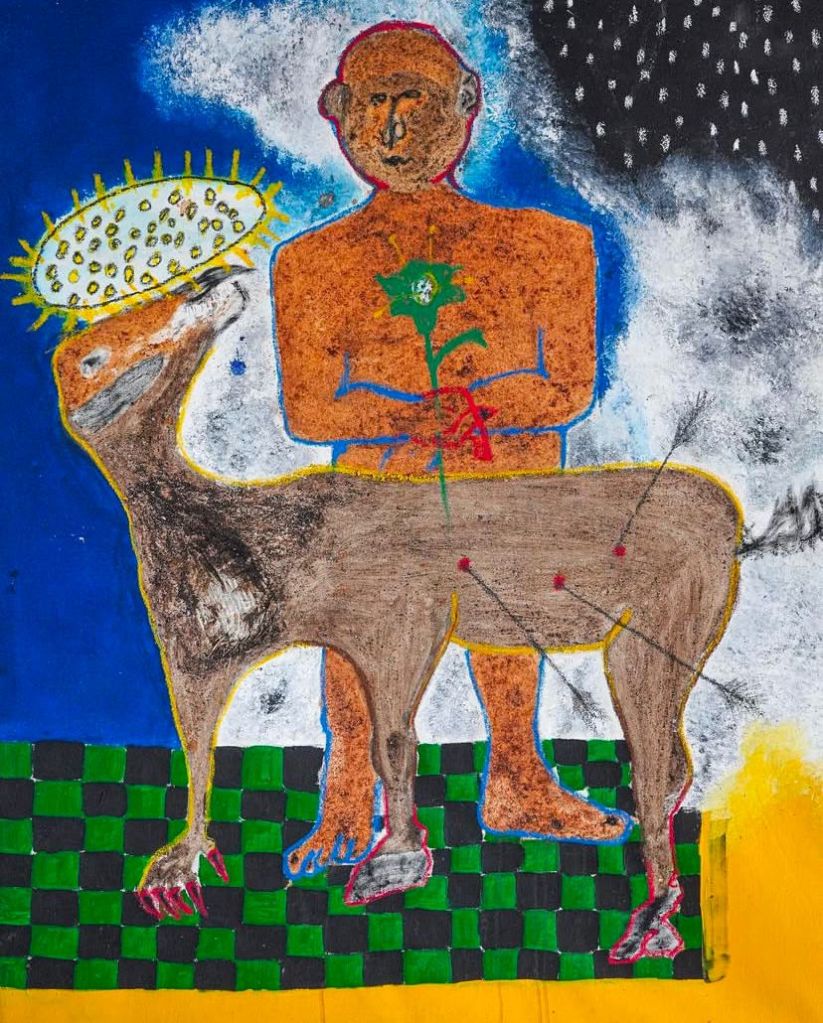
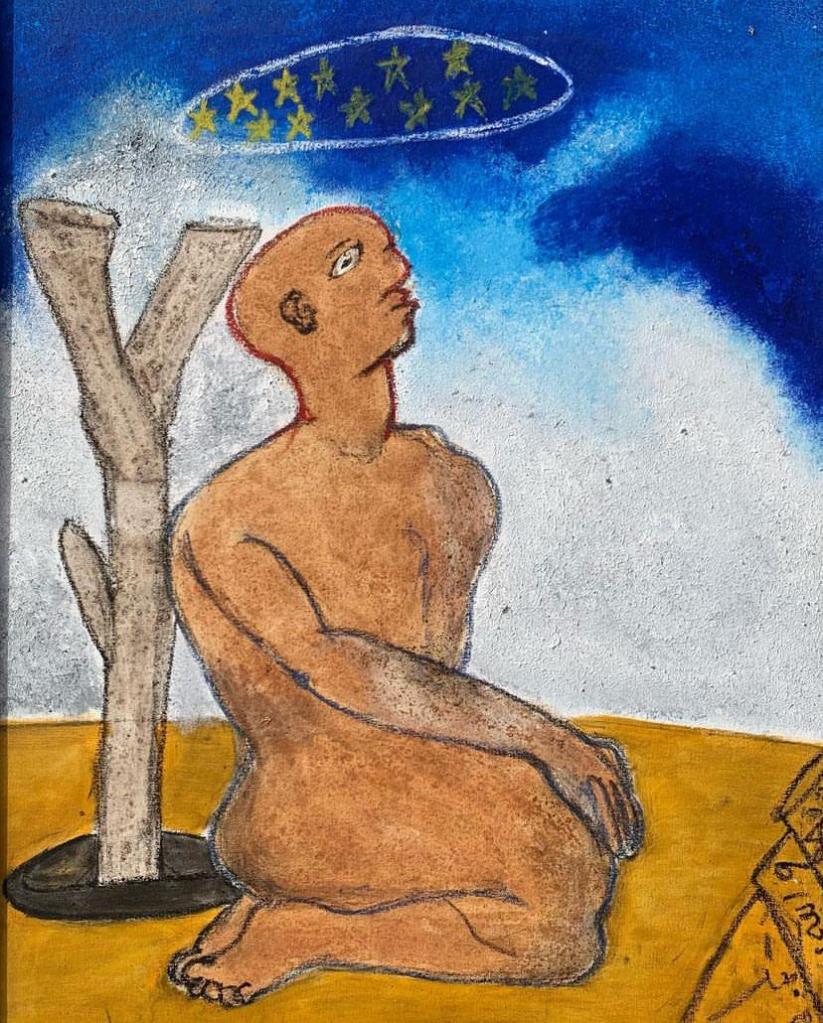

Ndiaga doesn’t just paint; he creates stories. These narratives, imbued with narrative power and symbolic depth, appeal as much to the eye as to the soul. By blending tradition and innovation, he elevates his art to a universal dimension, making his works mirrors in which every viewer can recognize and question themselves.
Baye Ndiaga is much more than an artist; he is a ferryman between worlds, a healer of the collective soul. His work, with its spiritual depth and social relevance, is part of a timeless approach, reaffirming the fundamental role of art: that of connecting us to ourselves, to others, and to that which transcends us.
INTERVIEW
My art is like a medicine
Can you tell us how you started with art?
When I was a child, I was already drawing small sketches on baobabs’ trunks, and on anything I could find around me. In my second year of high school, I decided to leave school and dedicate myself to art—that was in 2012. I enrolled in evening classes at the School of Fine Arts in Dakar, where I graduated in 2016. From 2016 to 2018, I spent time searching for my style with the help of artists like Ndoye Douts and Cheikha Siggil, who guided me to develop my unique approach. By late 2018 and early 2019, I started participating in group exhibitions. My first participation was at the Ségou’Art Contemporary Art Fair in Mali. Then, in April 2019, I took part in a group exhibition at the Théodore Monod Museum of Dakar. Later that year, in November 2019, I participated in the 10th Visual Arts Salon at the National Gallery. It was at that moment I started to feel confident enough to join the ranks of Senegalese visual artists.
Why do you create art?
I create art to express what’s happening in society, in my life, and in my surroundings. It’s also a way to express what hurts me. I’m deeply engaged in issues concerning humanity and our relationship with one another.
What hurts you in society?
What hurts me the most is seeing how humans fail to respect one another. In Senegal, for example, there are many things that I feel no human being should tolerate. The way politicians manage the country is one of them. I’ve noticed that politics has corrupted and ruined much of the world.
When we look at your work, we feel a transcendent dimension. What role does spirituality play in your art?
Spirituality has been a great help in fighting my battles and rising above challenges. Sheikh Ahmadou Bamba has been an immense inspiration to me. His teachings emphasize respecting humanity and our fellow beings. In one of his writings, he said: “Oh God, forgive all my enemies who wronged me when I was at sea, striving to free the descendants of Adam.” I draw on that wisdom to create my works because I have faith in Allah. I don’t even harm animals or insects like flies. I hope my art can inspire people to behave better and adopt positive attitudes. We all come from Allah, and nothing harmful should reign among us.
We often see the figures in your artwork engaged in struggles or battles. Is this a reflection of a personal fight?
Life today is indeed a fight—a struggle that’s both material and spiritual. For example, as an artist, even if you’re talented, negative forces will always try to get in your way. You have to be spiritually grounded to overcome them. I’m a survivor of life. I’ve faced numerous attacks, even by members of my own family, simply because I’m known now and still young. It’s been a battle, but I’ve come through it. My personal story shows that life isn’t easy, and you must fight to succeed.
What goal do you want to achieve through your art?
I see myself as a painter here to heal people’s troubles. A single painting of mine in someone’s home can serve as medicine for an entire generation. That’s because the natural pigments I use in my works have healing properties. Take cola, for instance—it’s a fruit with remarkable benefits that brings people together. Coffee does the same. In Senegal, for example, ten people can share a single cup of coffee, fostering connection. That’s why my work invites people to heal and come together. Even if you’re in a bad mood, it can give you hope to keep going.
You say your art is like medicine for a generation. Does it also help you heal?
Absolutely. Painting allows me to forget many negative things and focus on the positive. When I paint, I feel relieved. It takes me to another dimension, another world, where I can leave behind all the negativity.
Why do you use natural pigments in your work?
My grandfather was a traditional healer who cured many ailments. He also used cola in his remedies. When I was a child in the village, I would watch him as he helped people with kidney problems. He would take a cotton thread, tie four knots in it, and on each knot, he would chew a piece of cola and rub it. After five minutes, the knots would turn red. When I started researching my style, I thought of my grandfather, and that’s how I began incorporating cola into my work.
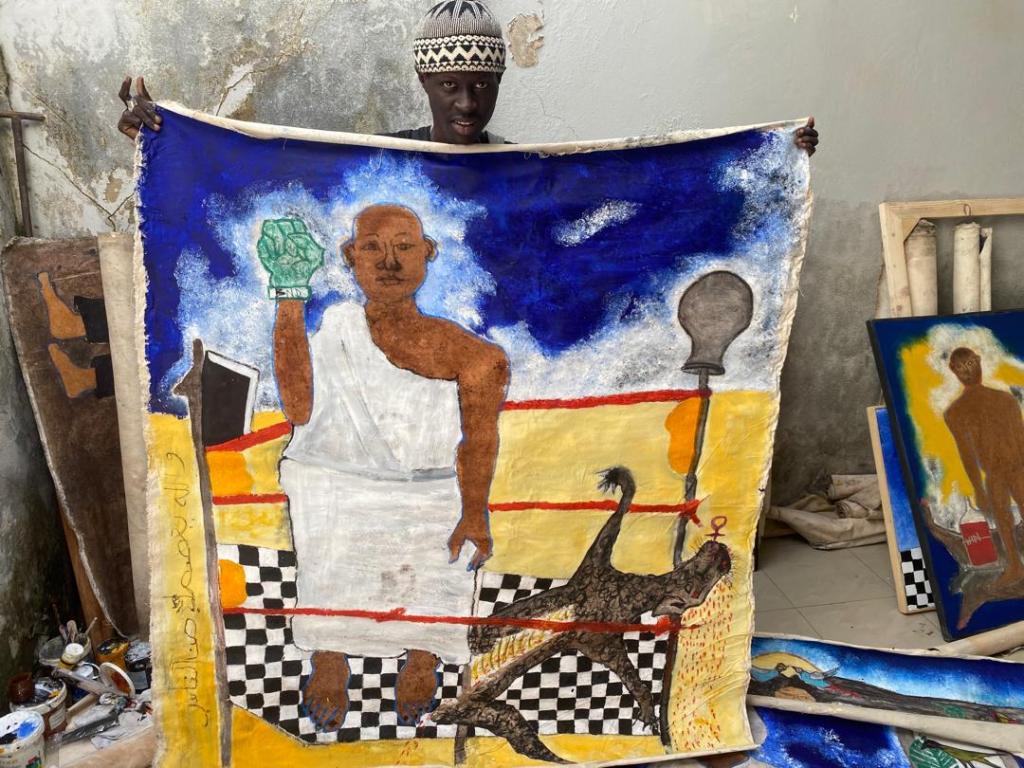
Can you tell us about this painting, Knowledge is the Key to Wisdom?
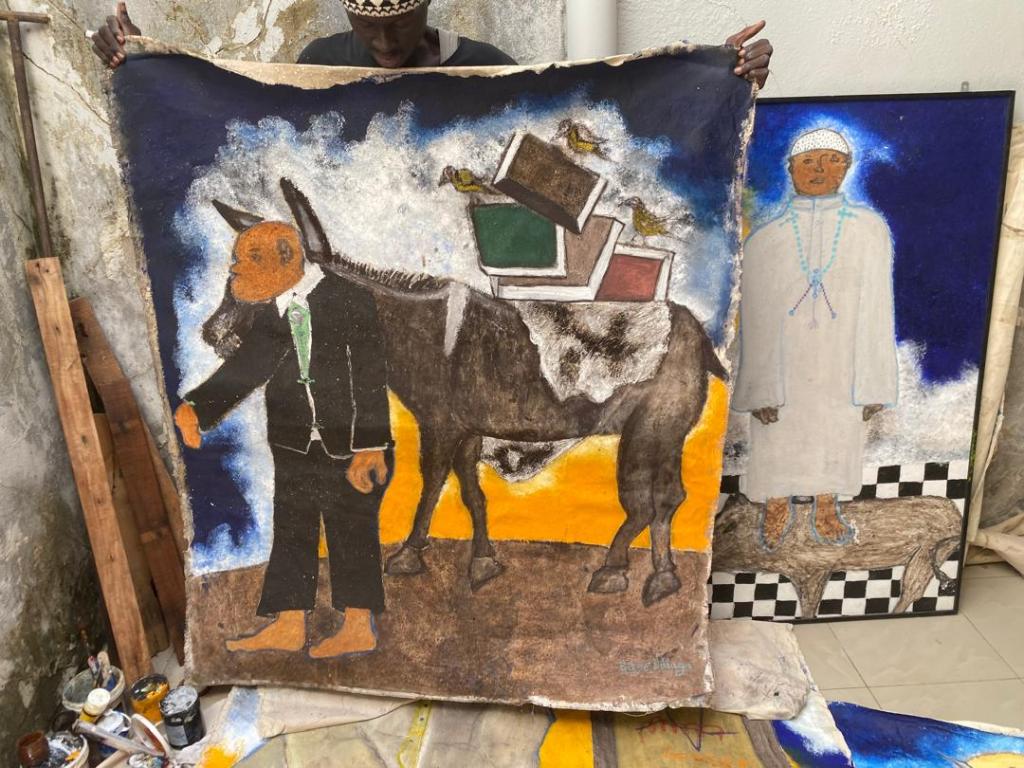
It speaks to people who have a lot of knowledge but don’t apply it wisely, especially in Senegal. Some marabouts who have learned the Quran fail to put it into practice in a meaningful way. They do things that are haram. This painting is directed at them. Cheikh Ahmadou Bamba said: “A man who has knowledge but doesn’t use it for good is like a donkey carrying books on its back.” I work on themes of wisdom, knowledge, and the loyalty Cheikh Ahmadou Bamba showed toward his Creator. For this painting, I use Touba coffee and cola mixed with other pigments. I dilute the coffee with other natural elements like pastel, charcoal, and cola to create the piece.
Why are you so interested in knowledge?
I’m deeply interested in knowledge because it’s what allows us to live peacefully with others, even when we’re different. That’s part of what knowledge is about.
What about beauty—is it something you strive for?
No, beauty doesn’t interest me. What matters to me are the details. The details are what allow the viewer to truly read the work. The message is more important to me than the aesthetic. The aesthetics and colors may draw people in, but once they delve deeper into the piece, they’ll be captivated by the details.
Do you have any rituals before you start painting?
I say Bismillah, Allahu Akbar—God is the greatest. People say artists create, but no, we don’t create; we merely recreate.
Which artists have influenced you?
Jean-Michel Basquiat has influenced me a lot, as has Ouattara Watts from Côte d’Ivoire.
What is your ideal world?
A world where every human being serves as an example for the next generation.
PAST EXHIBITIONS
Solo shows
2022
Crise des valeurs – Crisis of values, Beluga Art space, Dakar Biennale
Group shows
2024
Blaise Diagne International AirPort, Dakar Biennale
Utopie – Rooftop Babaladji, Dakar
2022
Duo Show, Dialogue et Symphonie, Espace Médina
Group show with Dada Gallery, 1-54 Contemporary Art Fair
2020
Gueew-Bi, Institut Français
Li Nu Bokk, Institut Français
2019
Group Show, Musée Theodore Monod IFAN
10th edition of the Senegal Visual Arts Exhibition, Senegal National Gallery
2018
Art Fair, Segou Contemporary Art Fair
2017
Alem L’avenir avec le Laboratoire Agit ‘art, Institut français of Senegal, Galerie Le Manège
 Bridging Africa and The World Through Contemporary Art
Leave a comment