
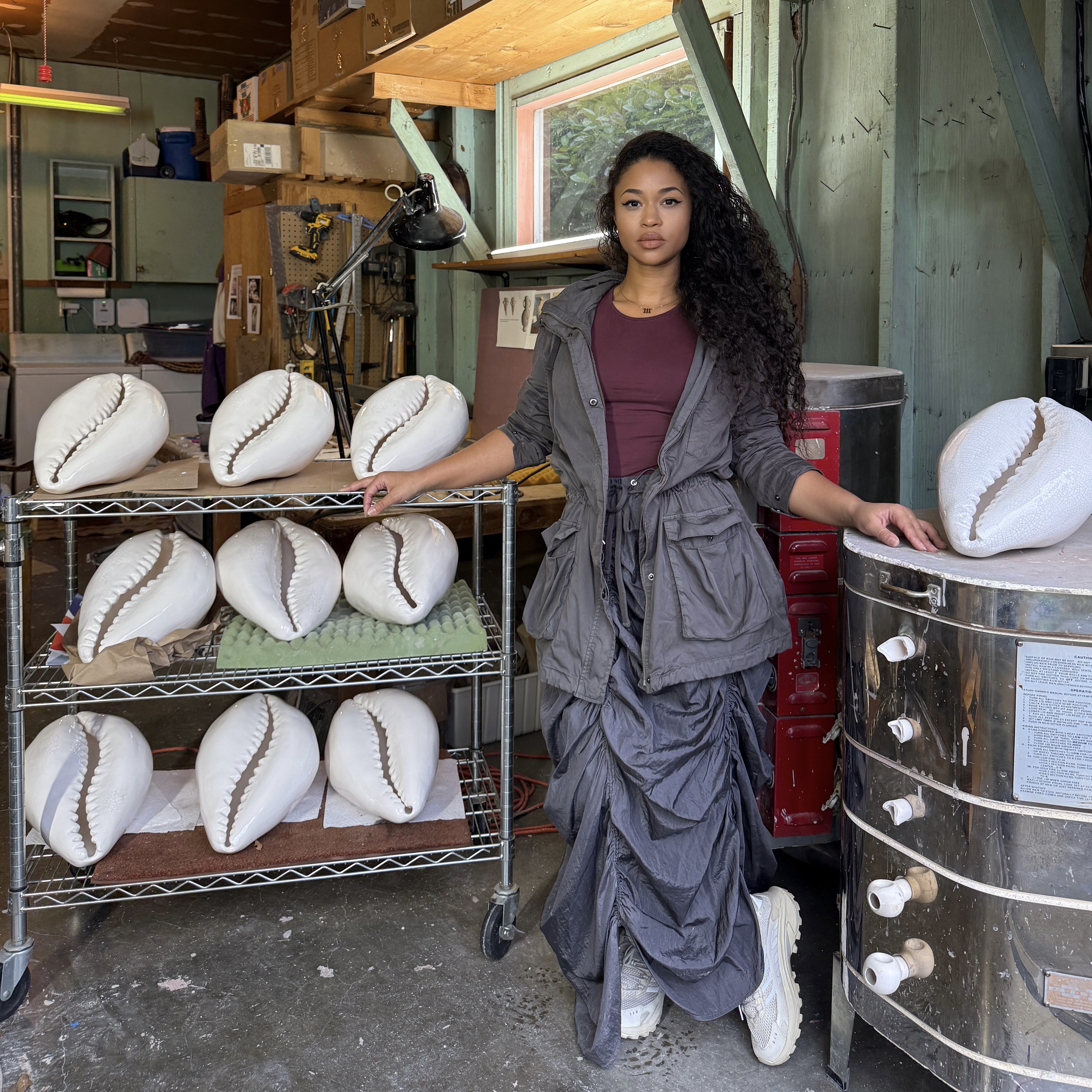

Raised between Mali and Portland, Oregon, and now based in Los Angeles, the Malian American artist was introduced to painting as a child in Mali, where she learned traditional bogolan painting. Today, her work draws on childhood memories, oral histories, Malian cultural traditions and spirituality. Working across collage, painting, film, photography, ceramics, bogolan and cowrie forms, she brings stories of Mali and West Africa into a contemporary visual language.
Her work often places women and overlooked histories at the center—not, she insists, to rewrite the past, but to pay homage to those whose contributions have too often remained in the background.
In this conversation with DakArtNews, Diakité speaks about memory, womanhood, cultural erasure, spirituality, beauty and what it means to remain truthful to her own voice as an artist living between two worlds.

What does memory mean to you as an artist?
Memory plays a big role in my art in a few different ways. I spent a lot of my childhood in Mali, and so much of my work is influenced by Malian culture. I’m always recalling these gems from my childhood and my experiences there, whether it’s different art forms I learned, or traditional and cultural experiences that were really beautiful and special to me. I want to keep those experiences alive through my artwork.
I also had a handful of friends who were part of griot families, so I spent a lot of time learning about West African and Malian history. There’s a huge element of memory in the way that history is kept alive through oral tradition. I bring those elements into my artwork because they are such beautiful stories that deserve to be carried forward and preserved. So memory plays a huge role in my work and in my practice.
How does working with these oral histories shape the way you approach the past?
I guess there’s a stronger sense of connection because these histories come from friends and family. There’s a deep sense of connection that I feel toward these histories and memories, so they are already a part of me before I begin the artwork process. It’s not necessarily separate historical facts that I’m researching. Everything I’m creating is a part of me in a sense.
Do you think oral histories can preserve things that a written archive sometimes cannot?
Oral history is the traditional way of passing these stories down. They’re passed from family to family, and there can be slight differences from one family to another as the stories are passed down.
When I was back in Mali with my father, we did a lot of archival recording. We’ve met with oral historians within families and villages with which we have close relationships and worked together to document those stories.

There are so many ways of preserving history—through voice, oral tradition and song, for example. As we move forward, there are also many other ways to preserve and circulate these stories. I think there can sometimes be a tendency, particularly through a Western lens, to feel that histories need to be preserved in written form. I think that’s a valuable method too, as long as it doesn’t erase the culture of oral history itself. It’s important to preserve the art form of oral history and make sure that traditional cultures are not erased through more modern methods.
What is the strongest memory you carry from your childhood in Mali?
The strongest memory I carry is the sense of feeling free as a child when I was in Mali. There was a sense of independence and freedom that I didn’t necessarily have when I went back to the States. I think that’s something I still pour into my work. There was always a different sense of freedom when I was there. That’s the number one thing I remember and carry with me when I think about my childhood in Mali.
In Mansa Musso (She is King), you brought women from the history of the Mali Empire to the center of your work. What did it mean to you to place them at the center of these stories?
I found it interesting as I was learning and listening throughout my life about the Mali Empire and West African history, and about all the different kings and their stories. I would hear about the women in those stories—their mothers, their sisters—and how, in my eyes, they really shaped the direction in which things unfolded. Without their help, things could have unfolded very differently.
I always noticed that, and I thought it was really amazing. I wanted to highlight them because they were part of these stories, but they weren’t necessarily the main characters. That show was about giving them the spotlight and making them the main characters of these stories, in the way that I saw them and recognized their contributions.

Was it a way of rewriting history?
Oh no, no, no. It was really about paying homage to them.
You often portray women as powerful figures. What does female strength mean to you?
I always really looked up to my aunties in Mali and the strength they showed me every day through their everyday lives and the things I learned from them. I always felt such a strong sense of pride in everything they taught me.
Going back to Mansa Musso and learning about the connections we all have to these incredible things that women in West African history have done, I wanted to bring that energy to the forefront of the artwork I created. I felt a strong connection to that.
Do you see a difference between how female strength is expressed in Mali and in the United States?
Yes, there’s a difference. I feel like I’m always walking a tightrope because I spent a lot of time in Mali while growing up in America, especially when it came to learning history. It’s taught very differently here, and I’m very grateful to have been able to learn the history I did in Mali.
Strength is strength to me. When I’m creating, I go by an intuitive feeling and try to create from that source point. But I think both countries have very different histories and different sources that they’re drawing from. So the strength you’re drawing from is going to be different because the environment is different.
For example, my experience in Mali with my aunties was that we would wake up very early, take our buckets, walk a mile to the market, get everything we needed, and carry it back home on our heads. There was a lot of physical strength, as well as emotional and mental strength, in doing that day after day.

In the States, it’s a different ballgame. It may not involve that same physical strength or having to perform the same tasks every day, but there is an emotional and ancestral strength that you have to have as Black women in the United States. So when it comes to my art, I’m pulling from all of those aspects. Strength is strength.
How do your experiences in Mali and America come together in your work?
It would be a blending of my experiences. As an artist who grew up in two different parts of the world, I’m bringing my lens from both places and putting it into my artwork. That’s all I can do as somebody who is bicultural and living between both worlds. I’m bringing my authentic view to it.
What does living between Mali and America mean to you today?
Yeah, I mean, it’s me. It’s all I know. But I think it will always be a lifetime of balancing both sides.
As an artist navigating between two worlds, how do you approach authenticity in your work?
It just has to come from a place of truth. When I’m creating, it has to feel right in my spirit. If the subject and what I’m creating feel aligned and feel right, then that’s where I create from. I can only create from an honest and authentic perspective.
I’m not creating what I think people might want me to create or how people might see me. The art world is so large, and there’s so much noise coming from so many different angles. I think it can be easy for an artist to pull from that noise and create from it. But if I’m being authentic to myself, none of that noise matters. It has to come from what’s true in my heart and in my spirit.
How does distance from Mali shape the way you represent your culture in your work?
I am paying homage to my culture and the beauty in my culture. That’s how I would describe it.
What have you noticed about the way your work is received in Mali compared with the United States?
Art in general is subjective. As an artist, I know it’s my responsibility to tell my story in the way I know best. I know where I’m coming from, and it’s not really up to me to control how someone is going to interpret it. That’s out of my control. I’m telling my story the best way that I can.

Do you ever feel the need to translate the African references in your work for an American audience?
That’s an interesting part of it because many of my pieces are representations of stories. With oral history, a griot can sit there and sing for a week straight. The stories are so vast that there’s only so much I can capture on a canvas. I’m really trying to capture the energy and essence of that moment in time.
I do notice that the feedback from people in Mali is different because there’s an immediate connection. They know the entire story, so there’s a whole different level of connection there. When I show the work in the States, I think it’s more of a learning experience. People are either looking at the work and enjoying it, or they’re also learning something new and seeing where they can connect with it.
Depending on where somebody is in their relationship to West Africa, the work is going to give them something different. Either way, I’m highlighting the beauty and strength of whatever it is I’m painting that’s connected to Mali.
What do you wish American audiences understood about Mali and West Africa beyond the dominant images of Africa?
One huge driving force for me comes from being a young girl in history class and rarely learning anything about African history, let alone West African or Malian history. It simply wasn’t taught, and that was very odd and confusing to me.
That’s a big driver when I’m creating the work that I create. I’m seeing that these stories don’t even exist in this part of the world, and they deserve to exist loudly. With shows like Mansa Musso, where I’m creating pieces about the incredible things women in West African history have done, I’m putting those stories at the forefront because sometimes people really have no idea. Sometimes it’s something where they can come and learn a little bit about their own history, or about West African history in general. That’s a driving force for me.
“I’m kind of living by collaging different parts of my life together from different parts of the world.”
Penda Diakité
What is art to you?
Art is something that I’ve always grown up with. I grew up surrounded by so many different forms of art. Both my parents are artists, so all of their friends are artists as well. They’re different types of artists, from sculptors and ceramicists to painters.
It’s something I explored very young and that has always come naturally to me. It’s felt like an amazing outlet for expression while growing up between these two worlds, and also a way to connect with my culture.
Has your understanding of what art is changed as you’ve grown from a child surrounded by artists into an artist yourself?
I don’t really think it has changed. Art is a creative expression. From my early years to now, it’s really the same thing. It just comes in different forms. I feel like that’s what it is all over the world.
What does beauty mean to you in the context of your practice?
What I’m really doing is highlighting the beauty in Malian culture. I’ve found so much beauty in so many different aspects of my culture. It’s in the music, the food I’ve learned how to make there, the energy of daily life, the traditions, and the spirituality.
I find there’s such a heightened sense of beauty and livelihood that I try to highlight in almost all of my work. One of my favorite parts of the culture is the relationship with plants, nature and animals, which I often incorporate into my collages. That element of Malian spirituality, where living in harmony with all living things is so important, is a part of traditional spiritual culture that I’ve always highlighted in my artwork. I feel such a sense of pride in the beauty of that part of the culture.
How important is aesthetic beauty to you when you create?
I think it’s all of it equally. It’s beautiful to me, but when it comes to artwork in general, everything is very subjective. So for me, the aesthetic of it is beautiful. And then the story behind it holds another kind of beauty, a weighted beauty. It’s an ancient beauty that comes from the culture and its histories.
Your practice brings together acrylic and spray paint, photography, collage, bogolan, cowries and ceramics. What makes a material feel right for a particular work?
The base of all of my artwork is collage. I think it’s interesting because, if you think about my life in a metaphorical way, I’m kind of living by collaging different parts of my life together from different parts of the world. That’s always the base of my work. Then it’s whatever intuitively feels right or comes through for the story I’m telling on the canvas.

What does bogolan (mudcloth) allow you to express in your work?
Bogolan was one of the first art forms I ever learned. My dad and cousins taught me when I was a young girl, and I always found the patterns so powerful and beautiful. Then I learned the meanings behind each of the patterns. There’s just so much you can say through a simple design.
I adorn most of my pieces with bogolan patterns because they allow me to summarize the meaning of the work through these symbols. I’m not creating new ones. I’m using symbols that have been traditionally and historically used and that have meanings associated with them.
Bogolan patterns are now widely used outside their original context. How do you view that?
A lot of the time, they’re not actually correct bogolan symbols, but it is a beautiful art form, so I can’t blame people for widely using it.
But where I’m from, when you go back to Mali, it is still traditionally made and traditionally used in a lot of ways. There are bogolans with certain meanings for weddings or baby showers, for example, and they are still very much used traditionally there.
When traditional cultural symbols are used without acknowledging their origins, do you see that as a form of cultural erasure?
I mean, it’s not great in the sense that it does feel like there is a part of the source that’s being erased. It’s taking the product without really acknowledging the source or what it’s meant to represent. A lot of people don’t know where bogolan is from or even know that the patterns are being replicated elsewhere and printed on a pillow or whatever it is. Some people don’t even know that it’s bogolan.
There is a sense of erasure there that is not good. But when it comes back to my art, I am working to preserve it in a sense. I guess, consciously and subconsciously, it’s just part of what I’m doing every day—to preserve what I can through my art.
What happens when you bring traditional materials and contemporary ones into the same work?
It’s just a combining of the past and the present, and sometimes a combining of the past, present and future. That naturally comes when I’m creating historical stories. I’m bringing the past into the present while also creating through my lens as a bicultural woman who is mainly in America now. My whole life and everything I’m doing is a combining of different elements.
“My art practice is part of my spiritual practice.”
Penda Diakité
You also created a limited ceramic series of cowrie forms. What does it mean to give new physical form to an object that carries such historical and spiritual significance in West Africa?
Those cowrie shells began with an installation I did. When I was younger playing Ludo, when we couldn’t find the pieces, we would use cowries.
For the installation, I created an abstract, large-scale version of a Ludo board, and in each of the home bases I made four cowries. I found that significant because we know the importance cowrie shells have had in West Africa. There are so many different ways in which they have been relevant, both historically and today.
But even sitting on their own, there is so much historical and spiritual weight to the cowrie shell as a symbol. So enlarging it and putting it at the forefront is something I like to do in my artwork in general—taking something and magnifying its cultural, historical and spiritual significance.
What place does spirituality occupy in your artistic practice?
I’m a spiritual person, so I think that comes with what we were talking about with authenticity. I always have to feel grounded and feel like what I’m creating is right. My art practice is part of my spiritual practice in a sense, because it is a connection to my ancestors in a lot of ways. It is also a way of paying homage to my ancestors.
So there is a sense of spiritual practice that surrounds my art. I’ve always said that I feel like art itself is a form of meditation. I meditate every day, and I get the same feeling when I’m creating as when I am meditating—that very intense sense of peace and presence.
Do you see art as accessing something that cannot be reached through words?
Absolutely. I think artwork itself is a universal language. That’s why I think it’s so beautiful that you can make a piece and it can bring a sense of healing, peace or beauty to people all over the world. That’s why art is so needed. It really is a universal language in itself.
What role does healing play in your relationship with art?
I do feel there is an element of healing—receiving healing and giving healing through the artwork. I get so much healing from the creation process itself, and part of my hope and goal is to give that sense of healing, along with many other elements, to the viewer. I do think it is a healing journey, both in the creation of the artwork and in showing it.
“The point of being an artist is to speak your truth through your artwork.”
Penda Diakité
Has becoming more established as an artist changed what you feel you can say through your work?
No. It always has to come from the truth in myself. I think the outside world will always tell you what they think you should say. There’s always going to be a template for what you should or could be. But I don’t think that’s the point of being an artist. The point of being an artist is to speak your truth through your artwork. To me, there’s no other way and there’s no other option.
It doesn’t matter who you are. When you’re speaking your truth, there are going to be other people who connect with it. There are going to be people who resonate with it and feel seen, heard or empowered through your truth.
You have used the word “truth” several times. What does truth mean to you as an artist?
Truth is just creating authentically. It’s not creating what would necessarily be expected or asked of you. It’s creating what’s aligned with you.
Sometimes that may align with what galleries or collectors want, and that’s great. If it doesn’t, that’s okay too. But it’s not going to change what I create. That’s what I mean when I talk about truth.

Are there subjects you feel you have not yet explored through your art?
I think as I continue, more things that I feel I need to say will obviously evolve. But there’s nothing right now that I feel I’m not saying that I need to say. Everything I’m creating is happening in real time, based on what I want to say.
Do you think there is a right time for a work to be seen?
I’ve felt that way in the past with my work. You see this throughout history with artists—sometimes their work is appreciated much later. There’s this strange question of whether a work will be seen for what it is at a particular moment.
It’s something you grapple with after you’ve created a body of work: Is this the time for this to be seen? And honestly, not always. But that doesn’t mean you shouldn’t show it. For me, it’s the right time because I created it, so I’m going to put it out there. That doesn’t necessarily mean the collective is going to see it in the same way.
How do you see your practice evolving in the coming years?
I see it evolving in new and different spaces throughout the world. I see my artwork being seen a lot more in Africa and on the East Coast.
It feels like places can absorb your work differently. So I think as I continue to grow and create, the spaces throughout the world where my work is shown and the audiences who encounter it will continue to grow.
Read also
Tidiane Ndongo: Mastering Bogolan Art and Tradition
‘Painting Feels Like Prayer’ for Keemetaane’s Mystic Canvases
Leave a Reply