
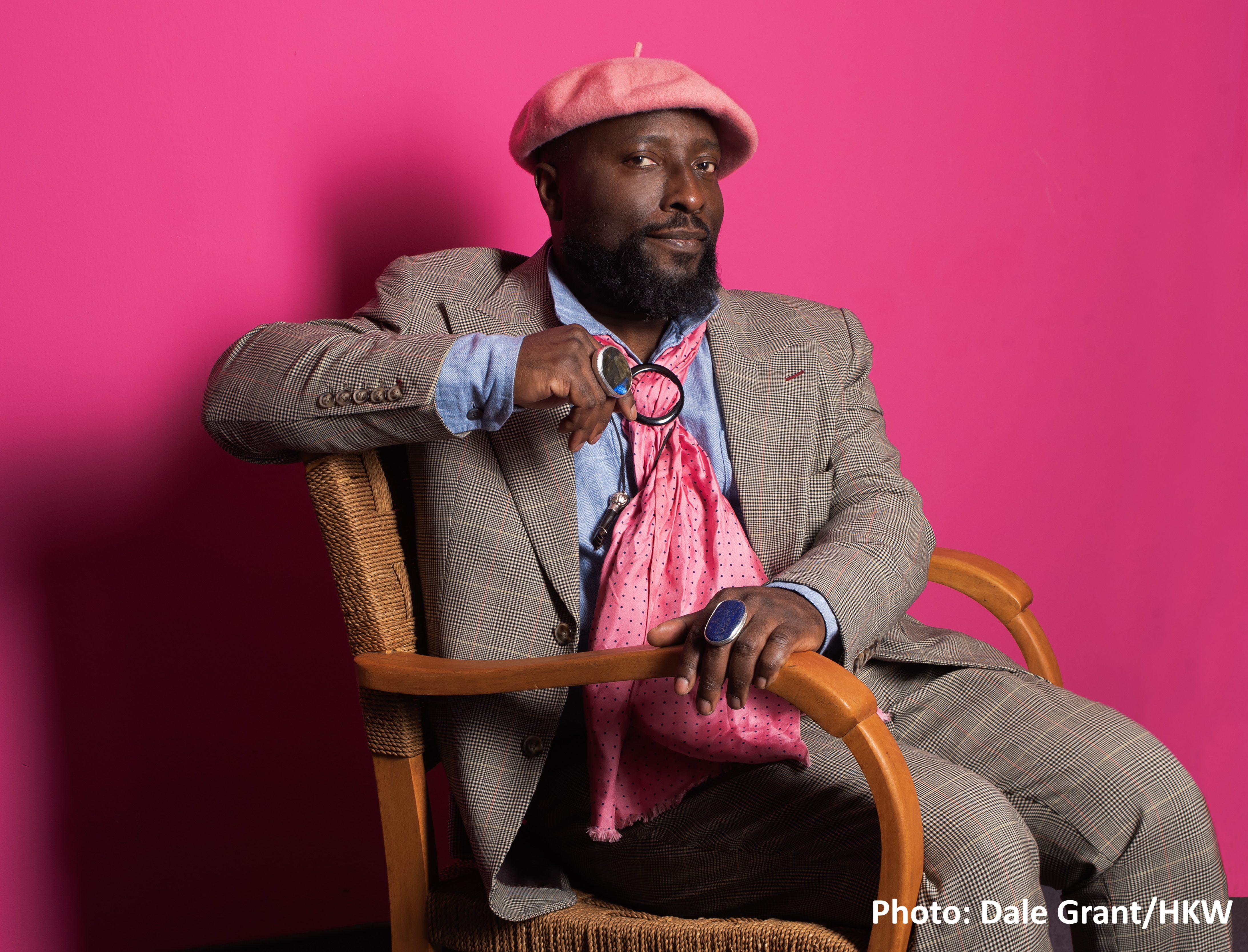

In 2021, when Bonaventure Soh Bejeng Ndikung was appointed Director of the Haus der Kulturen der Welt (HKW) in Berlin, he set out a clear ambition: to shape the institution into a House of World Cultures grounded in complexity, co-creation, and the reconciliation of cultures. Five years later, DakArtNews sat down with the Cameroonian curator, writer, and thinker to reflect on that vision. Throughout the conversation, he discusses the principles that guide his curatorial practice, the role of cultural institutions in the production of knowledge, the need to rethink inherited narratives, and the importance of creating spaces where new forms of dialogue, creativity, and thought can emerge.
Your exhibition Tirailleurs: Trials and Tribulations has just come to an end at HKW. Why was it important for you to revisit the history of the Tirailleurs today?
Well, because I think that the issue of the Tirailleurs is a major subject of 20th and 21st century history, and we need to address that. I think that you cannot tell the story about the liberation of Europe and the democratization of the world without telling the story of the Tirailleurs. The first contract was signed in 1857 to start taking people from Senegal and then the other French colonies to fight wars in Europe. The Franco-German war at the end of the 19th century already had several Tirailleurs, but very few people talk about that.

Where it becomes very prominent is the First World War, 1914 onwards. And because the presence was so significant, it was very important for us to look at this history, to see where exactly the Tirailleurs came in and how exactly they participated, beyond the discourse of their contribution as something peripheral. Because you cannot be at the periphery and at the front line at the same time. If you’re at the front line and you’re cannon fodder, it means that you’re the one who takes the bullet and you’re the one who creates the path. So we wanted to shift the narrative.
That’s why the subtitle is From Cannon Fodder to Avant-Garde. We wanted to look at the military sense of the word avant-garde, to be at the front, which they were, but also in the philosophical sense, which means to excel in a discipline. And many of them excelled in their disciplines. Thinking of people like Birago Diop, who excelled in poetry, or Lamine Senghor in politics, or Léopold Sédar Senghor as a poet and politician. The motivation is really captured in the second part of the subtitle: the unknown soldiers that liberated Europe. And with that, we want to say: the soldiers that liberated the world.

In the accompanying essay, you open with Léopold Sédar Senghor’s poem and reference Fred Moten’s idea that “the avant-garde is a black thing”. ” Could you elaborate on that?
In the poem, Senghor writes about his fellow Tirailleur brothers, and by doing so, he essentially says: if I do not sing about you, who should sing about you? If I don’t sing your praise, who should? So there is a responsibility, our responsibility, to carry their history and to sing their praise.
Then the second part of it is Fred Moten really saying that if you want to look at the history of modernism, of modernity, you cannot speak of modernity without the presence of Blackness. Which is to say, if we go with the line that coloniality is the other side of modernity, then it is because of coloniality that modernity actually became.
There is no idea of a developed Western world without the presence of enslaved people or the colonial project. There is a certain argument to be made that the wealth that Germany has today also goes back to the fact that the Prussians and the Brandenburgers colonized the Gold Coast already in the 1600s, and that the money obtained from selling the Gold Coast in 1717 to the Dutch led to significant investment in building what is Germany today. One can argue that without the colonization of the African continent and the Americas, France would never be what it is today.

The enslaved Africans going to the United States or Brazil: those places would never be what they are without them. And if we go to technology itself, Ibn al-Haytham’s contributions to optics, the Dogon practicing astronomy, the technological developments that came from ancient Egypt, on all fronts, the avant-garde is there. We can come to the modern time and say there is no music, no cultural expression, no sports, without this Black presence. Fred Moten is right. And I say this as somebody who is not particularly drawn to the discourse on Blackness as such, it’s not my primary framework, but if we just look at the facts, yes.
“How do we de-erase what has been erased? How do we propose new knowledge structures? That, to me, is a curatorial practice.” – Bonaventure Soh Bejeng Ndikung
You said Blackness is not your framework, but one of your frameworks, I would assume, is that you have been for a long time advocating for decolonial approaches in curating.
I would disagree with you, even the so-called decolonial approach is not my thing. I think it’s intellectually lazy. When the notion of the decolonial becomes everything and nothing, then it doesn’t mean anything anymore. So I think we need to do some work to find concepts that fit the kind of work we’re doing. I hope that one day we actually find out what a decolonial approach to curating is, but in the meanwhile, I’m trying to develop, bit by bit, different strategies.
For example, I wrote a book on Pidginization as Curatorial Method. Is it decolonial? Yes, probably it is. But it would be intellectually lazy to just use the biggest umbrella to cover yourself. I see that especially with young curators, or even some of my peers, when they cannot articulate what they’re doing, they just reach for the notion of the decolonial. And if you ask them what it means, they cannot tell you. Because the idea of the decolonial is such a powerful thing, and we should be careful not to fall into that trap, what Catherine Walsh calls the adjectival lightness of decoloniality, that it’s just an adjective and nothing more, because we’ve watered it down. So we need to do some work.
What could be the nature of the work that needs to be done?
In the past years, I’ve tried to develop a few concepts. The first would be unlearning. I wrote an essay many years ago, in 2016, titled Unlearning the Given: Exercises in Demodernity and Decoloniality of Ideas and Knowledge. In that text, I write that unlearning is not forgetting. It is neither deletion, cancellation, nor burning off. It is writing bolder and writing anew. It is commenting and questioning.
It is giving new footnotes to old and other narratives. It is wiping off the dust, clearing off the grass, and cracking off the plaster that lays above the erased. Unlearning is flipping the coin and awakening the ghost. Unlearning is looking in the mirror and seeing the world rather than a concept of universalism that propels a hegemony of knowledge.
So a curatorial practice based on unlearning is about finding, as James Baldwin says in his essay on the creative process, that the role of the artist is to ask questions for answers that are already out there. How do we give footnotes to statements that are already there? How do we find new statements? How do we de-erase what has been erased? How do we propose new knowledge structures? That, to me, is a curatorial practice.
These ideas are compelling in theory. What are the concrete methods or tools you rely on to put them into action?
There are so many. Everything we do here is that. For example, the Bwa Kayiman festival we organize every year. How knowledgeable are people of the history of Haiti, or Saint-Domingue, that on the 14th of August 1791, Dutty Boukman and Cécile Fatiman called for people to come together in a ritual ceremony, a performance at Bwa Kayiman? And that was the beginning of the Haitian Revolution, which lasted from 1791 to 1804. People talk about Toussaint Louverture, who was important. But Toussaint Louverture wasn’t even at Bwa Kayiman. He joined the revolution months after.
If these courageous people, the Houngan and the Mambo, didn’t come together as spiritual beings and perform that ritual, maybe the Haitian Revolution would never have happened. So every year, at the beginning of August, we bring in performance artists from Haiti and the Caribbean at large. We bring in scholars like Ken Bugul from Senegal, musicians, poets, and we bring them all together with historians like Professor Jean Casimir. People ask: how could Haiti be so poor now, although it had a revolution in 1804? Because we have to tell that history. We have to unlearn the nonsense that has been taught to us. So for us, it is a performative gesture.
And then there is also the music program we have right now on Gnawa — The Global Echoes of Gnawa — which responds to the concept of pidginization as a curatorial method. Because Gnawa is a pidginization: a combination of music and spirituality from the Sahel joining the music and spirituality of the Maghreb, with its own instrumentation and practice. These are just two examples, but I could give you several more. There are many more I could talk about.
“When people talk about decolonization, they are talking about the roof without building the foundation.” – Bonaventure Soh Bejeng Ndikung
How do you mediate these processes of unlearning and pidginization?
That takes us to the third concept I wanted to present: the decanonization as method. And we are still not at decolonization. These concepts are the pillars that will make that house. When people talk about decolonization, they are talking about the roof without building the foundation, the pillars, and the walls. That doesn’t make sense to me. It’s intellectual laziness.
In the text I wrote about decanonization as method, I argue that the goal is not to create new canons. The goal is to make the canon porous. The goal is not to put one epistem above another, but to create the possibility of existing side by side. Decanonization is the possibility of creating a porosity in the existing canon, showing that the existing canon is as fickle as a banana leaf in the wind, and presenting other possibilities.
It means that if you bring another epistemic structure, the idea is not to say that everything that existed before is wrong. Not at all. But you want to show that before Newton, 500 years earlier, you had Ibn al-Haytham in Iraq, who promised to go to Egypt and build a dam. He couldn’t, and they put him in prison.
And in his cell, where he couldn’t communicate with anybody, he made a tiny hole in the wall. And he noticed that when the sun passed through that hole, he could see what was happening outside. That is how he developed the theory of optics, understanding that our iris functions in the same way. But what did we learn in school? We are not saying that Ibn al-Haytham did all the work alone, but it is simply not true that Newton did all the work.
What would a truly unlearnt, pidginized and decanonized institutional work look like?
I don’t know. We are in the process of finding out. This whole thing is an experiment. If I told you I had the exact solution, I would be lying to you. But we are in the process of finding out. After this, it will be for people like you to write about it and say: these people tried this, and they failed. And it’s fine to fail. But one thing is for sure, we will produce as much knowledge as possible.
Last year, we published 24 books in this institution. Twenty-four. That is an average of two books a month. We will produce so much knowledge that the next generation will no longer have any reason to say they went to the library and found no books about the Tirailleurs, no exhibition about the Tirailleurs.
Because we will have done that work. As others are doing it too. I am not saying we are the only ones. We did a show last year about global fascisms. Nobody can accuse us of seeing fascism happen and doing nothing. We see it happening, and we do something about it in our own way. I don’t believe in weapons. There was a time in my life when I believed in going out in the streets and protesting, those were the tools I had then.
The tools I have now are to conceptualize projects, to think spatially, to stage conversations between artists and artworks, and to stage encounters between artworks and an audience. That to me is what curatorial practice is: the production of knowledge, the cultivation of that knowledge, and its dissemination.
Where do you see the limits of this approach, especially in relation to the audience you serve?
The dialogue with the public is not a limitation, it is an invitation. An invitation to think otherwise. Everything we do here is an offering. Sometimes an offering is received. Sometimes it is not. And when it is not, you have to question yourself: is it in the way the offering is presented, or is it in the offering itself? The limitations are elsewhere. Economic limitations, how much money do I have to do the kind of projects I want to do? Epistemic limitations: how much do people know about this history? Capacity limitations: do I have enough team to do what I want to do? No, I don’t. It’s a big team, but I try not to push people beyond their limits. Those are the real limitations.
“I am an African. There is nothing I can do about that.” – Bonaventure Soh Bejeng Ndikung
And at the end of your curatorial practice, what is the knowledge that you would like the public or the audience to grasp? What is the big picture of your curatorial vision?
I don’t want to give you any grand vision, because that’s too easy. As Patrick Chamoiseau writes, a huge part of the problems of the world comes from the grand narrative. The grand narrative doesn’t interest me. Let’s look at the small narratives. Let’s look at the small bricks that make up the building, the pillars that hold it up.
I don’t know what the master plan is. But what I know is this: to be able to build a nation, you need a very strong cultural foundation. While reading Sékou Touré’s contribution to the 1959 Second Congress of Black Writers and Artists, there is a passage that caught my attention: “The imperialists use cultural, scientific, technical, economic, literary, and moral values to maintain their regime of exploitation and oppression. Oppressed peoples also use cultural values to better combat imperialism and to abstain from the colonial regime.” And it goes on. It is a brilliant text.
This is what people were thinking about in 1959, a political leader who understood the value of culture and understood that one has to build these bricks bit by bit. Not some vague notion of the grand narrative of economic development which is imposed on us. Because you cannot have any economic development without a cultural development, without a cultural base. So, to understand our culture is the foundation of building the nation-state.

As an African curator and thinker based in Berlin, how do you approach the question of speaking about Africa and its diasporas from within the West?
I am an African. There is nothing I can do about it. I don’t wake up every morning telling myself: you are an African curator, you have to act like this. No. I am a curator. A curator from the African continent. And my point of departure for anything would be anchored in the culture I grew up in. Everything else comes after that. I can only speak from where I stand. And where I stand is a deep trans-African political and cultural base, which means Africa in relation to the rest of the world. Yes, I am in Berlin. So what? I could be anywhere else.
But there is a particularity about this city, that in 1884, Otto von Bismarck called on the so-called 14 great nations to come here to partition the African continent. It happened just a few hundred meters from where we are now. And in so doing, having no African at the table, in their wildest dreams they would never have thought that an African would one day lead one of their most important institutions.
So what does it mean? It means that I am conscious of my Africanness. The work I do is related to that. But it is also about being in resonance with the rest of the world. Because Africa without the rest of the world is nothing. Just like Europe without the rest of the world is nothing. It exists only in relation.
In 2021, when you were appointed director of HKW, you spoke about Berlin’s citizens from 190 nations becoming “fellow travellers and co-creators of a house of complexity, of analysis of the diverse asymmetries of the world and ultimately of reconciliation of cultures.” Five years later, how close do you feel HKW has come to this vision?
We’ve done a lot of work, but there is still a lot to do. We have brought in people from different communities who have become part of the making of the institution. We have curators here from Senegal, from Brazil, from China, from Kenya, from the Philippines, from all over the world. We’ve done programs that have engaged different communities. We did a major project called Echoes of the Brother Countries, in which we looked at the history of the so-called brother countries, because the GDR took young people from communist countries, Mozambique, Angola, Cuba, Vietnam, and others, to come and work here. And that is a part of history that is hardly ever spoken about. I remember doing that project and some politicians came in who had never heard about it. Just as many had never heard about the Tirailleurs.

For Echoes of the Brother Countries, we brought in artists like Dito Tembe from Mozambique, who had come to work in a factory but was also an artist. We found works he made in the 1980s, and we commissioned new ones. And for this kind of work, we always collaborate with institutions in different countries. For the Tirailleurs exhibition, we collaborated with Raw Material Company in Dakar, with Hide and Seek in Taiwan, with Alice Yard in Trinidad and Tobago, with Cinémathèque de Tanger, with Ancrages in Marseille, to tell the history from different perspectives.
The people in Taiwan spoke about how Taiwanese people were taken to fight for the Japanese army, as Tirailleurs of a kind. We had artists in the show talking about how women from Korea were used as prostitutes in the Japanese army. Complexifying the narratives and telling a larger history than what is written in the history books. So to answer your question: we have done a few very challenging projects that have begun to undo these asymmetries. But there are still many. You cannot undo 2,000 years of asymmetries in five years. We are working towards that.
The idea of “reconciliation of cultures” is ambitious, especially in today’s polarized context. Do you still believe in this notion of reconciliation, or has your thinking on how cultures engage with their asymmetries evolved since 2021?
That’s a difficult one. I’ll answer it this way. I am not interested in the definition of reconciliation as we commonly know it. I am interested in the etymology of the word. Reconciliare. Which means to repair. An effort of reparation. Perhaps a certain form of rehabilitation. That is my understanding of reconciliare. And that is the reason I wanted to do a project on conjugating humanity for the São Paulo Biennial, because I think there is a certain form of repair that needs to be done for us to be able to move ahead.
Yes, the notion of humanity has failed us. But how do we move ahead? Some people advocate for discarding the notion of humanity completely. Fair enough. But whatever we call it, we still need a certain piecing together of the pieces that have been shattered, for us to be able to move forward. The sun doesn’t care whether you call it the sun. It will still wake up every morning and shine on you. So we don’t need to call it humanity.
But if we call it humanity, or something else, how do we conjugate it? The question is not really what we call it, but how we practice it. How do we practice humanity, that is the question at stake. So writing about reconciliation was an attempt to formulate a certain praxis. How do you create an institution that could possibly serve as a space of repair?
So you have a therapeutic approach to this institution…
Well, if we take the notion of curare seriously, then it can only be therapeutic. How else would we want to care? Repairing is a form of caring. My responsibility is to cater for knowledge. To cater for cultures. To cater for the people that carry these cultures. To develop methodologies through which these cultures can be carried, passed on, and respected. And I want to spend the rest of my life thinking about that notion of humanity.
As Chinua Achebe said: your humanity is contingent on mine, and my humanity on yours. The whole work is to say that if you are dehumanizing people, you are first and foremost dehumanizing yourself. There is no way to dehumanize the Palestinians without having dehumanized yourself first. There is no way to enslave somebody without having enslaved yourself first, even though you stand there thinking you are some superhuman being.

Let’s now turn to the current Venice Biennale. Koyo Kouoh’s curatorial vision for In Minor Keys placed Africa and its diasporas at the centre. How do you situate this edition within the broader history of the Venice Biennale and the global art world?
I have been going to Venice for over 20 years. I cannot speak for the whole history of the Biennale, but I would say that this was an important moment in many ways. There is no perfect exhibition, but there were certain works presented that spoke to me very powerfully. The work of Theo Eshetu, the olive tree turning around with sound, the poetry in the work of Otobong Nkanga, the incredible assemblages of the Puerto Rican artist Daniel Lind-Ramos. So many works that resonated deeply. I think it was an important moment. And that it was curated by my elder sister was a bonus.
Do you think that we are truly living in the time of Africa and the Global South at large?
Those are all slogans, and we need to get out of sloganism, it never helped anybody. If you want to take it seriously, you would say that the past 1,000 years have been Africa’s time, but no African ever profited from it. These are slogans. Somebody else should talk about that, but not me. Africa’s time, what does it mean? Africa’s time is not going to be defined in Venice. No. It is going to be defined on the African continent and in African diasporic spaces. We have to be very careful.
What do you see as the specific responsibility of your generation of African and diasporic curators and thinkers today? What is at stake?
I cannot speak for my whole generation. But one of the things I am certain of is that we need to create institutions. Institutions that can carry our concerns, our aesthetics, our joys and our sadnesses, our histories. That is the first thing. The second is that my generation needs to do everything possible so that the next generation does not have to invent the wheel. My generation hasn’t invented the wheel either. But we need to identify where the wheel is and how it functions, so that the next generation doesn’t have to try to invent it as we thought we needed to.
The third thing, in my opinion, is that we need to consolidate. So many things were done before us that others let slip through their fingers. We need to close our fingers. We need to consolidate, in terms of knowledges, in terms of institutions. And then the last one: we need to be in solidarity. In allyship. That is something that many people in my generation have lost, which was even stronger before us.
After building your career in Europe, do you see yourself one day leading or contributing to a major cultural institution on the African continent?
The day you invite me, I’ll be there. I am just waiting for the invitation. In the meanwhile, we are already building an institution in Africa. We have functioning institutions there, look at the SAVVY Kwata in Limbe (Cameroon). We put up a library, which is perhaps the most important thing to do these days. We started a few years ago with 6,000 books, and now there are far more. And the day an institution would call me, I would drop everything and go. It is just one call.

What advice would you give to younger African curators?
Take it seriously. Read. Come up with your own path. And understand that curating is not Instagram. It is serious work. It is a commitment. As the artist Leo Asemota always says: we need to do the things we are tasked with. So what is our task? It is really about understanding what that task is, and finding an aesthetic for it.
Do you have recommendations of books you are currently reading that you would like to share with our readers?
I am reading several things at the same time. The Présence Africaine collection of texts and contributions from the 1959 Congress of Black Writers and Artists. I also have Naguib Mahfouz — The Last Dreams, which was given to me by a colleague. And I am also reading The African Image by Ezekiel Mphahlele. These three happen to be on my table now.
Interview conducted by Remy Mallet
Read also
The State of Contemporary African Art Today: Dr. Ibou Diop’s Critical Perspective
Forget ‘African Art.’ Franck Hermann Ekra Argues for the Trans-African
Against Hierarchy, Toward Community: How Esinam Damalie is rethinking curatorial practice in Africa
Leave a Reply