
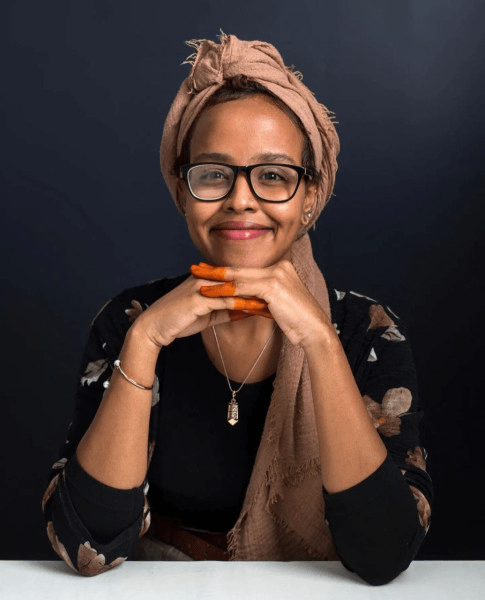

Born in Somaliland just a few years after the civil war, Najaax Mohamoud Suleiman Harun belongs to a generation that inherited the task of rebuilding a country while questioning the stories that shaped it. A poet before she became a painter, she has developed a practice in which words and images continually inform one another. Her work explores memory, womanhood and the stories inherited across generations. Through painting, Harun has found a language for examining experiences that are often left unspoken.
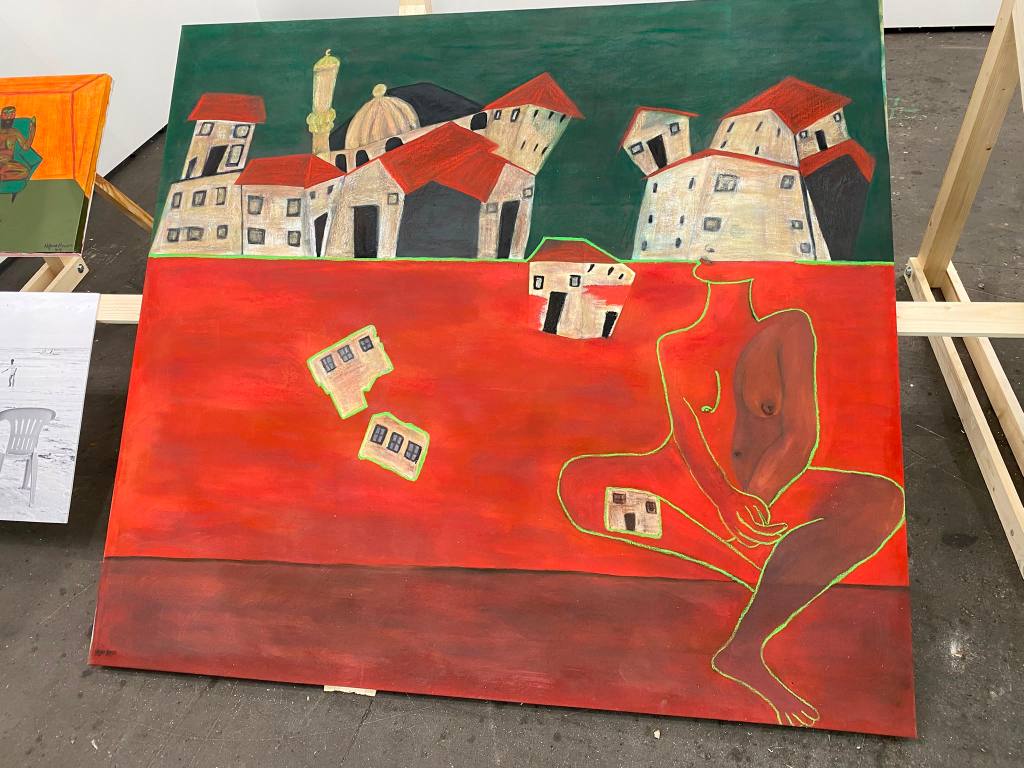
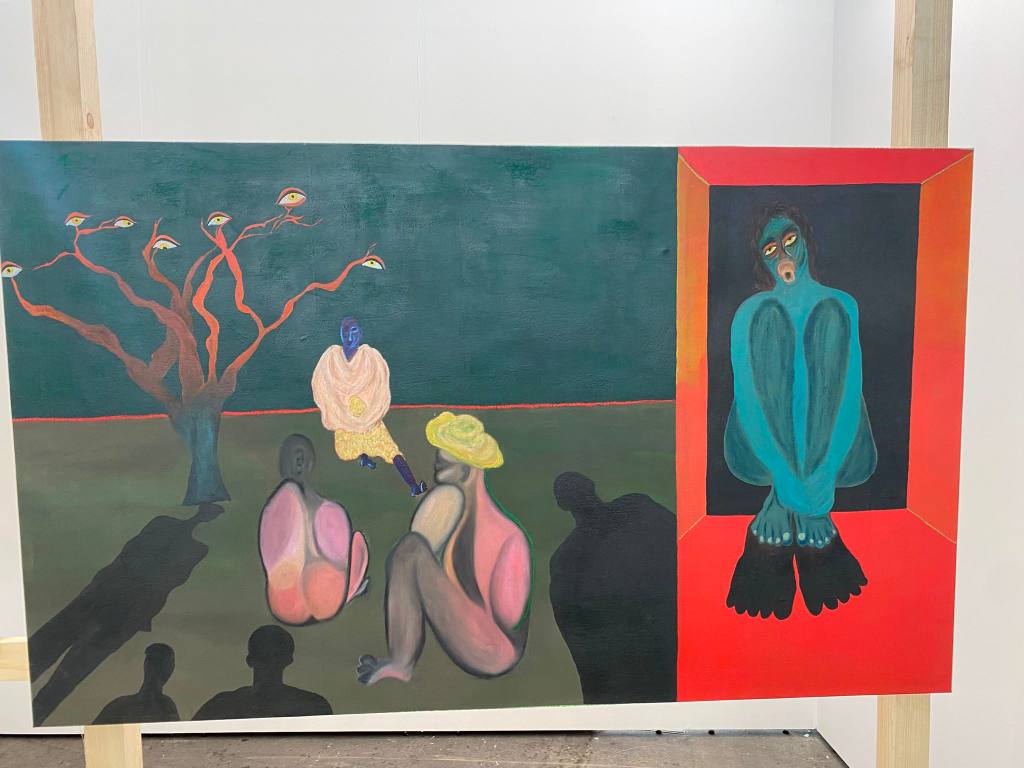
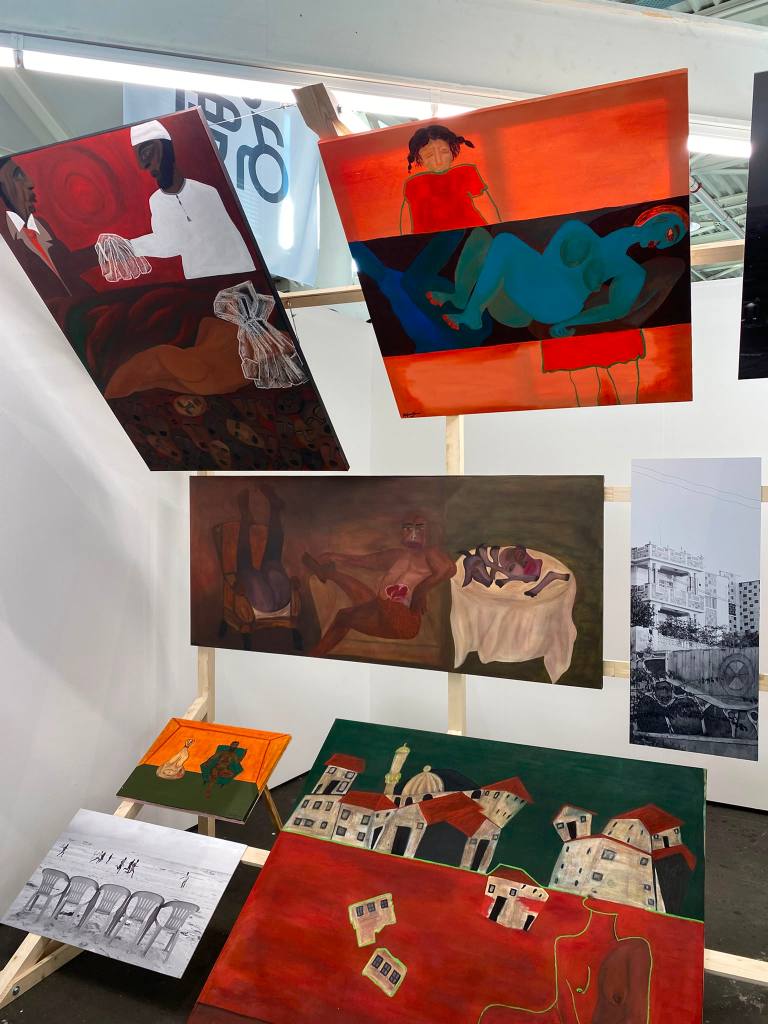
Some artists paint what they see. Others paint what they remember. Najaax Harun paints what refuses to remain silent. What immediately distinguishes Najaax Harun’s paintings is the tension they sustain between the human figure and the spaces that contain it. Her protagonists never inhabit the canvas freely. They appear enclosed within chromatic architectures where strength and vulnerability coexist. Within these fields, the body is at once whole and fragmented, powerful and vulnerable.
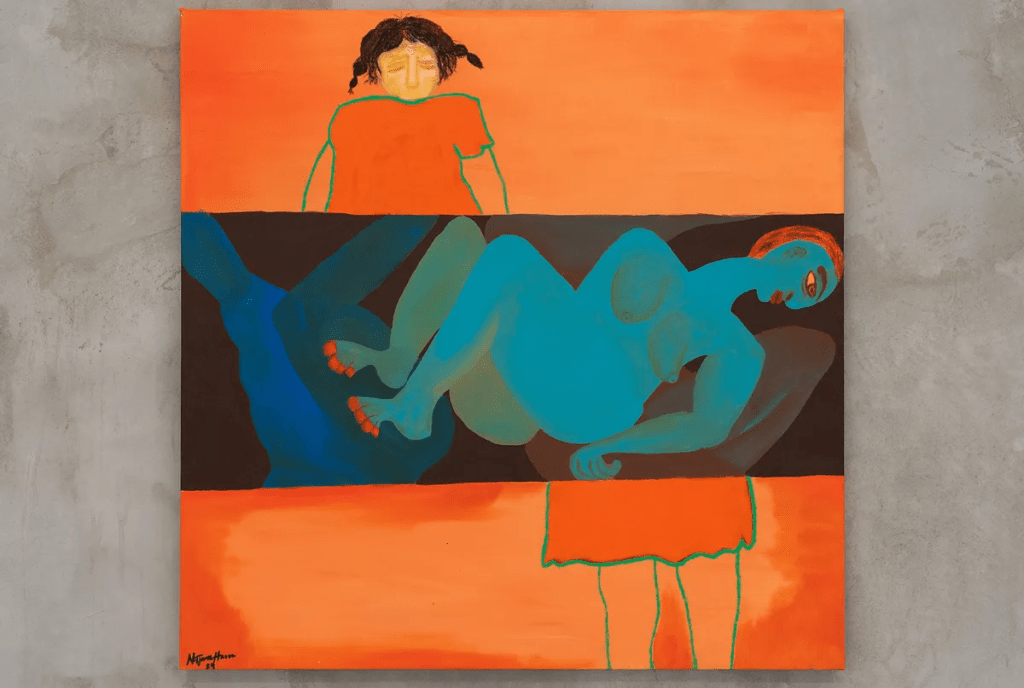
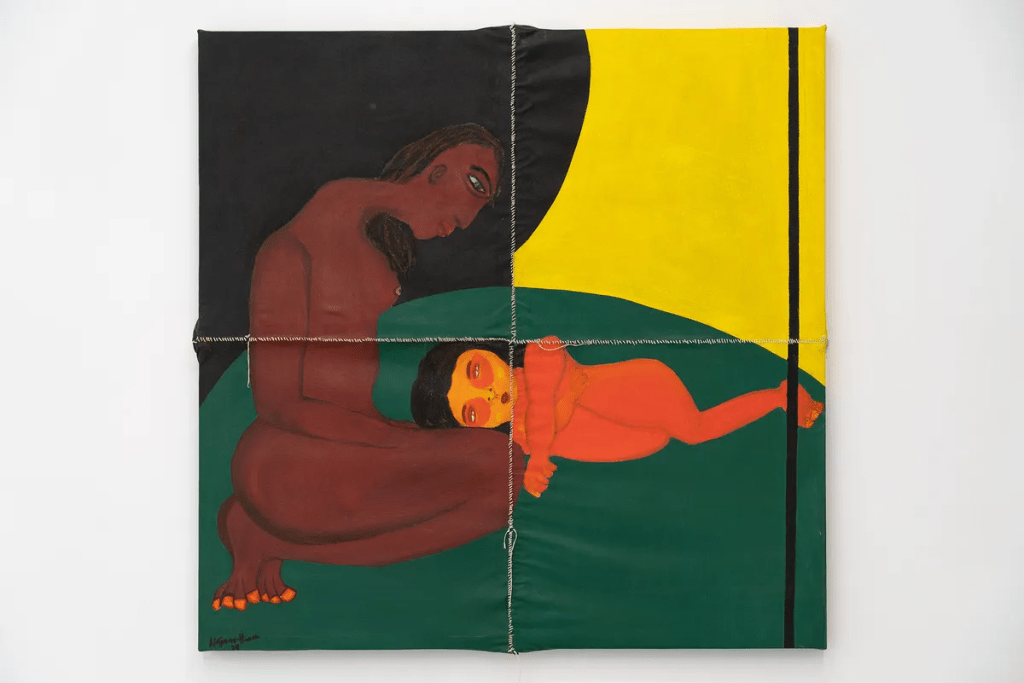
The visual impact of her paintings is based on stark color contrasts and bold blocks of color: acid yellow against black, saturated green against reddish-brown, electric orange against deep blue. These contrasts create an almost aggressive energy that prevents the eye from resting.
Her canvases are inhabited by fragmented bodies, watchful eyes and quiet tensions. Nothing seeks to explain itself. Instead, her paintings ask viewers to enter a space where emotion precedes interpretation.
It is tempting to read these paintings as a reflection on Somaliland, on women, on the legacies of patriarchy, or on the traces of war. All these readings are possible. None is sufficient, because what interests Harun exceeds the territory that produced her: a condition, that of bodies carrying histories they did not choose but continue to bear.
A Generation That Rebuilds
Born in 1995 in Somaliland, a few years after the civil war, Najaax Harun belongs to a generation that did not experience the conflict firsthand but grew up amid its aftermath. “When people came back to the country, they were rebuilding the country from that generation. So, they tend to become more conservative when it comes to art and culture. All we had before the war was destroyed. So we are the generation that is rebuilding,” she explains. Rebuilding doesn’t just mean rebuilding roads or institutions. It also means reinventing cultural life.
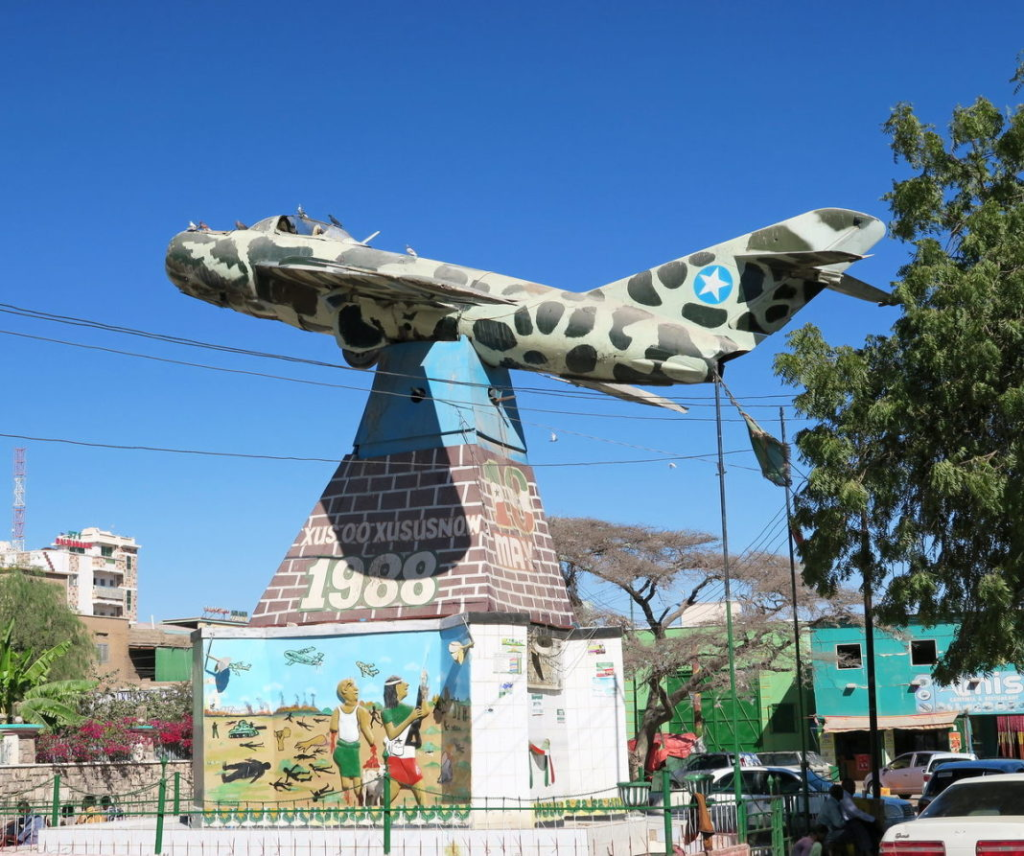
When Harun discovered her calling, there was neither an art school nor a real artistic infrastructure in her country. Galleries were rare, materials were hard to find, and becoming an artist was more a matter of sheer determination than a well-defined path.
She remembers using house paint and borrowing makeup brushes from her sisters. Her first studio was a rooftop, built by her mother, where she painted through the night and slept through the morning, convinced no one would ever see the work.
“I actually believed I could spend the rest of my life painting in that studio, and that nobody would ever know about my work, or maybe, when I died, people would discover it. I was very romantic about death back then. But things changed. I never imagined I’d have the career I have now”, she recalls.
Writing to Survive, Painting as Refuge
But before painting came writing: a notebook given to her by her father, himself an artist, when she was still a shy child who struggled to voice what she felt. After his death, when she was only ten years old, this notebook became a space where she could come to terms with her grief. At age twelve, she wrote a short story inspired by a scene that left a deep impression on her: a mother cat trying to gather the bodies of her kittens. Behind this animal story lies a reflection on loss, born of her own experience.
It is perhaps no accident that words came first for her. Somalia is often called a nation of poets, a culture that carried its history and its hardest truths through verse long before it had a written language.
While poetry thus precedes painting, it never replaces it in Harun’s practice. Even today, she regards both practices as extensions of the same line of thought. Some paintings are born from a poem; some poems extend a canvas. But the two mediums do not fulfill the same need.
Painting offered Harun something that poetry no longer could: protection. Through images, she discovered a way to address patriarchy, social conservatism and the invisible structures shaping women’s lives without placing herself at the centre of the conversation.
“Painting became a defence,” she says. In a context where certain subjects are difficult to address publicly, metaphor offered a form of freedom that direct language could not. A freedom she has used to return, again and again, to one question in particular: the place assigned to women in her own community.
“A woman belongs to no clan”
Her work draws on experiences deeply rooted in Somaliland society. In particular, she references a proverb that states, “A woman belongs to no clan.” In a society where clan affiliation shapes political and social life, this saying becomes, through her brush, much more than a cultural legacy.
“Coming from a clan-based community, I never understood that,” she says. “We are a clan-based country, everything is based on tribe. So when people actually say a woman doesn’t belong to a clan, that means a woman doesn’t belong to this country. Those were the things that never made sense to me.”
Yet Harun refuses to reduce these issues to their original context alone. The mechanisms she observes seem to her to transcend borders.
Her paintings, therefore, do not seek to document a local reality. They construct a language in which, she hopes, the intimate becomes something that can be shared.
This sense of universality also stems from the way she understands memory. For Harun, memory is inseparable from storytelling. The stories we inherit are not immutable. They can be dismantled, reshaped and understood anew. “I’m not preserving memories. I am trying to process them,” she explains. “To break them down, mould them back together and make sense of them.” Painting, in this sense, becomes less an act of remembering than a way of questioning the narratives that have shaped her experience.
“The price of staying would have been too high.“
Today, she is dealing with these stories far from her homeland. After living in Ethiopia, she is now based in Kenya. Harun explains that her departure was driven as much by material constraints as by a need for freedom. Staying would have meant devoting daily energy to defending the simple right to be the woman and the artist she wanted to become.
“Sometimes, leaving is easier than staying. The price of staying would have been too high.” This statement speaks to the plight of many artists who choose exile not to break ties with their country, but to preserve their ability to create. Harun, however, refuses to define herself as a political artist. She simply points out that no one can escape politics, given how deeply it shapes our lives. “Despite if we like it or not, we are all affected by politics”, she says.
Recognition, Without Compromise
In recent years, her work has been gaining increasing international recognition with exhibitions outside the Horn of Africa and participation in fairs. Yet this newfound visibility inspires in her as much caution as it does enthusiasm
“I don’t want it to affect the honesty of my work,” she says. “I don’t want to get stuck in one story because collectors love a certain kind of painting. I don’t want to paint for that.”
Facing the future, and the expectations that come with it, she says she is trying to stay “real, honest with myself, to know whether I’m painting because it’s expected of me, or because I want to. And as long as I want to, I’ll paint. I’ll paint what I feel, what matters to me. Sometimes people will like it, sometimes they won’t, but at least it will be honest.”
Asked what honesty means to her, the answer comes quickly: “Being honest with the story I’m telling. If a collection does well, for instance, and I keep painting the same way just to hold onto those numbers, that’s not honesty. There’s no integrity in that.”
“I want to create a timeless work that can stand in front of time itself.”
Najaax Harun pauses when she speaks about what she hopes to leave behind. As a child, she was, in her own words, “always with my head in the clouds.” She remembers reading novels and discovering the painters and writers she admired, imagining their lives as she turned each page. Could that ever be my life? she would ask herself. Today, that childhood dream has become something quieter but perhaps more enduring. She hopes to leave behind work that will outlive her. Not because it bears her name, but because it continues to feel true to those who encounter it.
“I want to leave behind something that feels real to whoever reads it or stands in front of it, generations from now. I want to create a timeless work that can stand in front of time itself.”
Success, she believes, is not measured by visibility but by coherence, the difficult work of becoming, each day, the person one claims to be. “Actually waking up every day and living it, that takes a lot.”
Real also
Ken Aicha Sy: A Decade of Advocacy for Women in Art in Senegal
 Bridging Africa and The World Through Contemporary Art
Leave a comment