
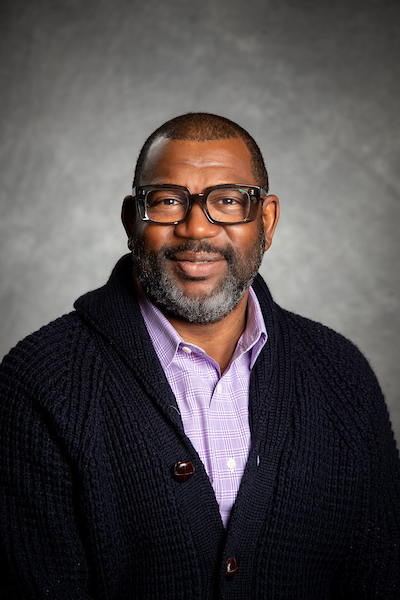
Collector, philanthropist and Denver Art Museum trustee Wole Bakare founded the Tilga Foundation to support emerging African artists at the beginning of their careers. From a formative encounter with a painting by Kehinde Wiley to his ambition to make Tilga the continent’s premier grant-giving organization, he discusses what drives his approach to art patronage.
When Wole Bakare speaks about his relationship with art, he goes back first to his childhood in Nigeria. His earliest encounter with artistic creation dates to FESTAC ’77, the Second World Black and African Festival of Arts and Culture, held in Lagos. His father would take him to the National Theatre, where he encountered both visual art and performance.
Art remained at the periphery of his life for many years. After moving to the United States in 1995, he initially began buying paintings to decorate his first home. That changed after an encounter that would fundamentally alter his relationship with art.
In 2010, at a gala at the Columbus Museum of Art in Ohio, Bakare encountered a painting by Kehinde Wiley. He describes the moment as a rupture: “I think about my life before that painting and my life after that painting.”
At the time, as a Nigerian living in the United States and working in telecommunications, he was often the only Black person in his professional environment. In his own account, he gradually adopted some of the codes of the world around him, while growing increasingly distant from parts of his own identity.
Wiley’s painting became a mirror. “How do I become me?” he began asking himself. He started deliberately collecting works by Black artists, particularly figurative works and portraiture. The purpose was both aesthetic and personal: to surround himself with images that reminded him of who he was.
That experience largely explains his transition from collector to patron. “The power of a painting to impact your life, to change the way you see yourself and change your perspective, is something that I experienced,” he says. “And I want other people to experience that.”
It is in this context that the Tilga Foundation and its flagship programme, the Tilga Art Prize, should be understood.
Giving artists the means to build lasting careers
For Bakare, supporting an artist is not simply a matter of awarding a prize. The real challenge lies in the early years of a career, when artists may abandon their practice because of a lack of resources, recognition or professional opportunities.
“If we want to have the next Kehinde Wiley, the next Yinka Shonibare, the next El Anatsui, we have to provide the support necessary at the beginning of their careers,” he says.
Tilga focuses on artists aged 30 and under. Its approach combines several forms of support: identifying talent, providing financial resources, facilitating professional development, building a community among artists and connecting them with wider audiences.
Funding is therefore only one part of the programme. Residencies, conversations, mentorship and professional development are intended to help artists understand the economic and professional dimensions of an art career.
“Universities teach them how to create,” Bakare says. “But not necessarily how the art world works.” Tilga seeks to address that other side of the profession through career development, individual support and access to professional networks.
International exposure is another component of the programme. Tilga has supported exhibitions of its artists in independent gallery spaces held alongside major art fairs, including Art X Lagos and Investec Cape Town Art Fair, creating opportunities to connect them with curators, galleries, collectors and institutions.

Three art scenes, three realities
Bakare says Tilga’s experience in Nigeria, South Africa and Uganda has shown him that artists’ needs vary significantly from one ecosystem to another.
In Nigeria, where galleries, collectors, museums and a major art fair are already part of the ecosystem, he nevertheless sees a need for greater structural support to help artists build long-term careers.
In South Africa, the initial challenge was different. When Tilga launched its call for applications, the number of applicants was initially low. Applications increased rapidly, he says, after he began explaining his background and the foundation’s objectives through social media videos. The experience, he says, taught him that a philanthropic organization cannot simply act. It also has to explain why it is acting.
In Uganda, Bakare found the art market’s infrastructure less developed than in Nigeria or South Africa — one prize winner, he notes, traveled to Rwanda to find materials for his work.
These differences have led Tilga to favor gradual growth.
“We don’t want to grow too fast and have it become unsustainable,” Bakare says.
For now, the foundation remains focused on Nigeria, South Africa and Uganda. An expansion into North Africa is being considered in the longer term, followed by the possibility of reaching additional countries across the continent.
From collector to museum trustee
Bakare’s engagement extends beyond Tilga. For approximately two years, he has served on the board of trustees of the Denver Art Museum, where he has taken a particular interest in the representation of Black artists in the museum’s permanent collection.
He is also a co-founder of Denver’s Black Arts Collective, a group of collectors and patrons that helps raise funds for the acquisition of works by Black artists.
His approach is grounded in a conviction that museum collections influence the way a society tells its own story.
After joining the Denver Art Museum’s board, Bakare took the time to move through the museum’s different departments looking for works by Black artists from Africa, the United States and elsewhere in the diaspora.
What struck him was that these works are not confined to a section dedicated to African art. He points to works in the museum’s design, textiles and photography departments. According to him, the museum has also been acquiring works by Black artists for decades, well before the renewed institutional attention that followed 2020.
For Bakare, the role of a patron therefore extends beyond purchasing art. It also means supporting institutions, contributing to acquisitions, participating in governance and helping ensure that museums represent the communities they serve.
“We cannot guarantee success”
At Tilga, however, Bakare remains cautious about what a foundation can promise an artist.
“We cannot guarantee success to anybody,” he says.
The objective lies elsewhere: giving artists the tools they need to build sustainable careers. In ten years, he would like the artists supported by Tilga to still be active, able to make a living from their practice, support their families and pursue their own financial ambitions.
He also wants to see them represented in major collections and institutions internationally.
This ambition explains his growing interest in residencies. At present, the first prize of the Tilga Art Prize comes with a three-month residency. Bakare would ultimately like to offer a residency experience to all four prize winners, with different durations depending on the award.
He does not want to create a Tilga residency of his own. Instead, he prefers to establish partnerships with existing institutions on the continent. For him, changing environments for several weeks can have a real impact on artistic practice, allowing artists to develop new perspectives.

The 2026 Uganda edition illustrates how this approach is put into practice. On September 20, following our conversation, Tilga announced four prize winners: Trevor Aloka, who received the First Prize of US$5,000 and a three-month fully funded residency; Mutebi Martin David, who received US$3,000; Brogan Mwesigwa, US$2,000; and Yiga Joshua Mulungi, US$1,000.
With the Uganda edition, Tilga says it has now awarded its Art Prize to 25 artists across Nigeria, South Africa and Uganda over six years.
Building a pan-African philanthropic organization
Looking ahead, Bakare announced that the Tilga Art Prize will return to Nigeria in 2027. His longer-term ambition extends well beyond an annual prize.
Tilga is named after his father, and Bakare imagines a much larger future for the foundation. “We want Tilga Foundation to become the premier grant-giving enterprise in Africa,” he says.

The project is still young, but Bakare’s vision for it is clear: gradually increase the amounts awarded, expand its programmes, create more residency opportunities, and support a growing number of artists.
And above all, he wants them to be able to say: “Tilga was there when I started.”
Read also
How Dakar’s Museum of Black Civilizations Is Rethinking the African Museum
Leave a Reply