
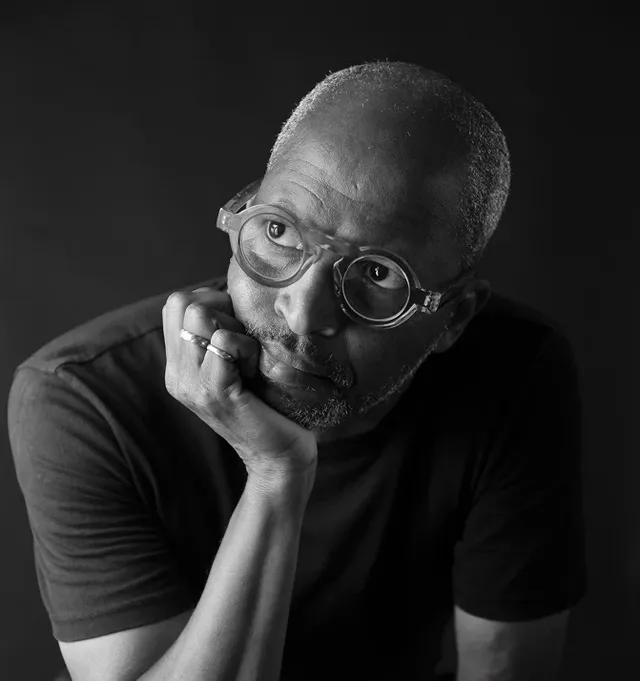
Presented at the 16th Dakar Biennale, Borgonha, by Bissau-Guinean artist Nú Barreto, winner of the UEMOA Prize, explores fragility, imperfection and the human condition. In a triptych combining drawing, painting and collage, the artist draws on his cultural memory to question the place of the individual in society. Twenty years after his first participation in Dak’Art in 2006, he also reflects on the role the Biennale has played in his career and on the prize he has just received. For him, a prize is not a consecration but an invitation to keep working.
Borgonha, or the Shame of Not Accepting Oneself
Let’s talk about Borgonha, your work presented at this edition. The title means “shame” in Creole. Why did you choose this notion as the starting point for the triptych?
This work fits particularly well with the theme of this Biennale, (Anti)fragility, because it rests on an ambivalence I deeply identify with in my practice.
Over the past few days, several journalists have asked me how my work relates to the Biennale’s theme. I always give them an example to explain my approach.
I am an artist who works between two ambivalent fragilities. Physically, I am rather slim, yet I produce works that are often very large, monumental, imposing. When people discover my work, they tend to assume that the artist behind such large, heavy pieces must be a sturdy man. That is not my case at all.
There is another side to my work: I also make much lighter pieces, which are sometimes harder to transport and require more care.
I remember a mover who regularly came to my place to collect my works. Every time, he ended up with the heaviest pieces. One day he said to me: “Mr Barreto, I don’t understand. Are you doing this on purpose? Every time I come to your place, it’s to pick up the heaviest works!”
He had come to see a kind of contradiction between my physique and the works I produced. When you look at my work, you see monumental, voluminous, imposing things. But when you see the person who made them, something doesn’t match the image you might have had.
To come back to your question, it is this ambivalence between two forms of fragility that interests me. Is what is heavy necessarily fragile? Is what seems light, because it appears easier to handle, any less fragile? No. There is fragility in both cases, but it does not show itself in the same way.

How is this reflected in the composition of the triptych?
I worked through the figures and their arrangement in space. They draw, in particular, on a proverb from home.
If you look at the work, you will notice that the figures are scattered. Each occupies its own space, apart from the others. Yet it is indeed a triptych. Even though the panels are separate, they should be seen as a whole. Where the work is shown, space constraints meant hanging two panels on one side and the third opposite. Normally, all three should be together.
This dispersion comes from a proverb from my culture. My work is always connected to society, and I regularly draw on my cultural heritage for elements I can reinterpret and bring into my work.
In French, the closest expression would be “être laissé pour compte”, to be left behind. Where I come from, we say a person has been “released like pollen into the air”. Pollen lets itself be carried by the wind; it drifts back and forth with the movements of the air. That image explains the dispersion of the figures, each having to cope with their own position.
“Where I come from, we say a person has been ‘released like pollen into the air’.” — Nú Barreto
There is another kind of fragility in how they are depicted: these figures are imperfect. If you look closely at their limbs, you will see that they are inverted.
Imagine your feet were put in place of your hands and your hands in place of your feet. Could you still do things normally? You would inevitably become far more fragile, because your body would no longer function according to its natural morphology. Human beings are not built that way. Our arms are where they belong, and so are our feet.
In my figures, I reverse that order. It is a way of bringing fragility into their representation.
The same idea runs through the visual vocabulary I use. Take the chairs, for example. My chairs are always wobbly. Sometimes they have three legs, sometimes two. You will never find a properly built chair in my drawings, with all four legs in place.
It is also a way of representing the fragility of power, through objects that are never completely stable. All these details, the figures, the objects and the symbols scattered across the drawings and paintings, are part of this reflection.

The word “shame” seems to point to something more inward. What kind of shame do you have in mind?
I was referring to the difficulty of accepting oneself. When I speak of imperfection, that is precisely where the word Borgonha takes on its full meaning.
Human beings find it hard to accept their imperfection. And yet they know very well that they are not perfect.
That is where the idea for the title came from: this difficulty in accepting oneself, in accepting one’s own imperfection. That is how the title came to me.
I often choose my titles from words or expressions from home. It is a way of staying connected to my culture and bringing that richness into my work.

You made the three panels between 2024 and 2026. Did you work on all three at the same time?
I started with one panel, then gradually worked on the others. The work had to be built as a whole, to find a certain harmony and avoid any imbalance between the parts.
If you look closely, you will notice the consistency of the colours. They remain balanced from the first panel to the third.
I could work on one panel at one point, come back to another later, then return to the third at another time. But because I had already set the base colour, I knew which direction to take. That allowed me to keep the three parts coherent and not drift away from the overall harmony.
Do you draw from a model?
No, not at all. I draw from memory. I always work from what I have in my head.
In fact, I always start my drawings with the ears. I have never really understood why, but that is how I always begin.

The human body is central to your work. Why this particular interest in the human figure?
The body is central because it represents humankind.
As I said earlier, my work is tied to society and to human beings. I take what society gives me, what I observe around me, and try to render it in my work while questioning those realities.
That is what artists do: we question. It can be through a landscape or other subjects, but every work is, in a way, a question.
What interests me most is the human being in society, because it is people who have the capacity to handle things and transform them.
Look around you, in a house for example: the only thing that can really move everything else is a human being. Everything else is more or less static. We are the ones who can move a painting, take it from here and put it there. If you leave a piece of furniture somewhere, it will stay there unless it falls or someone moves it.
So it is people who can make things move. And when I talk about movement, I mean above all this capacity to act, to transform and to change things. Everything starts with human beings, with their will and their capacity to act. The rest is material.

Your work combines drawing, painting and collage. Why mix so many techniques and materials?
I have never really asked myself that question when making this kind of work.
I began developing this collage technique around 2019, and it has evolved a great deal since. Over time, I have brought it to where it is today.
It is also a work of recycling. Behind this approach there is always a desire to recover, recycle and restitute. I call them the three Rs: recover, recycle and restitute.
It was an idea I discussed at length with Franck-Hermann Ekra when I was developing it. We talked a great deal about these three principles.
But to come back to mixing techniques, I don’t find it particularly extraordinary. For me, it is simply a matter of versatility in creation. I cannot stay with collage alone, because I would not be satisfied. Nor can I limit myself to drawing or to any other single technique.
I have also made drawings without collage. But that was for another body of work, another project.
Right now, I am in a period where I am working a lot with collage, with this approach to recycling. It is always about recovering, transforming and, above all, restituting. Restituting what we can restitute.
Red runs through all three panels, and through your glasses too. Why does this colour hold such an important place in your world?
Red is the only colour all human beings share, everywhere in the world. Africans, Asians, Americans, Native Americans, it doesn’t matter: everyone carries this colour within. It is blood.
Our skin colours differ. We are both African, for example, but our complexions can be different. Some are darker, others are of mixed heritage. But the one thing we truly have in common is blood. It is red.
I started from this idea to work on something that brings us together, something we all have and that no one can deny.
But you also have to consider the symbolism of the colour depending on where you are. In Africa, red carries a particular connotation, often more mystical, more painful, sometimes dramatic. It can also be used in certain ceremonies, depending on cultures and contexts.
When you change continents and go to Asia, to China for example, red means something else entirely. For the Chinese, it is associated with happiness, joy and celebration. So it is not perceived in the same way.
The same is true of Latin America, where other colours may hold an important symbolic place. Each culture develops its own perception.
For me, red evokes many things. It does not only represent what we all share as human beings. It also allows me to address different subjects: misfortune, pain, motherhood, since blood is part of that too.
When we speak of blood, we speak of life. But when we speak of anger, violence or conflict, we also speak of the blood that may be spilled.
So there is a positive side and a more negative one. And, once again, it comes back to the human being, who remains at the centre of my work.
For all these reasons, red is part of my life and of my artistic world. Some people might be tempted to pigeonhole me through this colour, especially because of the way I dress, since I often wear black with my red glasses. But if I use red, it is first and foremost for my work.
“Red is the only colour all human beings share, everywhere in the world.” — Nú Barreto
The Biennale runs for several more weeks and many visitors will discover your work. How would you like them to engage with it and interpret it?
Everyone will understand what they can. I will not necessarily be standing next to each visitor to offer clues.
I expect some will grasp the meaning of the lines that run through my works and paintings, because there are many lines in my work. For me, these lines represent life. We begin our existence somewhere and we end it somewhere.
I think some visitors will make that connection between lines and life fairly easily. But, naturally, everyone will have their own reading.
Even when I am there and explain a work to someone, telling them that this element means this or that, they may accept it and still understand something else. They may say to me: “Yes, but you see it that way, whereas I see something else.”
That has happened to me several times. I explained a work to someone and, at the end, they replied: “That’s your interpretation, but I see something else in it.”
And that is perfectly normal.
So I hope visitors will take the time to look at the works, to try to read what they can discover in them and to build their own interpretation. That goes for my work, but also for that of the other artists at the Biennale.
There are many artists to discover in this edition. You have to try to enter each work, take the time to look at it and draw your own conclusions, with your own sensibility and your own ability to understand the world of contemporary art.

Dakar, Twenty Years On
Your first participation in the Dakar Biennale dates back to 2006. Twenty years later, what has changed in your career?
I must admit that Dakar contributed to the first “explosion”, so to speak, of my work. It was here, for the first time, that people really began to hear about Nú Barreto on a much wider scale.
I had presented a video titled I Have a Dream. That work opened doors for me and helped make my name known, in Dakar and beyond.
When you speak of doors opening, can you give us some concrete examples of what that participation brought you?
There was a very fine exhibition in Switzerland, thanks to the Biennale. The curator who organised it had been working with the Biennale for several years and chose to present artists from that edition. I was among them.
There was also an exhibition in Berlin, organised by one of the curators of that Biennale, Youma Fall. There too, several of us had drawn particular attention at the 2006 edition.
Finally, there was an exhibition in Brussels, organised by the artistic director at the time, Yacouba Konaté, with artists from the same edition.
So you see, in three different countries, several opportunities arose. These were important openings. Through them, other projects developed, other proposals took shape, and that allowed me to explore new possibilities and keep evolving.
It is also worth remembering that Dakar was my first major biennale. I have done others since, but Dakar was really the one I needed to be part of at that point in my career. And I did not get in on the first attempt: I had tried three times before without being selected. So success is not always immediate. Those who make it on their first try, good for them! But in my case, it took several attempts.
Curator Yacouba Konaté recently told us that the Dakar Biennale is a form of validation for artists. Do you share that view?
Yes, I fully agree with Yacouba when he describes the Biennale as a platform of validation. Many artists have come through Dakar and seen their careers take on another dimension thanks to it.
But I would like to draw attention to one point: you must not rest on your laurels, thinking that because you took part in the Dakar Biennale, everything is now settled.
Some artists took part in the Biennale and are no longer heard of today. I have met a few of them again here, including an artist who lives in Germany and whom I had not seen for twenty years. It is only at this edition that we found each other again.
These artists followed other paths and developed their art differently, but did not necessarily remain present in the international circuits of contemporary art.
“You must not rest on your laurels, thinking that because you took part in the Dakar Biennale, everything is now settled.” — Nú Barreto
So taking part in the Biennale does not automatically guarantee an international career?
No, not at all. It confirms that you have the ability to do things, that you have something to offer. But then you have to make the most of that recognition to develop your work.
I also know many artists who took part in the Venice Biennale, which is considered one of the most important in the world. Some think that when you show in Venice, you have practically touched the sky. But that is not the case. There are artists who exhibited there whose names nobody knows today.
So you have to understand that taking part in a major biennale is a stage, a validation, but not a guarantee. A great deal also depends on what the artist does with it afterwards.
The Prize: “A Hand Held Out”
You have just received the UEMOA Prize at the 16th Dakar Biennale. What does this distinction mean to you?
I have always seen prizes as a form of encouragement given to artists. Once you receive a prize, you know you now have something to defend and that your work will be watched more closely, with a certain rigour.
So I have never taken a prize at face value, or as a kind of achievement that would let me think: “That’s it, I got this prize because I’m the best of all.” It may sound simple, but it is my philosophy, my way of thinking.
For me, a prize is a spur, not a reward. I take it as encouragement to produce more, think more and work even harder. That is essentially what I take away from this distinction.
You live and work mainly in Europe. Do you think receiving a prize in Dakar could have a particular impact on your career?
It has only just happened, so I don’t yet know what it will change in my life as an artist. I already have a lot of momentum, with a fairly intense schedule. It is a career that demands a great deal of commitment, especially when you receive various requests. So one can consider oneself lucky to have such opportunities. But I don’t yet know what this prize will mean in concrete terms for the rest of my career.
All I know is that it is as if someone had said to me: “Keep working so that you can grow.” That is how I see it.
Today, the world is fairly open and everyone is connected. People who will discover me, or who discovered me through this prize, will also be able to follow my work and see what I do. I hope I can touch their sensibility through my works.
Artists awarded at the Biennale sometimes go on to benefit from new openings, partnerships and collaborations. Is that what you hope for too?
Yes, as long as these openings are productive. And when I say productive, I am thinking in particular of the educational dimension.
I prefer that word because I would like to help those who really need it. Living in Europe does not mean I have found gold there. That is not the case at all. But if this recognition allows me to bring to the continent what little I have, the knowledge, the experience and the means I have as an artist, and to share them with other artists, then I am interested.
So I am open to these kinds of prospects. We will see what comes of it. But my real wish would be to share my experience on the continent with other artists, especially younger ones, but also those of my generation. I’m not old, even if there are obviously artists younger than me!
If these openings come about, I hope above all that they will benefit those who need them most.
Do you see a difference between receiving a prize in Africa, in Dakar for example, and receiving one elsewhere in the world?
Not necessarily. Perhaps there is a geographical angle, but in itself, a prize remains a spur for me, as I said at the start. Whether it is here in Dakar, in Nairobi, Honolulu, Helsinki, São Paulo or anywhere else in the world, it remains a form of confirmation, but above all a challenge to rise to.
I think this challenge matters far more than waiting for new openings. You must not wait for openings to keep working. If they are to come, they will come in time. Honestly, that is how I see things.
Of course, on the continent, we are at home, and it may be experienced differently. For young artists, seeing their elders receive this kind of distinction can spark dreams and make them want to reach that kind of recognition one day. The Dakar Biennale is an event with a certain prestige on the continent. It necessarily means something, even if I would be unable to measure its exact scope and significance.
It remains a special moment in any artist’s career, whatever one may think of prizes.
Listening to you, what really interests you is the challenge this distinction represents, rather than the opportunities it might bring?
Exactly. It is a hand held out.
Once people say, “All right, he was given this prize”, they will naturally watch what comes next. They will look at how the artist evolves, what he proposes and how his work develops.
Not everyone necessarily likes what you do. So some will wonder why you received this prize and question your ability to live up to that recognition.
That is how I see it: it is a hand held out and, now, it is up to the artist to prove his worth. Not only to those who awarded him the prize at the Biennale, but to the world, through what he brings to society. Because every artist contributes, through their work, to building a society.
Interview by Remy Mallet
Read also
Yacouba Konaté on Dak’Art: “What We Build Here Will Not Be a Ghost Memory”
Leave a Reply