
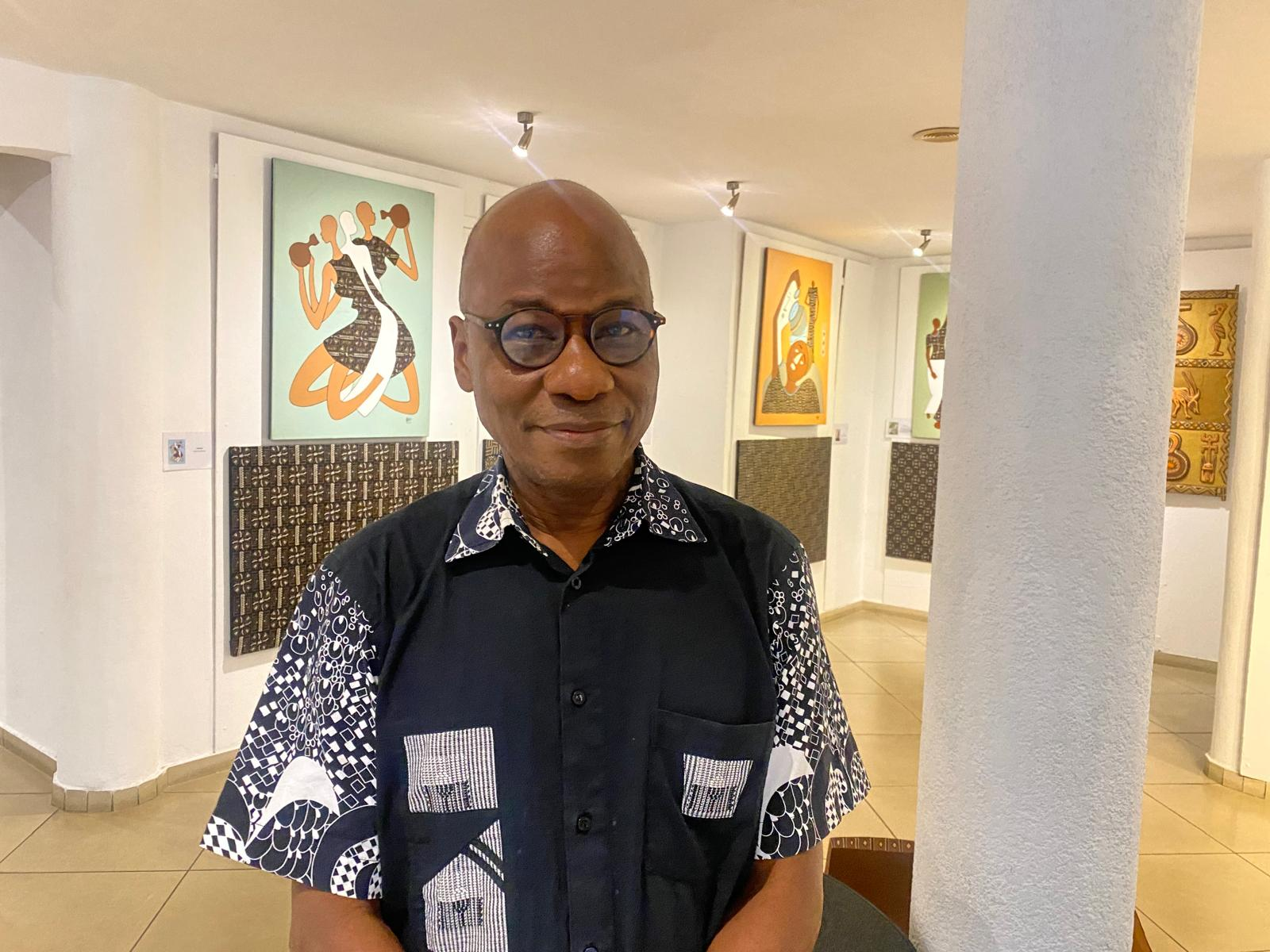
Ivorian philosopher, art critic and academic Yacouba Konaté knows the Dakar Biennale from the inside: a member of its selection committee from 1998, he became its artistic director in 2006. Here he returns to what, in his view, makes Dak’Art singular: the need to address Dakar’s own publics first, its power to validate careers, and the urgency of building an “inter-African international.” A conversation about identity, ghettos, memory, and what contemporary African art must now give itself: a sequel.
“We Are Situated”
Since its creation, the Dakar Biennale has defined itself as a biennale of contemporary African art. Is that designation still useful in 2026 for thinking about contemporary art on the continent?
My answer is yes, quite simply because these are questions we have thought about a great deal.
Senegal is the country of Senghor, whose friend was Césaire. These were figures who made very powerful reflective gestures on questions of identity. Their thinking was later taken up by Fanon and many others. It interrogates the question of African being, or even of Black being, in the world at large and in today’s globalised world.
I remember a debate in which Simon Njami took part. We were discussing a phrase I often quote. I had the good fortune to know Manu Dibango and to listen to him regularly. He used to say that when he got up in the morning to pick up his saxophone, he did not think: “I am going to make African music.” He simply thought: “I am going to make music.”
Simon Njami added: “Yes, but when a Japanese person listens to Manu Dibango, they will say it is African music.” Which means that whatever we do, as Sartre would put it, we are situated.
Once we are situated, we have to see whether we can turn our situation into a position. A situation is not a stance you choose at the outset. It is our history that situates us, and also the gaze of others. Then we take a position. The position is an ideological choice.
“Whatever we do, as Sartre would put it, we are situated.” — Yacouba Konaté
But being situated is not necessarily accepting an assignment. Does that claim not risk reproducing a form of essentialism, of the kind Senghor has sometimes been reproached for?
Essentialism is saying, for instance, that all Africans are artists. That I reject too.
What I am proposing is different: whatever you do, you risk appearing as African. Everything we make in Africa is liable to be perceived as African production, in either the pejorative or the flattering sense of the word.
I do not experience that as a burden. As a cultural operator, but also as a teacher, I consider it my role to help younger generations become clearly aware of their situation within their societies, in the world, and right down to the global economy.
In that respect, African biennales such as Dakar’s have a distinctive and singular role to play. The problems we face when we try to build an art system are at once economic, ideological and anthropological. They also touch on how we take on our own history.
It is that singular history which justifies, in my view, our biennale fully asserting its African and contemporary character.
The Diaspora and the Weight of the Gaze
Contemporary African creation today covers a wide diversity of practices and trajectories, including those of diaspora artists. How should that diversity be taken into account in defining contemporary African art?
Diaspora artists are often presented in the West as Africans. They are not simply described as French artists, but as French artists of Congolese or Haitian origin, for example. There is a determination at work there, sometimes light, sometimes heavy, and it is difficult to escape.
You can choose to take that gaze very seriously or, on the contrary, to lighten its weight. But you cannot not feel it, even in well-integrated circles, among people who are anti-racist.
And it is not only a question of race. It is also a question of integration into one’s environment. I often cite the example of Johnny Clegg, who played an important part in spreading South African music at a time when many artists were mobilising for Nelson Mandela’s release.
He told the story of a day, while he was living in South Africa, when he took journalists and musicians into a township to meet South African friends. At one point they said to him: “When you come with white people like that, you have to warn us, because it can be dangerous.”
Which meant that he was not perceived in the same way as other white people. His day-to-day commitment had allowed him, within that community, to move beyond the identity his skin colour might have assigned him.
So we have to understand that this question is not merely skin-deep. It is structural. Our visibility is expressed through our relationship to colour, but also to language and to our imaginaries. The battle we have to fight consists in cultivating those imaginaries in all their diversity, in order to produce narratives that accord with our history and our memory. It is those narratives that will allow us to better interpret the situations we find ourselves in.
“What Do We Do With Our Ghettos?”
Some artists nevertheless express a fear of being ghettoised. Others point out that we do not speak of contemporary European art, for instance. How do you see that concern?
For me, appearing inside a ghetto is not necessarily a problem. You can live in a palace and still be shut inside a ghetto. You can also live in a castle and live as though in a mousetrap.
The real question is what we do with our ghettos. They are not only geographical, in the sense that geographers speak of neighbourhoods or shantytowns. They are also circles of enclosure. Racists, for example, live in ideological ghettos. And those ideological ghettos help to shut us inside economic and political ghettos.
Our states, by not always giving themselves the means to build open societies, reinforce that situation too.
Whatever we do, at one moment or another we risk appearing as though enclosed in a ghetto. The question is therefore how to reorganise it, how to turn it into a living centre in which one can project oneself. Above all, younger generations must be given the means to get out: economically, physically, mentally, intellectually and emotionally.
2006: Building an Event, Not an Identity
You were the Biennale’s artistic director in 2006. Looking back, how do you see its evolution? Has it managed to build an identity and an authority of its own?
The role of the Dakar Biennale is not to build an identity. Identity may appear in what we say, in the works, or not appear at all.
That is why I think the question has to be taken on. Even when an artist does not address it directly in their work, you can always bring them back to that supposed identity and read the work through it.
For my part, when I take an interest in the question of identity, I set it alongside the notion of non-identity developed by Adorno. In our own countries there are tensions that sometimes lead us to refuse the identity others want us to carry. It is a profoundly ambiguous notion.
When the Biennale was entrusted to me, my concern was above all to build an event. I remember a minister of culture at the time who received me and gave me a single instruction: “Monsieur Konaté, please, make us an African biennale.”
I interpreted that request as the need to propose works capable of interacting with the public of Dakar, of offering them ways in. In a second stage, those works could also open spaces of understanding and dialogue with a global public.
How did that concern translate into your curatorial choices?
At the Dakar Biennale I had the opportunity to work on several teams before becoming artistic director. I worked in particular with curators who were not African.
I am thinking of Achille Bonito Oliva, one of the major figures of the Italian avant-garde, who directed an edition of the Biennale (1998 — Ed.). I was a member of the selection committee at the time.
We proceeded by collective decision: there were twelve or thirteen of us, and when a majority felt a work was good, we selected it.
At the end of the process, as we were reviewing the selection as a whole, Achille Bonito Oliva voiced his disagreement. He told us he could not approve the selection, because he would be criticised by his colleagues when they saw it.
I tell this story with great respect, because he is someone who encouraged me a great deal. But I drew a lesson from it: the choices he was defending were not primarily addressed to the public of Dakar, whom he did not know, but to his colleagues in the United States and in France, who might not understand some of our decisions.
For me, when you exhibit a work, it is essential to ask what ways in it offers our publics. We must not make selections that only satisfy ourselves, so that curators can talk among themselves. They also have to be able to hold up internationally.
The curators’ view counts, but it must not be the predominant one.
My selection did include very conceptual works, as well as videos and photographs. I remember in particular an American artist who came and settled in a neighbourhood of Dakar for three or four months. He made photographs there, in situ. We found him an exhibition space slightly apart from the main hall. It was very moving to see residents of the neighbourhood come and take part in the Biennale through a work that was dedicated to them.
That shows that Africanness is not only a matter of speculative identity. It also concerns our capacity to be coherent with the populations in whose name we speak and organise the Biennale.
Even if the whole world supports us, we have to ask how this event can speak to those populations. It is not about repeating to them what they already know, but about proposing something that concerns them, and that can also unsettle them.
Making Africa Visible as a Site of Contemporary Art
If building an identity is not the Biennale’s role, what in your view is its main function today?
It is about animating Africa’s creative excellence, making it manifest, but also about building Dakar as a place where contemporary art is put to work, constructed and circulated.
The Biennale also allows curators from around the world to come and discover new experiences and artists they do not necessarily know, but who are part of the history of African art.
There is always a heritage dimension and a dimension of recognition across the different editions. I am glad that this is being maintained, not least through the tributes paid to the great elders. It is a way of recalling that a history of art has already been built.
But the Biennale’s principal role, for me, is to make Africa manifest as a site where contemporary art is constructed.
You cannot build the history of so-called African art without taking account of the events that have taken place in Dakar. The Biennale is a strong punctuation mark in the construction of that history.
It is about taking back the initiative in writing our own art history and keeping it alive over time. Since 1992, the Biennale has demonstrated its durability while remaining rooted and open to the world.
That openness is essential. If you look at this year’s selection, you will see that it is not limited to artists from the African continent. There are French artists, just as there have been American artists in the past, as well as artists from various diasporas.
To what extent can the Dakar Biennale influence the direction of the contemporary art world as a whole, and not only the African scene?
Its influence begins with the simple fact that it exists. That existence obliges the art world to look at how it works, which artists contribute to its relevance, and how it manages to last.
We also have to understand that some artists may have no value on the international market while living very well off local markets. In Côte d’Ivoire, for example, there are artists whom collectors, young and older, fight over, but who do not generate the same interest internationally.
What matters is to build a selection that takes account of artists’ international openness while adding value for those who are present locally and do not necessarily circulate elsewhere.
That is also how we can bring a message and a conception of the world. We can welcome new artistic currents while remembering that not every current can necessarily work in our contexts.
Speaking First to Our Own Publics
How do you strike a balance between new artistic currents and a relationship to the context in which the works are shown?
You probably know the sculptor Ousmane Sow‘s line: “A lump of sugar dissolving in water will never make a work of art.” At a time when installation was expanding, you would see videos showing nothing more than a glass of water in which a lump of sugar was dissolving, the artist filming the dissolution in order to project it as a work.
Ousmane Sow courageously denounced certain abuses in video art and in what was then called installation. That did not mean he was opposed to those art forms.
What we can do, I think, is propose a way of our own of thinking our contemporary relationship to art, and then seek to have it validated.
When curators gather to choose the works, they have not been mandated by the Senegalese state, by Senegalese people as a whole, or by an institution that asked them to select works in its name. But we know very well that we cannot show work in Dakar that was conceived only to please Tokyo or Paris.
Our first requirement must therefore be to address our own publics. Then, possibly, the others will follow. Or not. But that choice has consequences.
“We cannot show work in Dakar that was conceived only to please Tokyo or Paris.” — Yacouba Konaté
But is art not also a space of freedom? Is its function not precisely to unsettle our imaginaries, to disturb us and make us think about what does not yet exist?
Of course. But when you speak of what does not yet exist, you are necessarily drawing a distinction between what is already here and what is still to come. One way or another, you are therefore referring to what already exists. You can unsettle, certainly, but you still need to know what it is you are unsettling.
Artists are people profoundly turned towards the future. Their role is to dream. They have that freedom, and in a sense they are even charged with that mission: to dream for us, to make us dream, to open new horizons, to let us hear sounds we have never heard, to show us images and to draw our attention to those we were not looking at closely enough.
So I fully agree with the idea. But when you say “I am unsettling” or “I am breaking free,” you are necessarily starting from somewhere. And that point of departure gives a direction to the movement you are setting off. The rupture will be all the more visible if people can see what it is you are seeking to free yourself from.
That is what makes me say that when you leave your village to go out into the world, you take your village with you. It travels with you, precisely because it is the point of reference from which you are trying to break free.
Even the most fundamental dreams take us back to our childhood. That does not mean we are prisoners of our past. The dream transforms it, recomposes it. The question is rather which anchor points we need to shift, and where that shift can take us.
Validation, Not Prescription
You mentioned video art as a practice that is now widely internationalised and present at the Biennale. To what extent can the Dakar Biennale influence artistic practices today and become a place of prescription?
Prescription strikes me as far too strong a word. I prefer to speak of validation.
The Dakar Biennale first validates the curators it chooses. When I was appointed curator of the Biennale, I gained in recognition myself. I had held that role before in Côte d’Ivoire, but my appointment in Dakar amounted to a validation of my trajectory.
The same goes for the selected artists: when an artist is chosen to exhibit at the Biennale, their path is validated.
I think that validation is stronger in the IN than in the OFF. But it also happens that independent curators present works in OFF spaces that are so strong they contribute fully to the artists’ recognition.
I remember in particular an edition, perhaps that of 1996, in which Clémentine Deliss and El Hadji Sy organised an exhibition in what is now the Village des Arts. The proposals there were especially strong. That was, to my mind, one of the important moments of validation for the OFF in the Biennale’s history.
The Dakar Biennale is therefore a space of proposal and of validation for the trajectories of artists and curators. I do not think it can be considered a space of prescription for all that.
Can that validation nevertheless have effects beyond the Biennale, particularly on how institutions and art-world actors perceive artists?
Yes. I have a very concrete example. A museum director in Bern, Switzerland, had been approached several times by an artist to whom he had always refused an exhibition. That artist was then selected for the Dakar Biennale. When he found her name in the official selection, he said to me, in substance: “You have killed me! Now that she has been selected for the Biennale, I will have no peace. She is going to put just as much pressure on me.”
One day the three of us found ourselves together with this young artist. She put a finger near her eye and said to him, jokingly: “You see, you didn’t want me, and now look!” For that museum director, selection in Dakar had produced an effect of recognition that invited him to reconsider his judgement. The Biennale had allowed the artist to cross a threshold and to return in a position of strength within her own environment.
That is how validation can sometimes produce effects that resemble prescription, even if that is not its primary function.
Building an Inter-African International
International recognition for African artists is still largely tied to major Western galleries, collections and fairs. How can the Biennale help reverse that dynamic and build its own mechanisms of legitimation?
I think the mechanism of legitimation already exists within the Biennale’s structure. As I was saying, once an artist is selected, they are in a sense legitimated. The same goes for curators.
But to move forward on this question, we first have to redefine what we mean by “international.” When we speak of the international, we do not spontaneously think of the inter-African. We think of taking an artist from Dakar and sending them to Bonn, Lausanne or Paris.
What has to be reversed is precisely that conception. We must understand that there is an inter-African international which we can build and set in motion ourselves.
I am ready to fight so that every two years, after the Dakar Biennale, initiatives are organised in Abidjan, Douala, Kinshasa, Johannesburg and elsewhere, presenting a selection of artists from the latest edition. Those scenes must be able to discover the artists selected in Dakar and to exhibit them in turn.
In other words, a sequel has to be organised. I have already written a project along those lines, but I have not yet found a partner to carry it out. And this does not concern the visual arts alone. I am thinking of cinema too.
When a film wins an award at FESPACO, what do we do with it afterwards? There are cinemas in all our cities. We have venues and we have organisers. Why not set up circuits allowing the works honoured at our major events to travel and be shown in other African countries?
That would be a way of showing that the international is also inter-African. It would also be a way of asserting that Africa is a space of validation and viability, where artistic tendencies can circulate, become visible and enter into dialogue with other creators.
For me, what is missing today is exactly that kind of “African sequel.” It is the title of an exhibition that already existed in France, but I borrow the expression here to name a structure we ought to build.
There are certainly other mechanisms to put in place, but this one strikes me as essential. At this stage of my career, if I had the means, I would really like to manage to create that kind of circuit for everyone who has been legitimated by events to which we attach importance and in which we place great hopes.
They have to be put into circulation. We need a sequel to the Dakar Biennale, a sequel to FESPACO, a sequel to MASA.
You defend the idea of an “inter-African international.” What does that mean concretely, particularly in the face of Western circuits of recognition?
It means fighting a particularly pernicious asymmetry. Even today, some African countries are ready to fund tours abroad for artists from their own country. Ivorians, for example, are able to find financing to present works in places like Venice or Basel. It is obviously important that our states fight for pavilions and visibility at those events. But there is a paradox: an artist who wants to exhibit in Sweden or England may sometimes stand a better chance of obtaining funding than an Ivorian asking for the means to show Ivorian work in Accra or Bamako.
That is where the asymmetries show themselves. They are not imposed solely by Europeans or Western institutions. We reproduce them ourselves. Our own system of validation holds that international means going to Moscow or Brussels, rather than to the country next door.
There is also the question of works coming back. Exhibitions are organised abroad without always anticipating the conditions of their repatriation. I have seen cases where works, in particular those of Moustapha Dimé shown in Paris, stayed there for fifteen years. It was thanks to the Blachère Foundation that we were finally able to organise an exhibition of those works in Dakar, as part of an edition of the Biennale. It matters. It is also why I am glad to take part in the adventure of the Dakar Biennale and to be able to show things there. The ideas I defend today have become, in a sense, fixed ideas: we have to stop building the history of African art in the mode of the ghost.
“We have to stop building the history of African art in the mode of the ghost.” — Yacouba Konaté
Against a Ghost Memory
Can you develop your idea of the ghost?
Art history has to have a concrete reality on the continent. The major exhibitions organised in New York, Paris or elsewhere are obviously very interesting. But how do you demonstrate to Africans that these form part of their memory when they have not seen them? They are exhibitions that speak about Africa, but to which Africans have not necessarily had access.
How can those events then be folded into a collective memory by claiming, for instance, that the history of contemporary African art begins with Magiciens de la Terre? That exhibition was not an African exhibition. It brought together around a hundred artists, among them eleven or thirteen African artists, depending on who is counting. So we have to distinguish the presence of African artists in an international exhibition from the construction of a history of African art.
That is why events like the Dakar Biennale must be supported. They contribute to writing a history of art in Africa, mostly by Africans or by people who take an interest in the continent, travel there and work with its actors. That obviously does not mean this history should not be written with artists from other countries or other continents.
But we have to change our mental software. What we build here will not be a ghost memory: it will be a lived memory, built on the soil of Dakar.
That is why I applaud everything being done in Africa, even when the initiatives are modest. We have to understand that American art was first bought by Americans, and that Italian art was first bought by Italians. Senegalese art should likewise find its first buyers in Senegal.
What allowed Magiciens de la Terre to produce lasting effects?
It is not only about organising a one-off event. After Magiciens de la Terre, the African artists who took part benefited from real promotion. They were put into circulation, their works were acquired, and they were connected with artists already established in the Western system.
When I speak of circulation, that is precisely what I am referring to. Events like Magiciens de la Terre benefited, directly or indirectly, from what you might call after-sales service. It is that after-sales service we lack and have never managed to put in place.
No artist can prosper over the long term without a sequel effect. It is that continuity we must try to build together.
The Next Twenty Years
To conclude: if you had to define one major ambition for the Dakar Biennale over the next twenty years, what would the priorities be?
For me, the ambition has to be durability and adaptation. I would even add flexibility. Many elements of the Biennale have proved their usefulness and their relevance, but the ways they are implemented have to evolve with the changes under way.
I think, for example, of my arrival at the Biennale in 1998. Applications arrived as photocopies. Floppy disks were not yet widespread. Then digital formats gradually took over. The tools change, and the Biennale has to be able to adapt to those shifts.
The same applies to its various programmes, and to the OFF exhibitions in particular. Ever since the Biennale’s workshops, we have known how much these initiatives can contribute to the event. But given the size Dakar has reached, scattering exhibitions across the four corners of the city, on a schedule that can be hard to follow, limits their accessibility. Even when several hundred exhibitions are on offer, the public cannot necessarily make the most of them.
We should therefore think about creating a hub that would give maximum visibility to galleries, private spaces and artists wishing to present their work. The aim would be to make these venues more accessible to the general public, who cannot always travel from one neighbourhood to another for the whole duration of the Biennale.
That does not mean imposing an artistic selection or controlling the content of exhibitions. In the way the OFF operated, there was already a form of selection, but it bore essentially on the venues: you had to make sure they were accessible and offered certain guarantees. At the time, Mauro Petroni would travel to visit the spaces and check their feasibility. He did not, however, have to decide what artists could or could not exhibit. Once a venue was accepted, each remained free to set their own programme.
The idea would therefore be to have a gathering space where galleries could exhibit, where visitors could make contacts, and where the various proposals would be more visible. Thinking is under way around a site that could be located at the Place de l’Obélisque. There is already the beginning of a mobilisation, and a first regrouping of part of the OFF exhibitions could be trialled.
I think that shift will be necessary in order to give the Biennale more visibility and more coherence.
Interview conducted by Remy Mallet
Read also
Why the Dakar Biennale Still Matters — Despite Everything
Curator and Art Critic Massamba Mbaye on Venice, Dak’Art, and Africa’s Place in the Global Art World
Leave a Reply