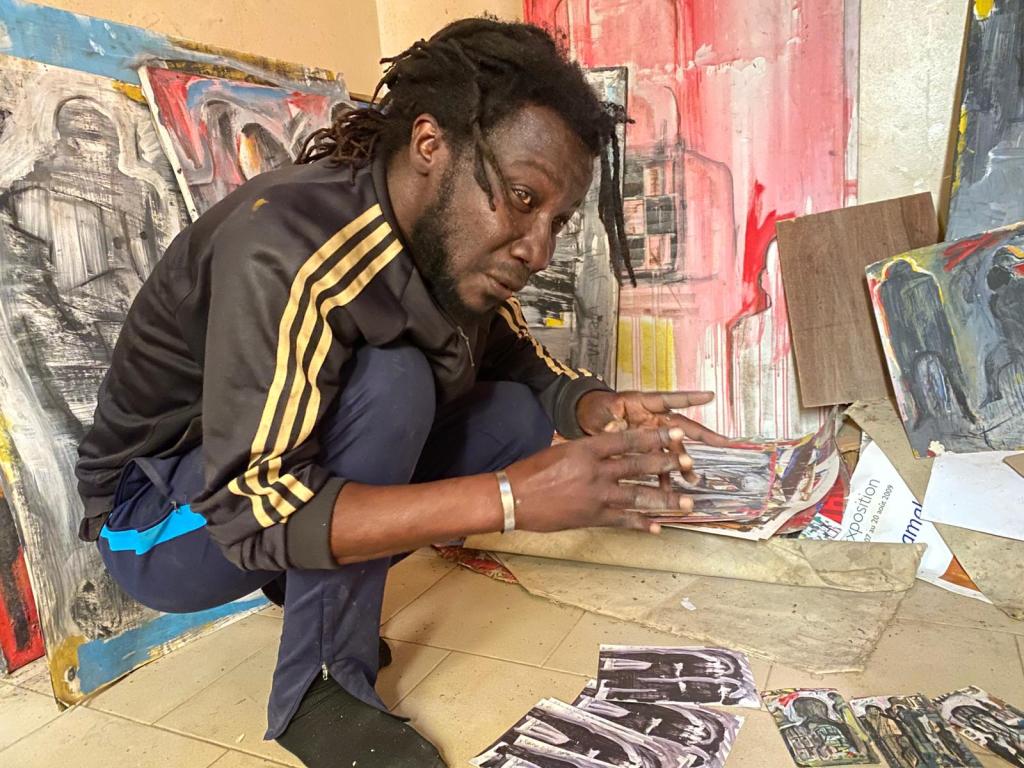

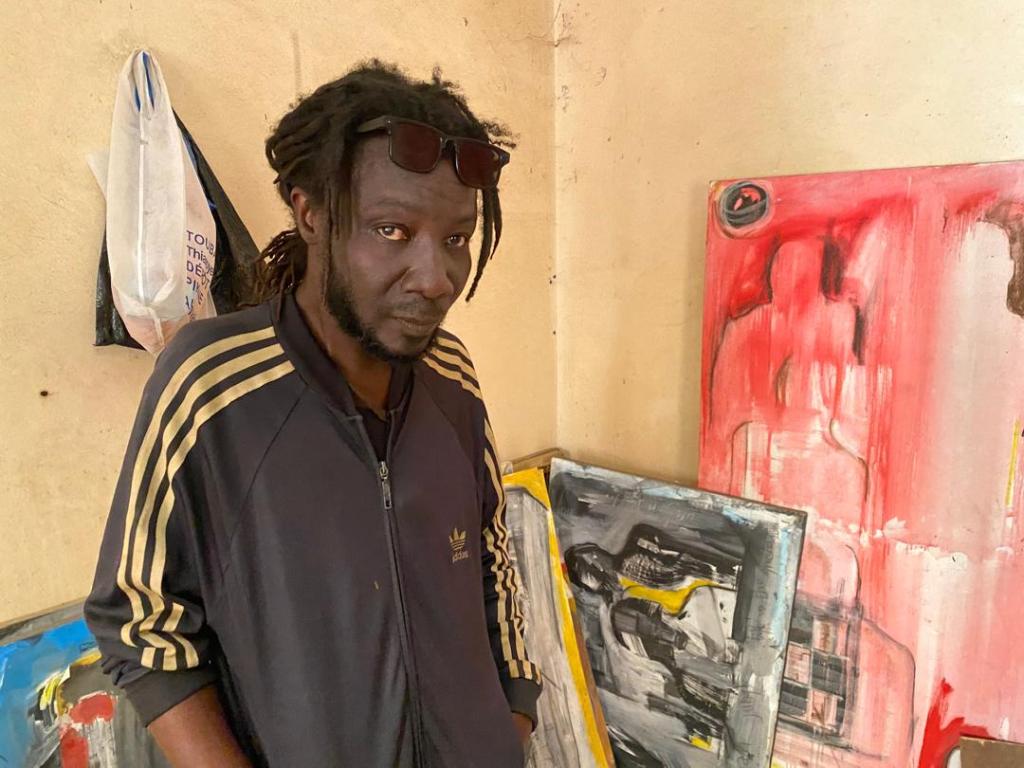
Birame Ndiaye (b.1968), a Senegalese visual artist from Pikine, a working-class suburb of Dakar where he grew up, has been developing for over thirty years a body of work deeply rooted in urban reality, which he calls Urban Jungle — the city as jungle: a dense, ruthless and vital environment governed by the laws of survival, improvisation and social predation.
A graduate of the École Nationale des Beaux-Arts in Dakar in 1998, Ndiaye draws on the legacy of the Set Setal movement (1988–1990), extending its spirit while shifting it toward an analysis of the contemporary transformations of the city.
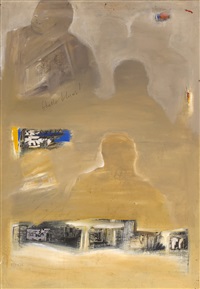
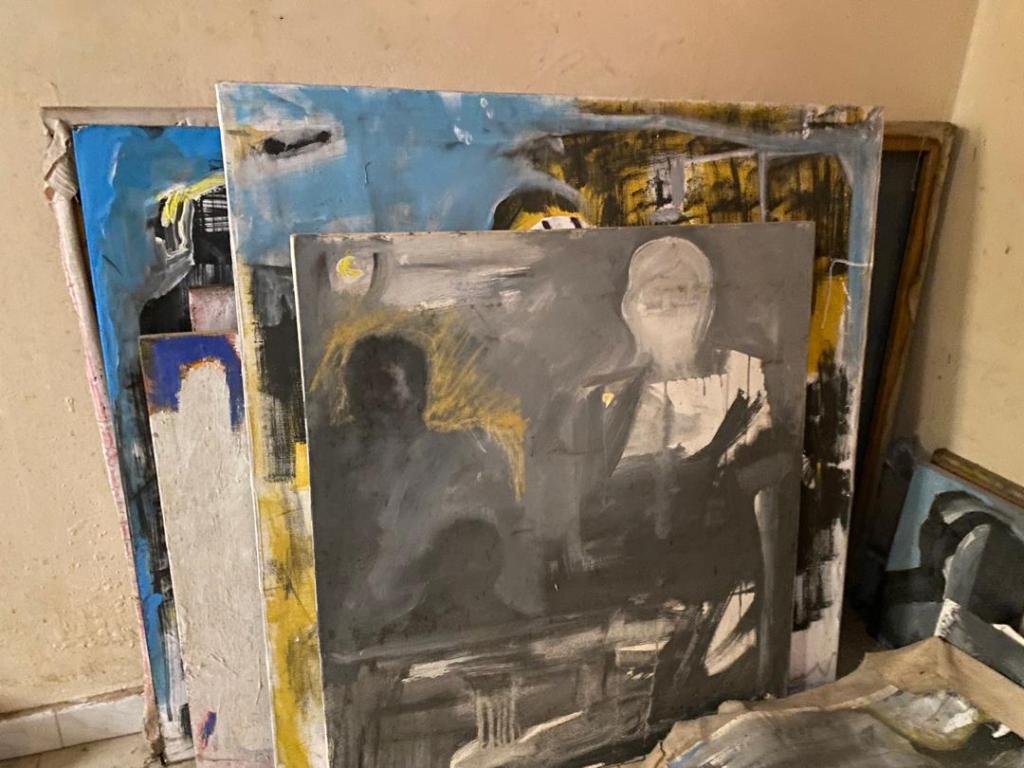
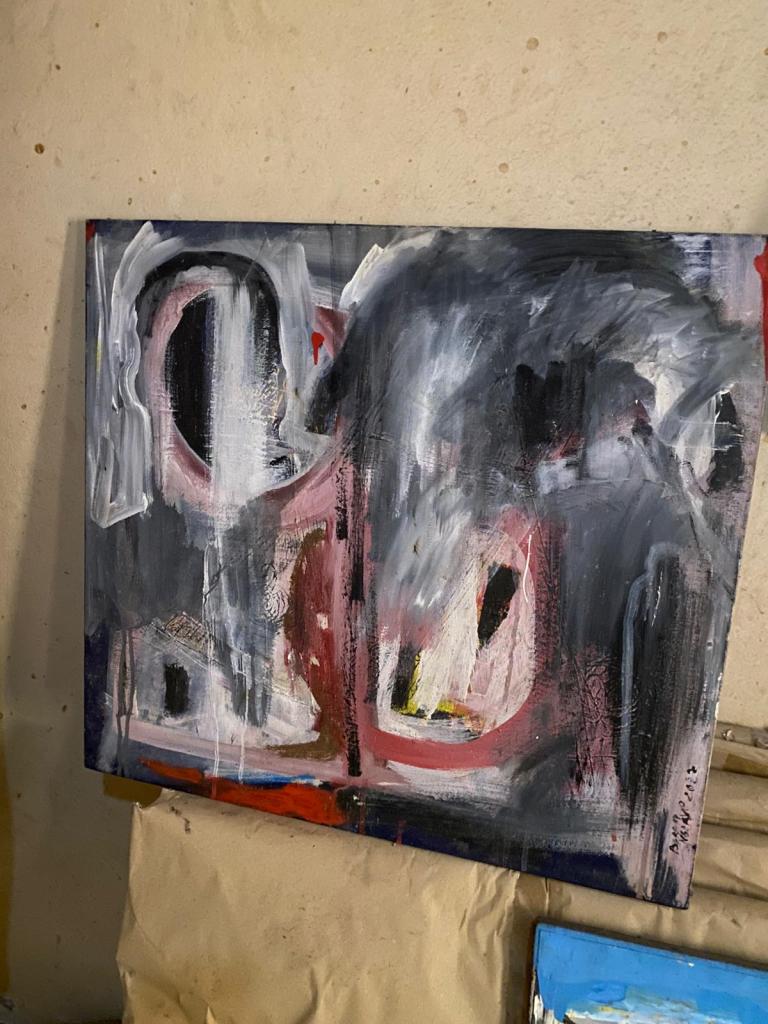
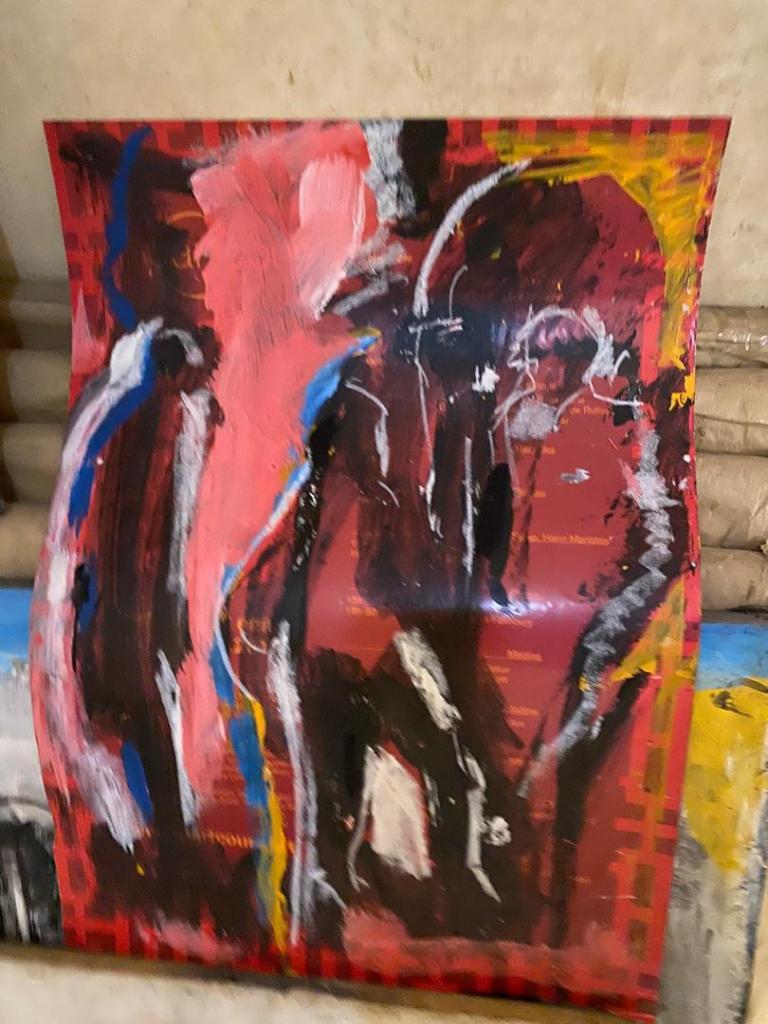
His painting draws directly from urban matter: he works as much on canvas as on recovered posters, which he treats as fully-fledged pictorial supports, equivalent to the wall itself. His often saturated compositions oscillate between figuration and abstraction, generating fragmented spaces in which unstable architectures coexist with surfaces on the verge of dissolution. This variability reflects a practice in constant tension, where the image is alternately built up and dissolved.
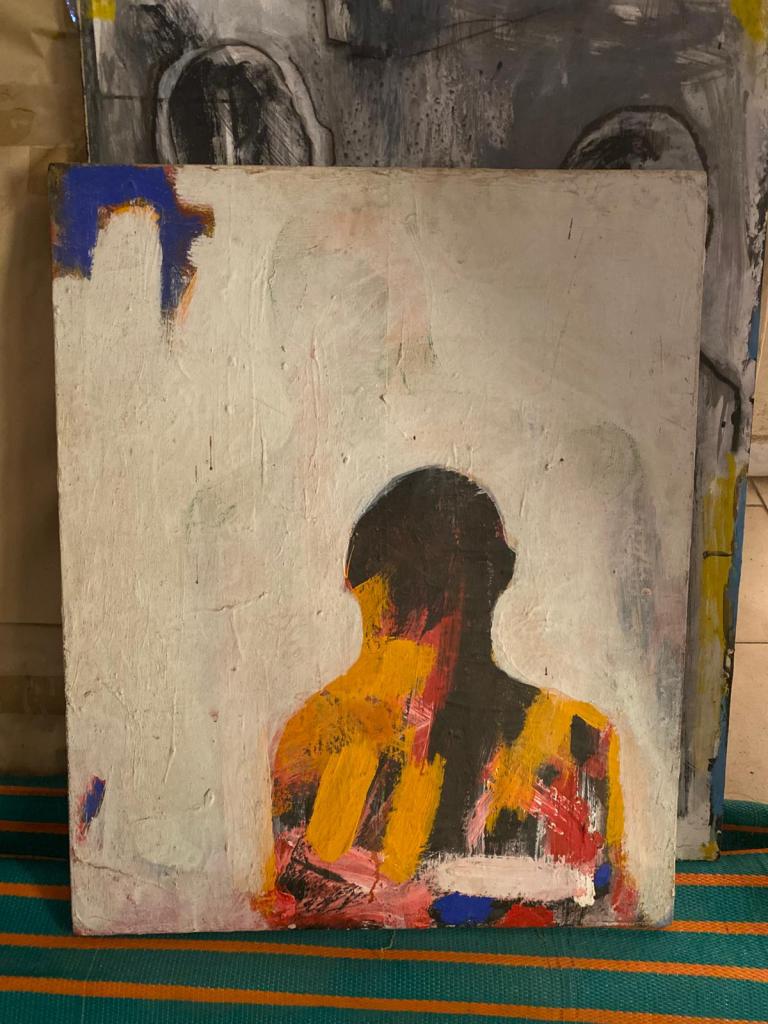
At the heart of this universe are his anonymous silhouettes: human figures stripped of faces, age and individual identity, crossing the canvases like unstable and vulnerable presences. Sometimes absorbed into the pictorial matter, sometimes standing out with an almost luminous clarity, they embody the inhabitants of this urban jungle — beings engaged in a silent struggle for visibility and survival.
These figures speak to a profound transformation of Senegal’s urban fabric. Pikine, where Ndiaye comes from, is the product of a policy of decongesting Dakar initiated in the early 1950s, which accelerated with rapid demographic growth and urbanization. From the 2000s onwards, the country’s shift toward economic liberalization further intensified these dynamics: infrastructure expansion, increased peripheralization of modest populations, and deepening spatial segregation. In this new urban jungle, anonymity becomes a form of camouflage, social interactions loosen, and a sense of detachment and generalized competition takes hold.
Birame Ndiaye’s work functions as a sensitive archive of this period. Through his evanescent figures, he makes visible the process of human invisibilization, as if rapid urbanization were accompanied by a dilution of human presence and a loss of collective soul. Without being overtly demonstrative, his gaze offers a lucid critique of the social fractures and logics of domination that structure this urban environment. The atmosphere emanating from the work is dense and often oppressive, traversed by a muted tension.
The gesturality itself sometimes carries the mark of contained violence, sometimes of resigned withdrawal. Deeply rooted in Pikine, Birame Ndiaye maintains a rare coherence between his living environment, his daily experience and his artistic language. His work can be read both as a chronicle of contemporary Dakar and as a broader meditation on the human condition in today’s cities: a space of survival where erasure threatens, yet where a form of silent resistance stubbornly persists. It is in his studio in Pikine, surrounded by the very environment that feeds his work, that we met the artist.
Your work often feels as though walls are speaking. Do you see yourself as a translator of the city?
Yes, absolutely. Walls have always been a medium for communication. What really struck me was during the 2000 election campaign in Senegal. Just by looking at the walls, I took in a huge amount of information: about the candidates, about political trends, about the mood of the moment. The torn posters, people tearing down their opponents’ posters… It was sometimes aggressive… all of it told a story. It was fair game, as they say. Artistically, these layers and tears also create a very interesting visual effect. It has become a real medium for my work.
And today, what do you think Dakar is writing on its walls?
It has slowed down a bit—perhaps because of social media. People express themselves less physically on walls, but the need to communicate is still there. The wall hasn’t disappeared; it has simply become virtual.
A recurring thread in your work is what you call Urban Jungle. Can you tell us more about it?
Urban Jungle is the city itself. City life. Economically speaking, many people leave rural areas to come to the city. They often arrive with no means, sometimes with no qualifications, and find themselves in precarious situations. This is where working-class neighbourhoods and slums spring up. It is this hidden side of the city that interests me: the underworld, the daily struggle to get by, the crime that can result from it, the harsh living conditions. It’s not a cheerful picture, but it is reality. We mustn’t turn away from it, because these people need to be reintegrated.
How do you translate that precariousness and resilience in your visual language?
Through silhouettes. With precariousness comes a sense of unease. We pass these people in their cocoons, yet they remain anonymous. We cannot pin down their age or a specific personality. They are silhouettes passing by, without any real interaction. And then there is this constant jarring contrast: right alongside poverty, there is also luxury, fine restaurants, big cars. It is this contrast that I seek to capture. It is the suburbs, that inner sense of unease that people do not always speak of.
Your surfaces are built in layers. Is that a spontaneous gesture or a deliberate construction?
It’s spontaneous. Being part of the city, I translate the expressions of those who live this reality every day. It’s an interpretation of lived experience. You can’t tell a story you haven’t encountered or felt. You have to put yourself in others’ place. I see myself as a kind of conduit.
Would you say your painting is a form of protest?
Yes, you could say that. My style can be unsettling because it’s raw; it’s true. There’s no censorship. Painting is about emotions and states of mind, so there’s no censorship. You can’t paint a subject that isn’t cheerful using pink colours. You express yourself as you feel. It’s social commentary, but also a warning so that people don’t pretend not to see. If you’re not prepared to look, it comes back to haunt you.
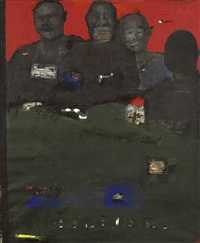
Why is painting your preferred medium for expressing this social critique?
You can do it through photography, video, film… I myself work in photography and video. But painting remains my primary medium. When I’m standing in front of the canvas, I express myself freely, without calculation. I bring out what’s inside me. The techniques come later, to create harmony and balance. The most important thing is to express oneself sincerely.
What are you ultimately trying to express through your work?
What I’m trying to express is the human condition – that difficult and precarious existence. There is always this aspect of domination: the rich remain rich, the poor remain poor. Rich and poor can also be a metaphor for the West and Africa. It is the exploitation of man by man, which takes different forms depending on the era – political, economic, social. Today it is more virtual, but the essence remains the same.
You also work directly on paper posters, leaving traces of existing text. Can you tell us about this approach?
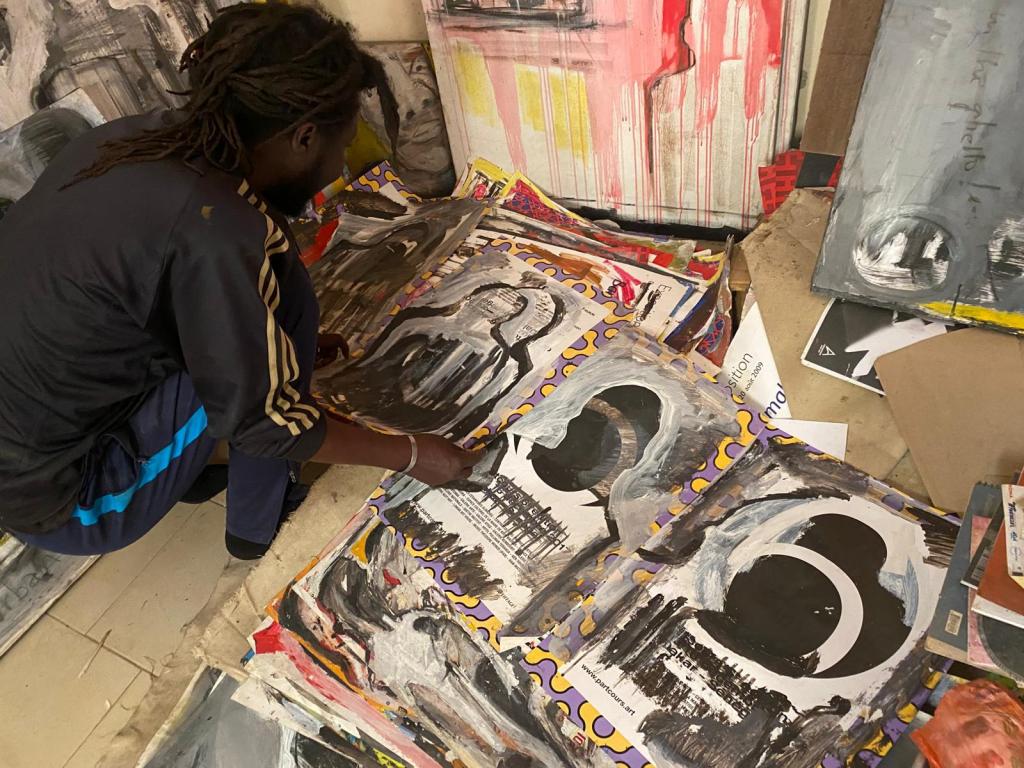
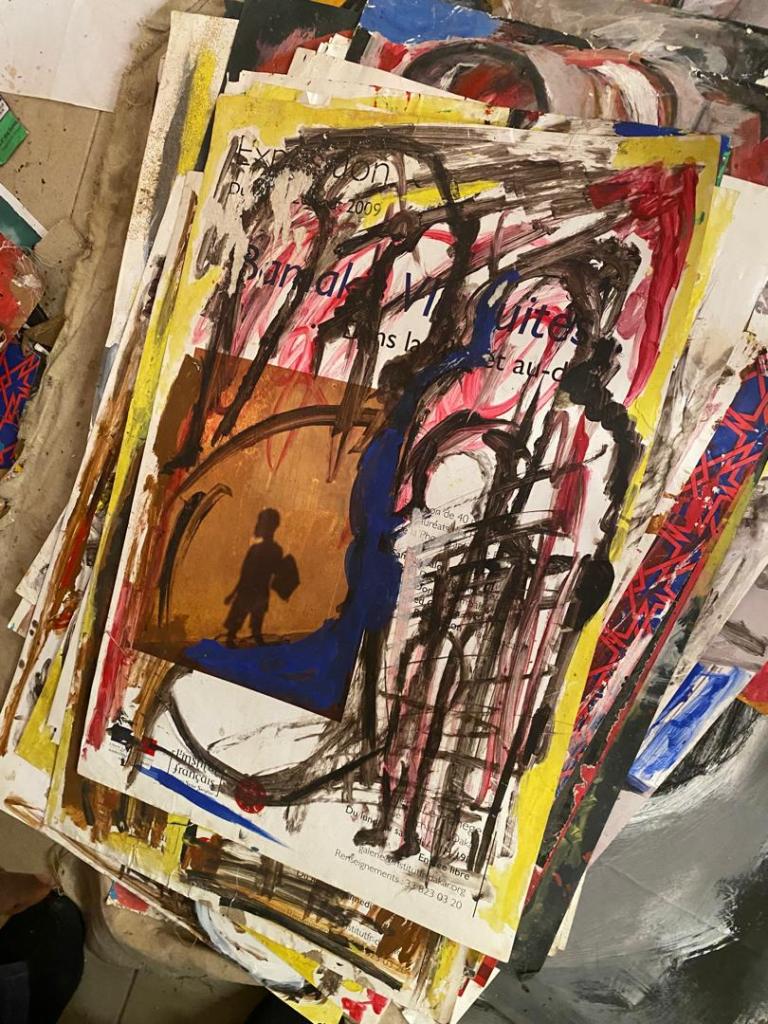
My final project at art school focused on graphic expression through literary graffiti. I used the wall as a starting point for my work, because it serves as a canvas. Over time, with the rain, the weather and the atmosphere, the wall takes on a graphic quality. Now, the poster on the wall creates texture, it creates an atmosphere, a harmony. For me, the poster has become like the wall. Ultimately, the message is that the wall has become a canvas, just as the canvas can become a wall. That is what my work conveys.
After more than thirty years as an artist, how would you define art?
For me, art is about being yourself. That’s what art is all about. It’s what everyone is looking for: to be themselves. It’s the first step towards discovering your own life. It’s difficult, because you have to be true to yourself, accept reality, and constantly question yourself, without compromising who you are.
When faced with a work of art, the viewer can gauge their own sense of humanity. Indeed, someone who stands before your work can help you discover things you hadn’t been able to see yourself. Art is something we share. It is a path towards truth, a path of knowledge. We learn at every stage. You take one step. Then you move on to the next, which opens other doors. Which reveals other things to you. So, it is a journey. It is also what we call an artistic process. This artistic process is a pretext for turning inwards in order to discover the other. That is what humanity is.
And what place does beauty hold in your work?
Beauty is harmony and balance. I don’t focus on academic or philosophical definitions. It’s about the sense of well-being we feel in front of something balanced.
When you paint, are you trying to make something beautiful?
The essence, the message, what I want to convey – that’s what matters. Why do we seek this beauty? It’s to help us move towards the truth we’re trying to convey. In my work, beauty serves to open the door to the message. If the painting is harmonious, the viewer can engage more deeply with the work and receive what I want to convey.
What does painting allow you to express that nothing else can?
There are no limits when it comes to painting. Except that you have to be consistent, balanced, and create harmony. There, you’re free. There’s no censorship. That’s where you can say whatever you want to say, without censorship. Because you’re honest enough with yourself. Elsewhere, you can’t be sincere. It’s politics, it’s the economy, it’s social issues. All of that is just bluff, a ‘social conspiracy’.
What does art bring to your life, personally?
It’s a relief. I accumulate worries and questions, and when I paint, I let them go. It’s like breathing. I don’t really believe in inspiration; it’s more a case of what we’ve stored up coming out. And sincerity is essential: standing before the blank canvas, it’s not just a matter of revealing your inner self, it’s as if you were laying yourself bare.
Why choose to be an artist, given that level of vulnerability?
It probably stems from my upbringing. I was raised by my grandparents from a very young age, which gave me a sense of detachment and solitude, even when surrounded by others. It allowed me to develop my own way of thinking, my own perspective on things. I’ve always loved being free, free in my thoughts, having my own opinion. Art allows me to be completely free: 24 hours a day, I do what I want. So, I have the conditions that make it possible to create good art. I’ve had them since I was a child. Above all, being alone. In my thoughts.
You experienced the Set Setal movement in the 80’s. What was your relationship to it?
I’m lucky that the movement started in my neighborhood, in my own street. It was a powerful grassroots initiative: making the environment clean and beautiful. That’s what they do in Brazil. In the favelas. You walk down a street and you see a green house with red windows. The next house is brown. You see, it brightens up the city. It’s not like Dakar now. I find our society is sometimes hypocritical. You can see it in the buildings. The whole country can’t be white and grey. It can’t be so neutral. That’s hypocrisy. But the buildings reveal it. That’s also what led to Set Setal with its colourful walls.
Do you think a city without color lacks soul?
Dakar is stressful. You come in here, you take the street before you leave. It’s stressful. But you have to think about it a bit to realise that it’s the walls that are stressful. Because they don’t soothe you. It’s white, it’s grey. It lacks soul. But if you take a street and come across a yellow wall, it’s as if you’re breathing. Simply because that colour is there.
If you had to sum up your artistic approach in a single sentence?
My art is an expression of urban life.
What emotion do you want to evoke in the viewer in front of your work?
Shock. So that they reflect, that they assess their own humanity.
If you weren’t an artist, what would you be?
I would be deeply immersed in spirituality.
In 100 years’ time, how would you like to be remembered?
As someone who has always been interested in humanity. Who has celebrated humanity.
Read also
In Dakar, Carole Diop Maps a City’s Art and Past
For Senegal at the Venice Biennale, Caroline Gueye’s Inquiry Into Gold and Perception
Why Dakar Stands Out in the World of Art! A Conversation with Wagane Gueye
 Bridging Africa and The World Through Contemporary Art
Leave a comment